
Organisations that decide to build a leadership competency model often spend more time arguing about what to call things than understanding what they are building. The result is usually a framework that borrows freely from whatever the most senior person in the room last read. There are dozens of published examples, some research-backed, some commercially derived and some assembled from intuition and convention. This article looks at what the better-known ones contain and how they are structured, so you can decide what to borrow. If you want a shortlist and a way to choose, see my comparison of the best leadership competency models.
What Is a Leadership Competency Model?
A leadership competency model is a structured set of behaviours, skills and attributes that define what effective leadership looks like in a given context. It describes observable patterns of action, not personality traits. It specifies clusters or dimensions of competency, the behaviours that show each one and, in better versions, the level expected at each leadership tier. For one leadership role, the selection and required levels are a competency profile. My guide to the leadership competency model covers building one.
A note on terminology. A competency framework is also called a competency model, especially in the United States. I use competency profile for the competencies and required levels for one role, and competency matrix for the grid of required against current proficiency. Usage varies by region, and I explain the differences in this competency model definition.
Why Published Examples Matter
The problem they address is consistency. Without a shared definition of leadership effectiveness, hiring, promotion and development decisions rest on subjective assessments that vary by manager, function and moment. Two people can both be called strong leaders for entirely different reasons. A published example gives a starting reference concrete enough to observe and assess. A peer-reviewed study of global leadership competency models is a useful read on how different models embed different assumptions about what leadership is.
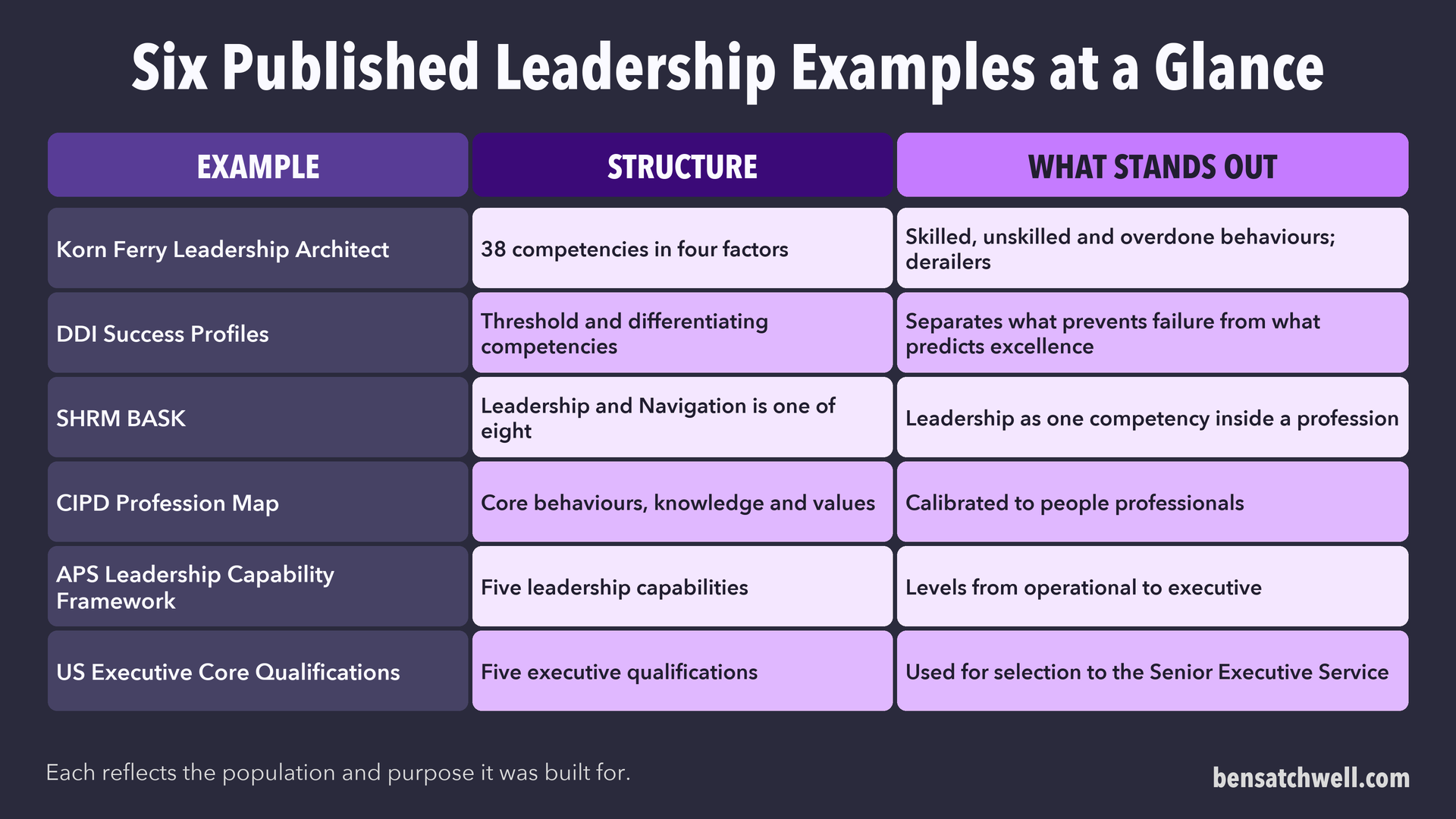
Each reflects the population and purpose it was built for.
How the Major Examples Are Structured
Korn Ferry Leadership Architect
One of the most widely used commercial frameworks. It organises 38 competencies into four factors: Thought, Results, People and Self. Each competency is described through skilled, unskilled and overdone behaviours, which makes it unusually helpful in development conversations. It also includes a set of career stallers and stoppers, behaviours that derail otherwise capable leaders, which most in-house profiles omit. Its strength is depth. Its weakness is size, since 38 competencies is a lot to communicate, and most organisations that license it select a subset of eight to twelve for active use.
DDI Success Profiles
DDI distinguishes threshold competencies, which most leaders need at a minimum standard, from differentiating competencies, which separate high performers from the rest. The distinction matters. A threshold competency does not predict superior performance. It only prevents failure. The framing makes an organisation say what it actually needs to predict, in place of listing everything that seems desirable. DDI also publishes norm data from its assessments, which gives a practical benchmark that purely internal profiles lack.
SHRM Body of Applied Skills and Knowledge
The SHRM leadership and navigation competency is one of eight behavioural competencies in the 2026 edition and covers directing and contributing to initiatives and processes in the organisation, including influence, change navigation, credibility building and conflict management. What stands out is that SHRM treats leadership as a competency within a professional role and not a standalone framework. That is a different philosophy: leadership is one capability among many and does not need its own taxonomy.
CIPD Profession Map
The CIPD map includes a leadership strand within its framework for people professionals, separating specialist knowledge from behavioural indicators, and treats leadership as purpose-led and values-driven practice more than hierarchical authority. It is built for a professional community, so it is highly relevant for HR and less transferable to general management. The CIPD's competency factsheet gives background. See also these wider competency model examples.
Public Service Examples
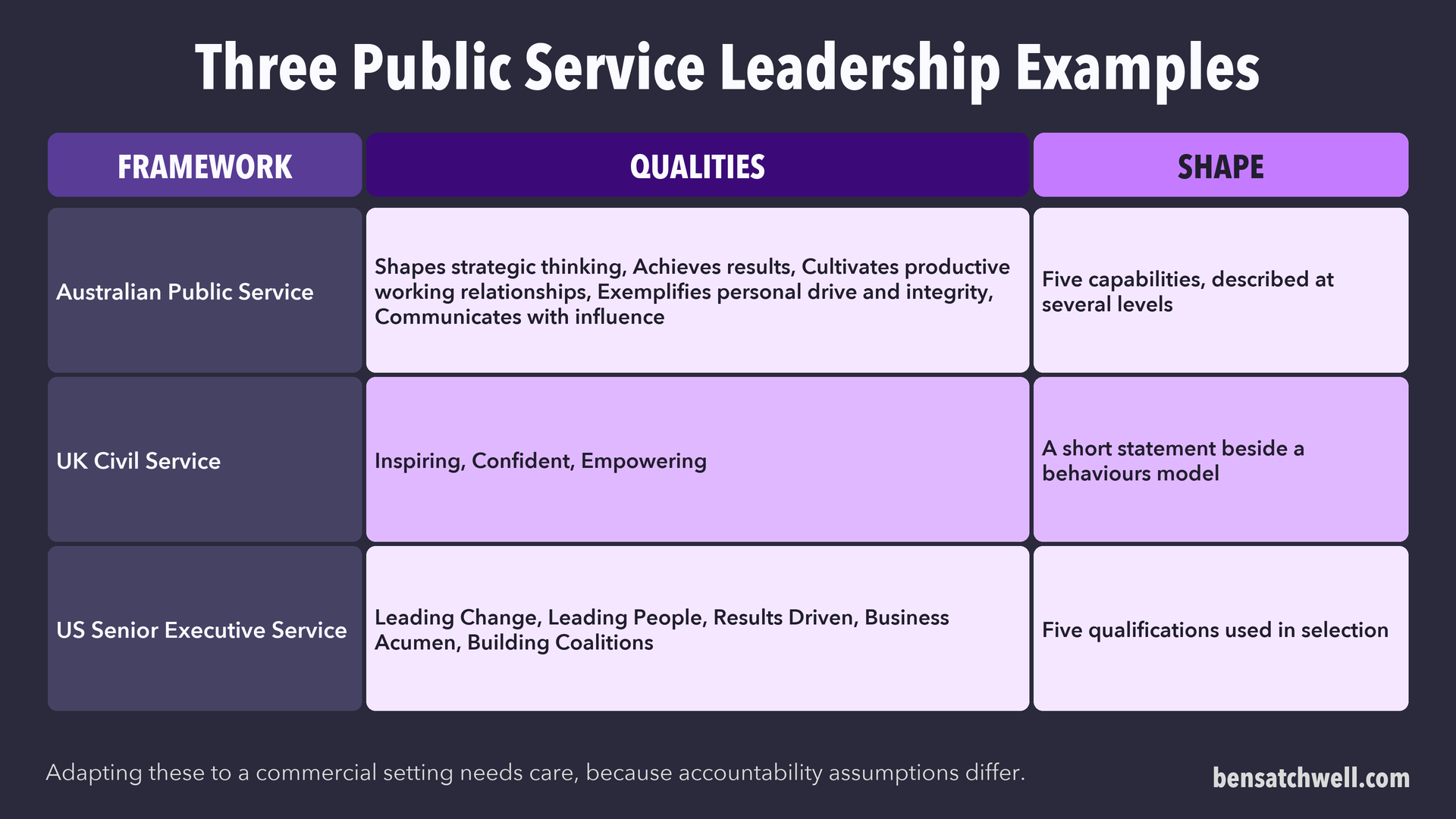
Adapting these to a commercial setting needs care, because accountability assumptions differ.
The Australian Public Service Integrated Leadership System identifies five leadership capabilities: shapes strategic thinking, achieves results, cultivates productive working relationships, exemplifies personal drive and integrity, and communicates with influence. Each is described at several levels from operational to executive, and its strength is the link between leadership expectations and the wider public service capability set.
The UK Civil Service Leadership Statement describes three qualities: inspiring, confident and enabling. It is deliberately brief, closer to a behavioural aspiration than a technical framework, and it sits beside the Civil Service Behaviours for more granular detail.
The US Senior Executive Service uses the five Executive Core Qualifications: leading change, leading people, results driven, business acumen and building coalitions. They are used in selection and assessment at the most senior levels of federal service.
Before You Borrow: Four Questions

Treat an example as a source to select from, not a profile to adopt whole.
Examples differ in the population they serve, the structure they use and what they leave out. Ask who it was built for, how it is organised, what it omits and what you would have to change. The structural choices behind any framework, including precision about what behaviours are, are covered in my guide to defining behaviours.
What a Leadership Profile Is Not
- Not a personality profile. It describes what people do, not who they are. Mixing the two selects for disposition over observable behaviour, which adds bias and reduces predictive value.
- Not a framework for the whole organisation. The competency framework covers all roles. A leadership profile is scoped to leadership behaviour from a certain level up.
- Not a learning catalogue. Competencies describe expected performance. They do not prescribe how people develop, and using one as a catalogue is a common misapplication.
Common Failure Modes
- Abstraction. Competencies such as strategic thinking or inspires trust are too vague to assess. Two assessors reviewing the same leader will reach different conclusions.
- Proliferation. Korn Ferry's 38 competencies rest on a substantial research base. An organisation writing its own without that foundation usually ends up with a list too long to use or too generic to mean anything.
- Disconnection from context. Leadership competencies written in a corporate head office may not describe effective leadership in a manufacturing site, a frontline service setting or a public agency.
Trade-Offs and When to Use Each Approach
Commercial frameworks suit organisations that need a research-grounded, norm-referenced starting point and can license and operationalise one properly. They suit less when the context is highly specific. Internally developed profiles suit organisations with the expertise to build them rigorously and a context distinct enough that an off-the-shelf set would need heavy modification anyway. The risk is something that feels bespoke and performs worse than a commercial alternative. Public service frameworks suit their intended populations, and adapting them wholesale to commercial settings often fails because assumptions about accountability, authority and purpose do not transfer cleanly.
FAQ
What are the most commonly used leadership competency model examples?
Korn Ferry Leadership Architect and DDI Success Profiles among commercial frameworks, SHRM and the CIPD Profession Map among professional bodies, and the Australian, UK and US public service frameworks.
How many competencies should a leadership profile include?
Six to twelve for active use. Korn Ferry includes 38 but organisations typically select a subset. Beyond twelve, a profile becomes hard to communicate and apply consistently.
What is the difference between the Korn Ferry and DDI examples?
Korn Ferry organises 38 competencies into four factors with detailed behavioural anchors. DDI distinguishes threshold from differentiating competencies. Both are research-grounded and reflect different analytical priorities.
Can a public service framework be used in a commercial organisation?
With adaptation. Public service frameworks embed assumptions about accountability, authority limits and purpose that often do not transfer directly.
What is the threshold versus differentiating distinction?
A threshold competency is one every leader needs at a minimum standard, which prevents failure but does not predict excellence. A differentiating competency is one where higher skill predicts better leadership outcomes.
Should we license a commercial model or build our own?
License one when you need norm data, a research base and a faster start. Build your own when your context is genuinely distinct and you can do it properly.