
A core capability framework is a capability framework that names the capabilities every person in the organisation is expected to hold, whatever their role or level. Most organisations build one by accident. They list a handful of behaviours, call them values, and then wonder why nobody can say what "good" looks like. I want to set out what a core capability framework actually is, how to build one, and where it goes wrong. It sits inside the wider capability framework, which also holds the role-specific capabilities.
What is a core capability framework?
A core capability framework is the organisation-wide set of capabilities that every person is expected to demonstrate, defined once with proficiency levels and behavioural indicators so that each role draws on the same shared layer.
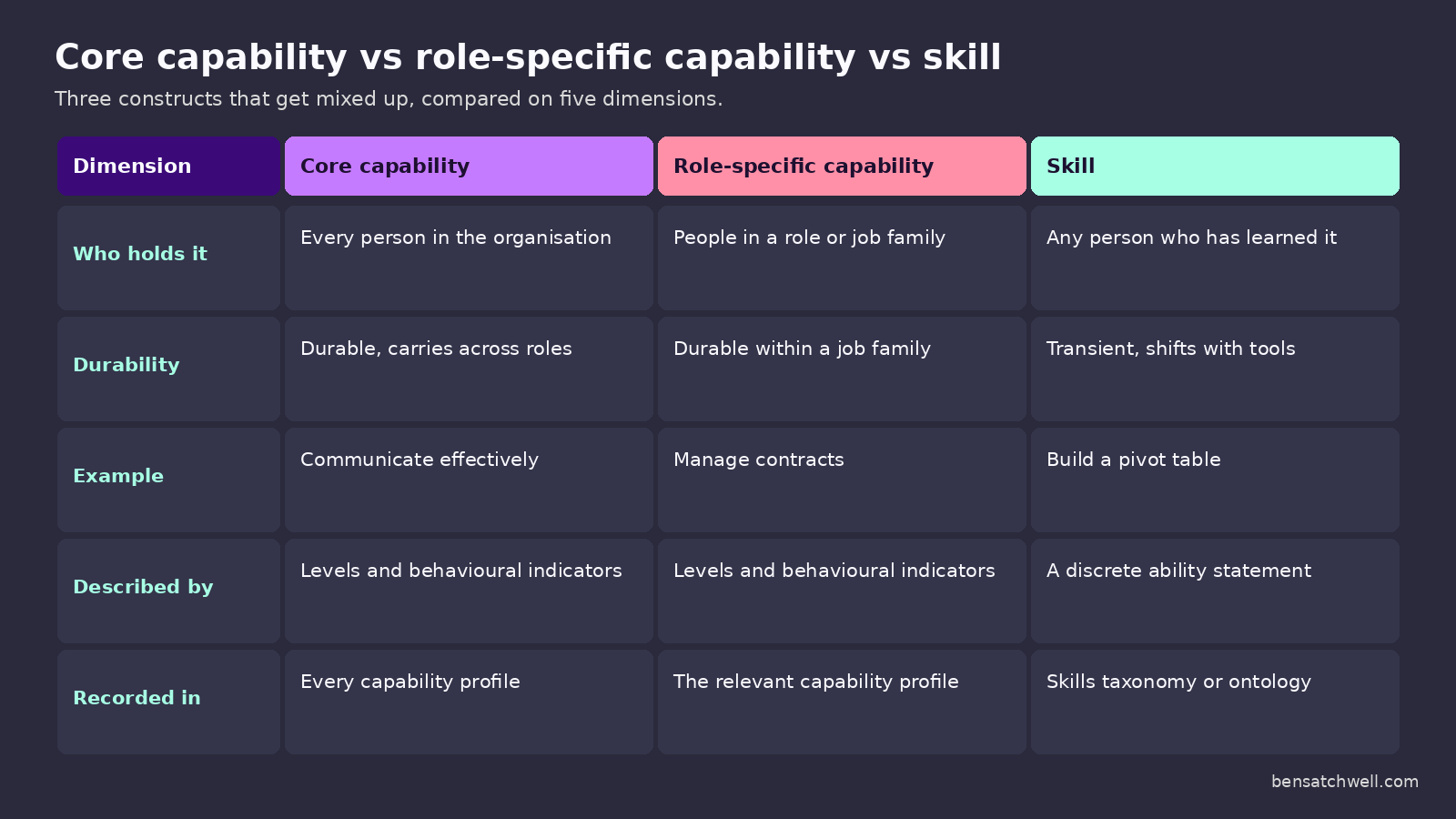
The word "capability" matters here. A capability is a broad, durable area of ability that a person owns and carries across roles, tasks and contexts. It integrates knowledge, skills and personal attributes into something transferable. It belongs to the person, not to one job. That is why a core capability, such as communicating effectively or working with others, can be written once and applied to a graduate, a finance manager and an executive.
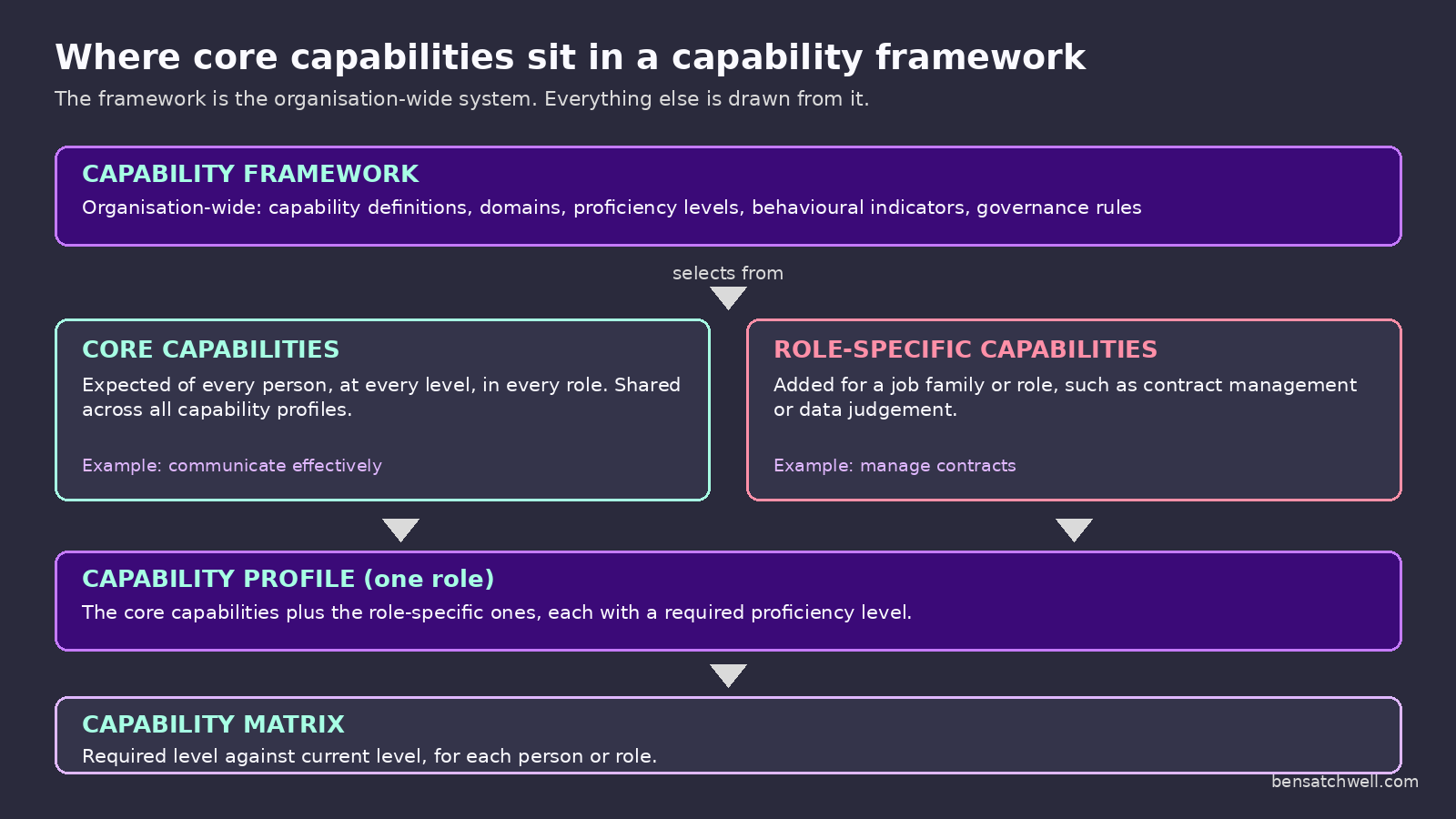
"Core" does not mean most important. It means common. A core capability is one everyone holds, at a level that fits their role. Role-specific capabilities sit alongside it and apply only to a job family or role.
A note on terminology. A competency framework is also called a competency model, especially in the United States. I use competency profile for the competencies and required levels for one role, and competency matrix for the grid of required against current proficiency. Usage varies by region, and I explain the differences in this competency model definition.
Why do organisations need a core capability framework?
Without a shared core layer, every team writes its own version of the same expectations. One function describes "communication" as presenting well. Another describes it as writing clearly. A third never mentions it. The result is inconsistent hiring, inconsistent feedback and no way to compare people fairly across the organisation.
A core layer solves a specific problem: it fixes the common expectations once. Every capability profile then starts from the same base and adds what the role needs on top.
The public sector shows this clearly. The NSW Public Service Commission circular that introduced the NSW Public Sector Capability Framework described 16 core capabilities and behaviours required of all NSW public sector employees, with four additional capabilities for people managers. The current version, issued by the Office of the Public Service Commissioner, now describes 20 capabilities across five levels of behavioural indicators. The count changed. The principle did not: one shared set, applied across every occupation.
Queensland takes a similar position for leadership. The Public Sector Commission's April 2026 Leadership competencies for Queensland states that everyone is a leader in the public sector, regardless of role or classification level. It is written as competencies, not capabilities, but it shows the same design choice of a common expectation for all roles.
How does a core capability framework work in practice?
A working core capability framework has five parts. Each one has to exist, or the framework becomes a poster.
- Capability definitions. A one or two sentence statement of what the capability is, written so it cannot be confused with the one next to it.
- Capability domains. Groupings of related capabilities, organised by the area of human functioning they draw on rather than by job function.
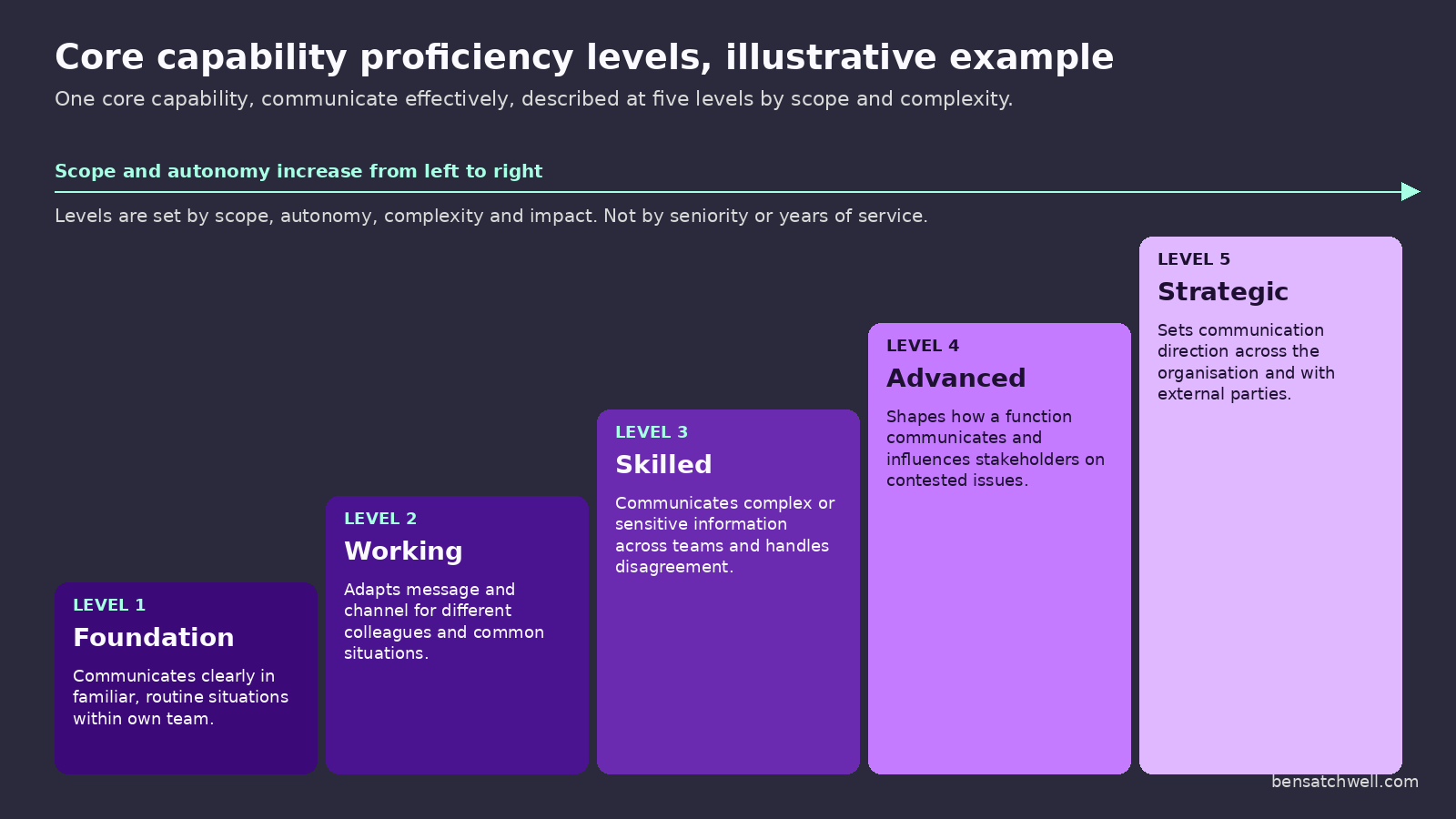
- Proficiency levels. A defined sequence of stages at which a capability is held or required. Four to six levels is workable. Levels are set by scope, autonomy, complexity and impact, not by seniority or years of service.
- Behavioural indicators. Observable, levelled statements of what the capability looks like at each level. They are the unit assessment is conducted against.
- Governance rules. Who owns the framework, how profiles select from it, and how often it is reviewed.
The core capabilities then flow into every capability profile. A profile for one role takes the core set, assigns a required level to each, and adds the role-specific capabilities. Required levels differ by role. The definitions and indicators do not.
I cover the level structure in more detail in capability framework levels, and the worked examples in capability framework examples.
How many core capabilities should a framework have?
Fewer than most organisations think. Core capabilities are read by everyone, so every extra one dilutes attention. The original NSW circular set 16 core capabilities and added four more for people managers, and the Public Service Commission also publishes occupation-specific capability sets on top. If your core set grows well past sixteen, check whether some are really role-specific capabilities in disguise.
What is a core capability framework not?
This is where most confusion starts. A core capability framework is not any of the following.
- Not a list of values. Values state what the organisation believes. Capabilities state what people can do, at a level, with observable indicators.
- Not a skills list. A skill is a discrete, learned ability, and skills shift as tools and methods change. Recent work from Swinburne University and the Institute for Working Futures argues the same point: skills describe what people can do in stable conditions, while capabilities describe the durable human abilities through which people exercise judgement, build relationships and act under uncertainty.
- Not core competence. The strategy term core competence, from Prahalad and Hamel, describes what the organisation as a whole does distinctively well. That is organisational capability. A core capability in this article is held by a person.
- Not the Australian Core Skills Framework. That framework describes foundation skills such as reading, writing and numeracy. It is a skills framework, even though "core" is in the name.
- Not a core competency framework. The two share a design but not a construct. A core competency is the integration of skills, knowledge, judgement and behaviour applied in a role, as I set out in core competency framework. The difference between the two is covered in capability and competency framework.
Which named frameworks use core capabilities?
The clearest public examples come from government. The NSW Public Sector Capability Framework is the best-known Australian case, and the Queensland leadership competencies show the same shared-layer idea in competency form. NSW applies one common structure across every occupation and publishes occupation-specific capability sets on top of it.
In the corporate world, the labels vary. Vendors and consulting firms publish their own competency libraries, and many are mostly lists of skills and behaviours. When I assess any of them, I ask three questions. Is each item durable or tied to a tool? Does it have levels set by scope and complexity? Does it have behavioural indicators someone could actually observe? If the answer to any is no, it is not yet a capability framework, whatever it is called.
What are the common failure modes?
- Too many core capabilities. A long list is never read. People cannot hold twenty-five expectations in mind.
- Skills labelled as capabilities. "Excel" or "stakeholder management software" in the core set ties the framework to tools that will change.
- Levels set by seniority. If level three means "manager", the framework is a grade structure with extra words.
- One required level for everyone. A core capability applies to all roles, but the required level must differ by role, or the profile says nothing.
- Indicators that evaluate instead of describe. "Excellent communicator" is a judgement. "Adapts the message to the audience" is behaviour someone can see.
- No owner. A framework with no governance drifts. Within two years, three teams have their own versions.
When is a core capability framework the right choice?
It suits organisations that need consistency across many roles: public sector agencies, large professional services firms, health systems and universities. The shared layer makes comparison fair and reduces the cost of writing each profile from scratch.
It is a poor fit when the organisation is small enough that everyone knows what good looks like, or when the work is so specialised that almost nothing is common. In that case a framework of role-specific capabilities, or a skills framework, serves better.
There is also a trade-off between breadth and precision. A core capability broad enough to apply to everyone is, by design, more general than a role-specific one. That is acceptable, provided the indicators at each level are specific enough to observe. The generality lives in the definition. The precision lives in the indicators.
Frequently asked questions
What is the difference between a core capability and a core competency?
A core capability is a broad, durable ability that every person holds and carries across roles. A core competency is the integration of skills, knowledge, judgement and behaviour applied in the context of a role. Both are shared by everyone, but the capability belongs to the person and the competency is defined by the role.
How many core capabilities should an organisation have?
Aim for a small number. The original NSW circular set 16 core capabilities for all employees, and the current framework describes 20 capabilities. Every extra core capability competes for attention, so keep only those that genuinely apply to everyone.
Do core capabilities have proficiency levels?
Yes. Each core capability needs levels, usually four to six, so that required proficiency can differ by role. Levels are set by scope, autonomy, complexity and impact, not by seniority.
Is a core capability framework the same as a capability framework?
No. A capability framework is the whole organisation-wide structure, covering all capabilities. The core capabilities are the shared layer inside it. Role-specific capabilities make up the rest.
Who should own a core capability framework?
One accountable owner, usually in the people and capability function, with defined review points. Without an owner, teams create their own variants and the shared layer breaks down.
Are core capabilities the same as soft skills?
Mostly they overlap. Much of what the market calls soft skills, such as communication, collaboration and adaptability, is capability by these definitions: broad, durable and transferable. Technical skills tied to a tool or method are skills instead.
