


A competency value framework is a competency framework in which the organisation's values are written as observable behaviour, at defined levels, so that people can be hired, assessed and developed against them. It is also searched for as a competency values framework. Most organisations have a values statement. Far fewer can tell whether anyone is living it. A competency value framework closes that gap, and it sits inside the wider competency framework as a values domain made up of core competencies.
I want to be precise from the start, because values and competencies get treated as the same thing. They are not. A value is a belief about what matters. A competency is the integration of skills, knowledge, judgement and behaviour applied effectively in a role. This article shows how a value becomes a competency, and where that translation usually breaks.
What is a competency value framework?
A competency value framework is the part of a competency framework that turns each organisational value into a core competency. A core competency is one that every person in the organisation is expected to demonstrate, regardless of role or level. Values are core by design, because they describe expectations that apply to everyone.
A competency value framework defines each organisational value as a competency, with a definition, four to six proficiency levels and a behavioural indicator at each level.
It has five parts:
- The value, stated in a word or short phrase, such as accountability or respect.
- The competency definition, a plain sentence on what applying that value effectively looks like in work.
- Proficiency levels, the stages at which the competency is held or required. Levels are set by scope, autonomy, complexity and impact, not by seniority or years of service.
- Behavioural indicators, the written statements of observable behaviour expected at each level.
- Rules for application, which say how the competencies are selected for a role and assessed.
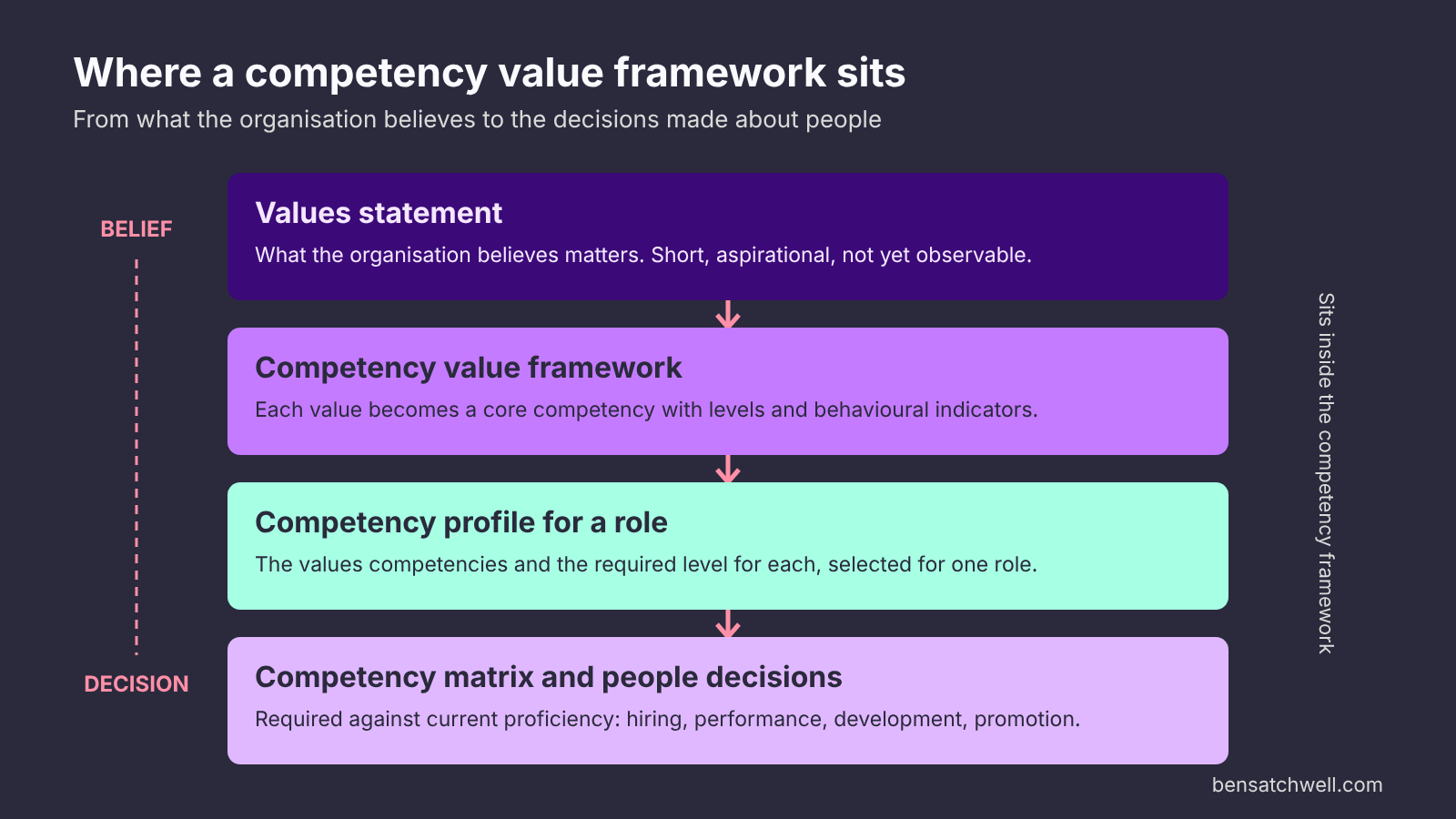
A note on terminology. A competency framework is also called a competency model, especially in the United States. I use competency profile for the competencies and required levels for one role, and competency matrix for the grid of required against current proficiency. Usage varies by region, and I explain the differences in this competency model definition.
Why do organisations put values into a competency framework?
Values statements fail at one specific point: they cannot be observed. Nobody can watch honesty. They can watch a manager tell a stakeholder that a deliverable will be late before the stakeholder asks. A behaviour is an observable act performed in a specific situation, and it is the evidence that competencies are assessed against. A value only becomes assessable once someone has written down the behaviour that shows it.
Without that translation, values live on posters and in onboarding slides, while hiring, promotion and performance decisions are made on other criteria. People notice. The values become decoration.
The second reason is consistency. A shared set of values competencies gives every role the same reference point, so a decision about a team leader in one function can be compared with a decision about a team leader in another. The UK Civil Service makes the same move with its behaviours. It defines a set of behaviours that, when demonstrated, are associated with job success, and it writes them specific to the grade level of the role, with examples at each grade band. Hiring managers choose the behaviours that matter for a role rather than assessing everything.
How does a competency value framework work in practice?
Step 1: Limit the number of values
Each value becomes a competency with several levels and several indicators, so every value you add multiplies the content you have to write, calibrate and maintain. Four to six values is workable. Ten is a poster, not a framework.
Step 2: Write each value as a competency
Define the competency in one sentence about work, not about belief. "Acts with integrity" is a value. "Declares conflicts of interest, raises concerns early and makes decisions that can withstand scrutiny" describes a competency.
Step 3: Level it by scope and impact
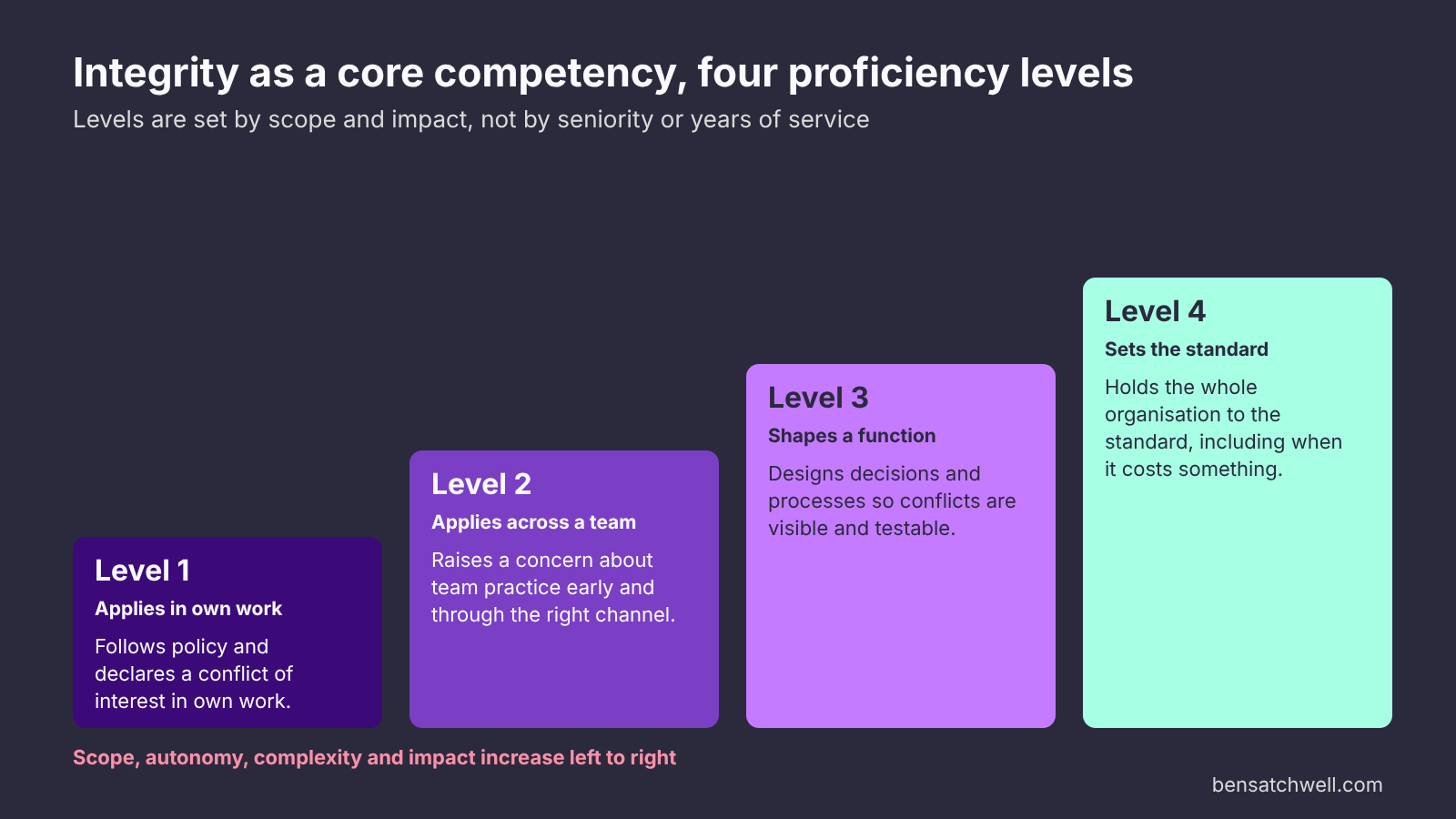
Set four to six levels and describe what changes between them: the scope the person influences, how much autonomy they have, the complexity they handle and the impact of their decisions. Seniority is a poor basis for levels, because it lets a long-serving person claim a level without showing the behaviour. I cover how to set levels in competency framework levels.
Step 4: Write behavioural indicators that can be witnessed
Every indicator has to pass one test: could a colleague see it happen? Indicators are descriptive rather than evaluative, and they are written at each level. Adjectives such as "honest" or "respectful" fail the test. Statements about what the person does pass it.
| Value | Level 1: own work | Level 3: shapes a function |
|---|---|---|
| Accountability | Meets commitments made in own work and tells others early when one will be missed. | Builds clear ownership into how the function plans and reviews its work, and reports results without softening them. |
| Respect | Listens to a different view and responds to the substance of it. | Designs meetings, decisions and feedback so that quieter and less senior voices are heard before a decision is made. |
| Integrity | Follows policy and declares a conflict of interest in own work. | Designs decisions and processes so that conflicts are visible and testable. |
Step 5: Apply it through role profiles and a matrix
For each role, select the values competencies and set the required level for each. That selection is the competency profile for the role. A competency matrix then shows required against current proficiency, which is what makes the framework useful for hiring, performance conversations and development planning.
What a competency value framework is not
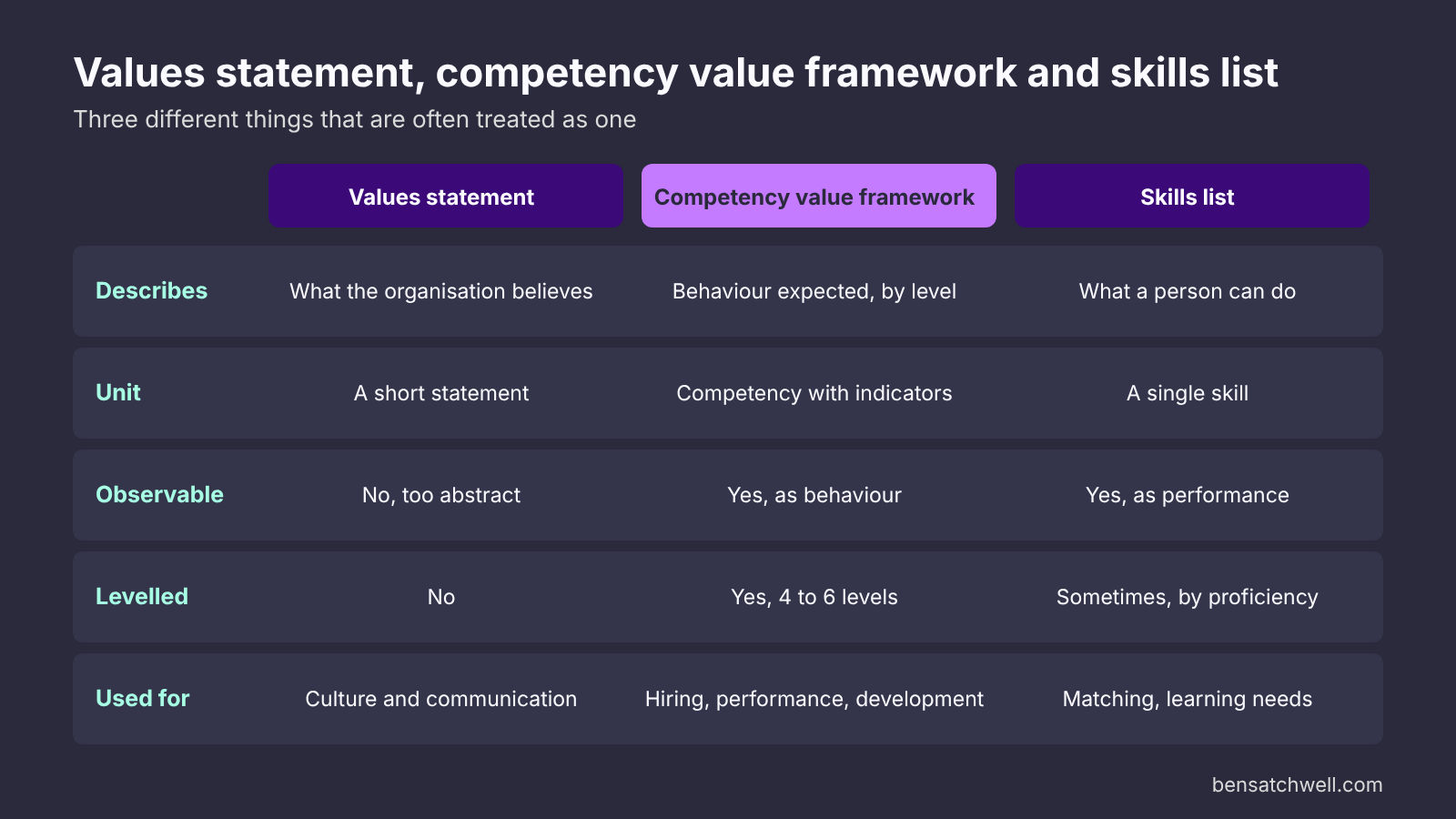
- It is not a values statement. The statement says what the organisation believes. The framework says what that looks like in behaviour, at each level.
- It is not a culture survey. A survey measures sentiment. A competency value framework describes expected behaviour and is assessed against evidence of behaviour.
- It is not a character test. Indicators describe what people do in a role, not who they are. I take up the character question in character and competency framework.
- It is not a skills list. A skill is a discrete, learned ability. A values competency integrates skills, knowledge, judgement and behaviour, and it holds across tasks.
- It is not a separate framework. It is a domain inside the competency framework. For the wider question of how values and competencies fit together, see competency and values framework.
Which named frameworks write values as behaviour?
Public sector frameworks are the clearest examples, because public servants carry formal values. The Australian Public Service Values are set out in section 10 of the Public Service Act 1999. A statute can state a value. It cannot tell a team leader what the value looks like on an ordinary Tuesday. That translation is the work of a competency value framework.
The UK Civil Service shows both layers. The Civil Service Code names four values, integrity, honesty, objectivity and impartiality, and sets out the standards of behaviour expected of civil servants. Its Success Profiles then describe behaviours by grade, as noted above. The pattern is the useful part: values state the intent, and levelled behaviours make the intent assessable.
Where does a competency value framework go wrong?
- Too many values. Eight or ten competencies with six levels each cannot be calibrated, so assessors stop using them.
- Indicators written as adjectives. "Is trustworthy" cannot be witnessed, so two assessors will rate the same person differently.
- The same indicator at every level. If level 1 and level 4 read alike, the levels describe nothing.
- Levels tied to seniority. Executives are assumed to be at the top level on every value, which removes the reason to assess them.
- No link to decisions. If the framework does not feed hiring, performance and promotion, people learn that the values are optional.
- Written once and left. Values and work change, and indicators drift out of date.
What are the trade-offs and constraints?
A competency value framework suits an organisation whose values are stable and which intends to act on what the assessment shows. It gives consistent expectations across roles and a shared language for hard conversations.
It is the wrong tool when the values are still being argued over, or when leaders are not willing to apply the same indicators to themselves. Assessing behaviour is also more subjective than assessing a skill, so it needs calibration between assessors and evidence drawn from real work. Keep the indicators tied to the role, so that you are assessing what a person does at work and not their personality.
Frequently asked questions
What is a competency value framework?
A competency value framework is the part of a competency framework that translates organisational values into core competencies. Each value has a definition, proficiency levels and behavioural indicators written at each level.
How is a competency value framework different from a values statement?
A values statement says what the organisation believes. A competency value framework says what that belief looks like as observable behaviour at each proficiency level, which makes it usable in hiring, assessment and development.
How many values should a competency value framework include?
Four to six is workable. Each value becomes a competency with several levels and indicators, so the maintenance load grows with every value added.
Can you assess values?
You cannot assess a belief, but you can assess behaviour. A competency value framework makes values assessable by writing each one as behavioural indicators that a colleague could witness, at levels defined by scope and impact.
Is a competency value framework the same as a competency values framework?
Yes. The wording varies, but both describe a competency framework in which organisational values are written as levelled, observable behaviour.
Where does a competency value framework sit in a competency framework?
It is a domain of core competencies inside the competency framework. Role profiles select from it and a competency matrix shows required against current proficiency.
