
Search "CIO competency framework" and most of what you find is not a framework. It is a fixed list of ten or twelve competencies, lifted from a leadership assessment tool and stamped onto a single executive role. That is not a criticism of the list. It is a naming problem, and it is the reason so many organisations end up with a document that cannot do what a framework is supposed to do: apply consistently across every technology leadership role, not just the top one.
What Is a CIO Competency Framework
A CIO competency framework is the organisation-wide system that defines, groups and standardises the competencies expected of technology executives, including the Chief Information Officer role, so they can be assessed and developed consistently. In the United States it is often called a CIO competency model. Most of what gets called a "CIO competency framework" in practice is narrower than that. It is a competency profile: the competencies for one specific role, at one specific level, with required proficiency levels attached.
The distinction is not pedantic. A framework is the governing structure, built to be reused across CIOs, CTOs, CDOs, IT directors and emerging technology leaders. A profile is a single selection from that structure, scoped to one role. Most organisations only need the profile. Very few need the full framework, and building one when a profile would do is where a lot of wasted effort in this space comes from.
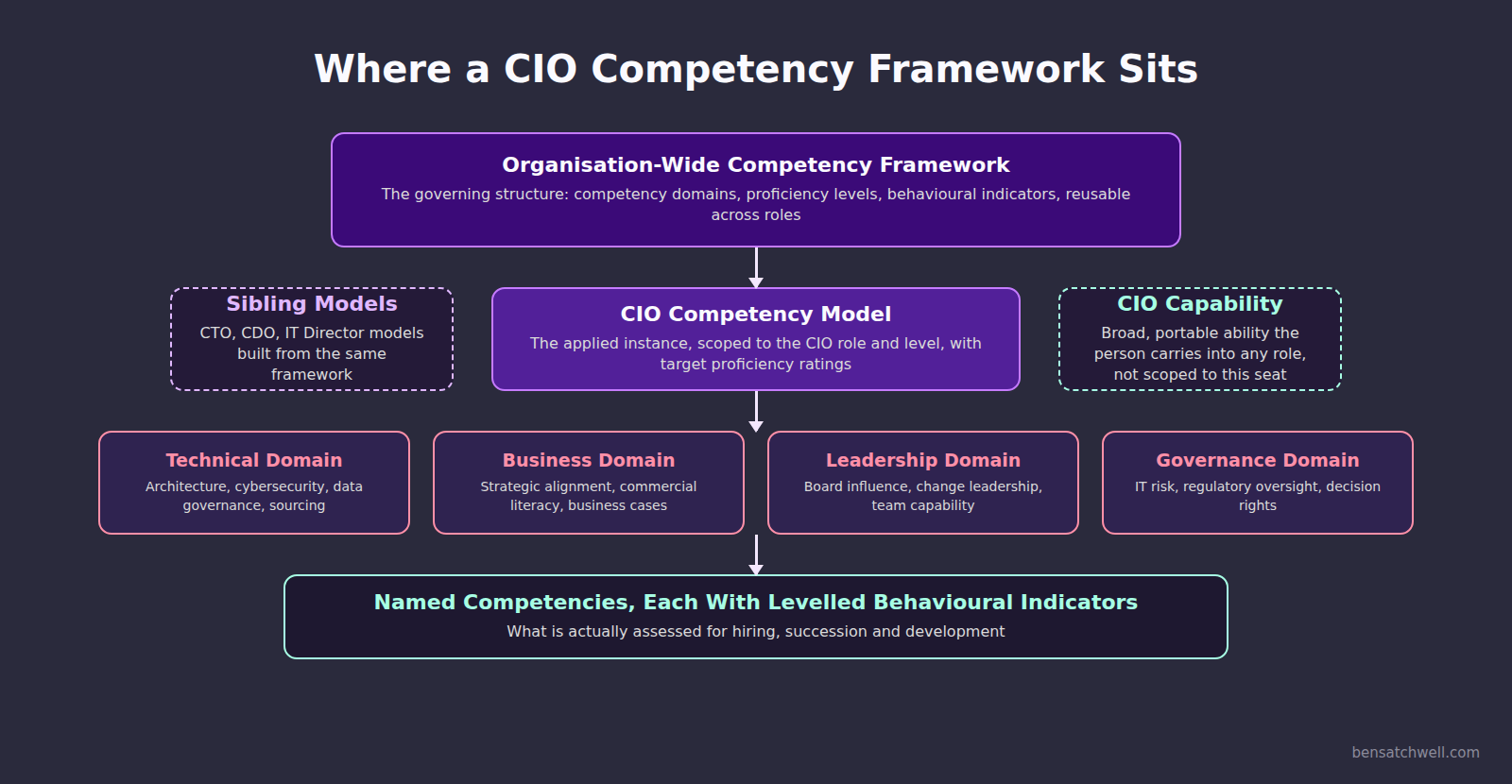
Where a CIO competency framework sits: the governing structure above, the CIO competency profile beneath it, and its four domains feeding into named, levelled competencies.
A note on terminology. A competency framework is also called a competency model, especially in the United States. I use competency profile for the competencies and required levels for one role, and competency matrix for the grid of required against current proficiency. Usage varies by region, and I explain the differences in this competency model definition.
Why It Exists
The CIO role sits in an unusual spot in most organisations. It carries deep technical accountability (infrastructure, security, data, architecture) and a genuine seat at the executive table (strategy, budget, risk, board reporting). A generic leadership competency set does not capture the technical judgement the role needs. A generic IT competency set does not capture the commercial and stakeholder judgement it also needs.
A CIO competency framework exists to hold both halves of that role in one structure, and to make the standard explicit enough that hiring, succession and performance conversations stop relying on a hiring manager's gut feel about "strategic maturity."
How It Works in Practice
A working CIO competency framework is built from a small number of competency domains, each populated with named competencies and levelled behavioural indicators.
Each competency is written with proficiency levels, usually four to six, and each level carries an observable behavioural indicator rather than an abstract trait. "Sets enterprise architecture direction that survives a change of vendor" is assessable. "Is strategic" is not. This is the same discipline that applies to any IT competency framework: the indicator has to describe behaviour someone can actually witness, not a personality description.
ISACA's Certified in the Governance of Enterprise IT (CGEIT) certification is a useful reference point here, not because organisations should adopt it wholesale, but because it shows how a credible body has organised IT governance competence into distinct domains, rather than one undifferentiated list of "leadership skills" (ISACA, CGEIT).
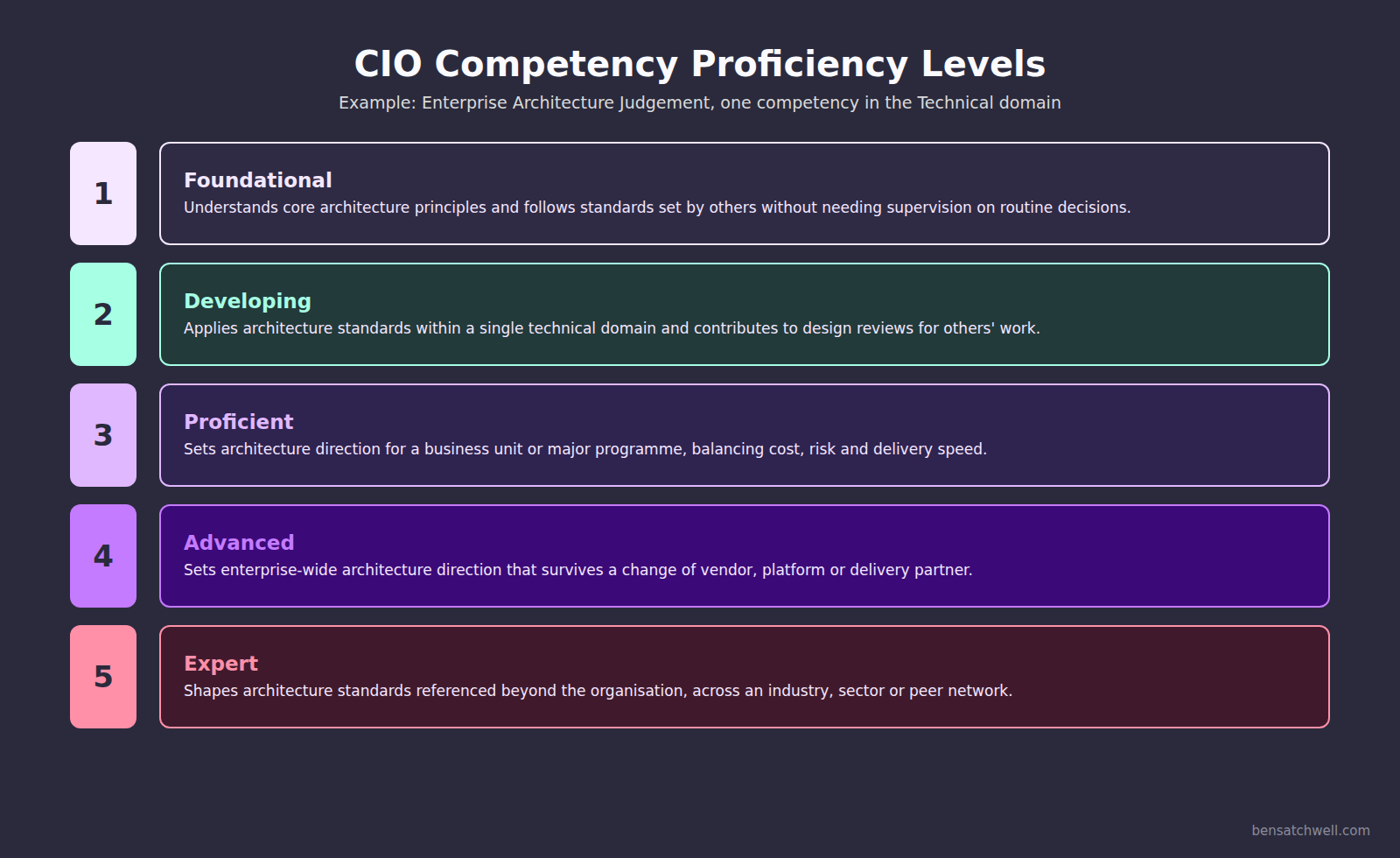
An example of levelled proficiency inside a CIO competency framework, shown here for enterprise architecture judgement.
What a CIO Competency Framework Is Not
It is not a job description. A job description states accountabilities and reporting lines. A competency framework states the standard of performance expected against defined behaviours, at defined levels, independent of who currently holds the role.
It is not a personality or psychometric assessment. Traits such as resilience or extraversion are stable dispositions. Competencies are learned, developed and assessed against workplace behaviour, which is why they can be built and improved deliberately in a way personality cannot.
It is not the same as a CIO capability. A capability is a broad, durable area of ability the person carries across roles and contexts, such as strategic judgement or stakeholder influence. A competency is that same underlying ability expressed as observable behaviour, integrated with technical knowledge and skill, and applied specifically within the CIO role. The capability travels with the person if they move to a CTO or COO role. The competency, as written, is scoped to how that ability shows up in this particular seat.
It is also not the same thing as a CEO competency framework, despite heavy overlap in the leadership domain. Both roles need stakeholder influence and commercial judgement. Only one of them needs a technical domain with named competencies in architecture, cybersecurity and data governance sitting inside the core structure rather than delegated entirely to a direct report.
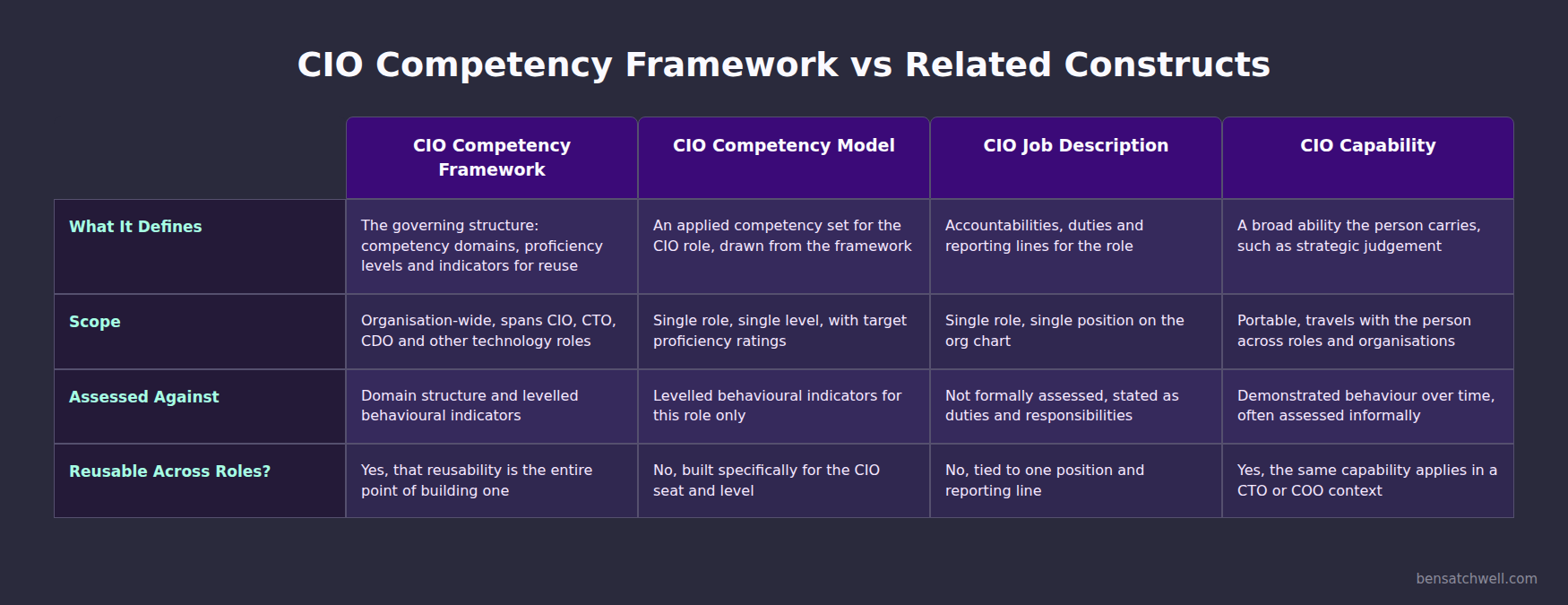
How a CIO competency framework compares with a CIO competency profile, a CIO job description and CIO capability across scope and assessment.
Named Frameworks and Reference Points
No single named framework covers the CIO role on its own, which is part of why so many organisations build something custom rather than adopt a standard off the shelf.
Peer-reviewed research on the role adds a useful qualifier to all of this: formal authority and demonstrated leadership capability do not always move together in CIOs, and organisations that assess only the title, or only a generic leadership library, miss the mismatch that actually predicts IT impact (CIO Leadership Profiles: Implications of Matching CIO Authority and Leadership Capability on IT Impact).
Common Failure Modes
The most common failure is building a leadership-only profile and calling it a CIO competency framework. Strip out the technical domain and what remains is indistinguishable from a generic executive competency set, which defeats the point of building something role-specific in the first place.
The second is copying a competency list from a vendor whitepaper or LinkedIn article without levelling it. A list of competency names with no behavioural indicators and no proficiency levels cannot be assessed against, which means it cannot be used for hiring, succession or development. It becomes a poster, not a working tool.
The third is treating the framework as static. Technology leadership expectations shift as fast as the technology itself, and a CIO profile written for an infrastructure-and-operations mandate five years ago rarely still matches a mandate that now includes AI governance, platform strategy and data monetisation. A framework that is not reviewed on a defined cycle will drift out of relevance quietly, which is worse than not having one, because it creates false confidence in a standard nobody is actually being assessed against anymore.
Trade-offs and Constraints
Building a dedicated CIO competency profile is worth the effort when the organisation is actively using it: for succession planning into the CIO seat, for structuring a search brief, or for a defined development plan for an incumbent. It is not worth building in isolation from those uses. A profile built and then filed away has no function beyond decoration.
Smaller organisations with one technology leadership role rarely need the full organisation-wide framework. A single, well-levelled competency profile for that one seat, drawing on reference points like SFIA and a leadership library, does the job without the governance overhead of maintaining a framework built to scale across roles that do not yet exist. The general design principles still apply, and are the same ones covered in a broader competency framework: defined domains, levelled proficiency and observable behavioural indicators, whether the structure covers one role or twenty.
Frequently Asked Questions
What is the difference between a CIO competency framework and a CIO competency profile?
A framework is the organisation-wide governing structure that defines competencies, domains and proficiency levels for reuse across multiple technology leadership roles. A competency profile is the selection of competencies and required levels from that structure, scoped to the single CIO role. Competency model is the usual US name for the framework itself.
What competencies should a CIO competency framework include?
Most working profiles include a technical domain (architecture, cybersecurity, data governance), a business domain (strategic alignment, commercial literacy), a leadership domain (stakeholder influence, change leadership) and a governance domain (IT risk, regulatory oversight).
Is a CIO competency framework the same as a CIO job description?
No. A job description sets accountabilities and reporting lines. A competency framework sets the standard of performance expected, described as observable, levelled behaviour, independent of any single job description.
Does SFIA cover the CIO role?
SFIA covers technical and digital skills at defined responsibility levels and is a useful input to the technical domain of a CIO competency profile, but it does not cover the commercial, governance and executive leadership dimensions the role also requires.
How many competencies should a CIO competency profile have?
Most workable profiles hold between eight and fourteen competencies across four domains. Beyond that range, the profile usually becomes too long to assess consistently and starts duplicating adjacent competencies rather than adding distinct ones.
Should a CIO competency framework include cybersecurity as its own competency?
Yes, in most modern frameworks. Cybersecurity risk oversight is now distinct enough from general technical architecture judgement, and carries enough board-level accountability, that treating it as a named competency rather than folding it into general technology governance gives a more assessable and defensible standard.