

Most boards asking for a CEO competency model are actually asking for three different things at once, and nobody has stopped to separate them. Sometimes they mean a generic list of executive traits lifted from a search firm's slide deck. Sometimes they mean a performance scorecard tied to financial results. And sometimes they genuinely mean a competency model built the way any other role model is built, just applied to the single most consequential seat in the organisation. Only the third one is actually a CEO competency model, and the distinction matters more than most boards realise.
What Is a CEO Competency Model?
A CEO competency model is the applied selection of competencies drawn from an organisation's competency framework, tailored specifically to the chief executive role, with proficiency expectations set at the highest levels of scope, autonomy and impact the organisation has. If the framework is the governing system that defines and standardises competencies across the whole business, the model is the instance of that system built for one specific role. In this case, the role held by exactly one person at a time.
That single-incumbent detail changes how the model has to be built. Most competency models are designed to differentiate performance across a population, a sales team, a cohort of engineering managers, a group of branch leaders. A CEO competency model has no population to differentiate. It exists to give a board, a succession committee, and the executive themselves a shared, behaviourally specific answer to one question: what does effective performance look like in this particular seat, in this particular organisation, right now.
Why a CEO Competency Model Exists
Boards have never lacked ways to measure CEO performance against financial outcomes. Revenue, margin, share price, cost discipline, these are well understood and easy to track. What boards have consistently lacked is a shared, defensible language for evaluating how the CEO is getting those results, and for deciding whether an internal candidate is ready to become one.
A peer-reviewed study on CEO evaluation published in the Journal of Corporate Finance found that boards weigh far more than lagging financial metrics when assessing a chief executive, including how well the CEO manages organisational change and overcomes inertia. That is precisely the gap a competency model fills. It converts vague board-level impressions of "strong leadership" or "good judgement" into named, observable behaviours that can actually be assessed, developed, and succession-planned against, rather than left as gut feel that varies by which director is in the room.
Without a model, evaluation defaults to two poor substitutes: financial results alone, which say nothing about how those results were achieved or whether they are repeatable, or personality-based impressions, which are unreliable and difficult to defend in a succession dispute.
How a CEO Competency Model Works in Practice
A working CEO competency model typically draws from three layers of the organisation's competency architecture rather than starting from a blank page.
- Core competencies every employee is expected to demonstrate, carried through to the top of the organisation rather than assumed to disappear at executive level.
- Leadership domain competencies such as strategic thinking, decision-making under uncertainty, and stakeholder influence, calibrated to enterprise-wide scope rather than team or divisional scope.
- Governance-specific behavioural indicators unique to the CEO seat: managing the board relationship, representing the organisation externally, and taking ultimate accountability for outcomes that cannot be delegated.

A functional CEO competency model usually holds between six and ten competencies, each with a written behavioural indicator describing what that competency looks like when demonstrated at CEO scope. It is not a longer version of a general leadership competency model. A leadership competency model spans many levels of leaders across the organisation, from team leaders through to the executive team, and is designed to show progression between those levels. A CEO competency model has one level, because there is one CEO.
Because the role is singular, the model cannot be statistically validated against a large sample of job holders the way a sales competency model might be. Instead it is validated qualitatively, through board judgement, comparator research against similar organisations, and direct testing against the strategic period the organisation is actually in.

What a CEO Competency Model Is Not
This is where most of the confusion sits, so it is worth being explicit.
It is not a CEO competency framework. The CEO competency framework is the broader governing structure an organisation, or a sector body, uses to define what CEO competence means across contexts, listed companies, family businesses, government agencies, not-for-profits, each with different accountability structures. The model is the single applied instance built for one organisation's actual CEO role, drawn from that framework.
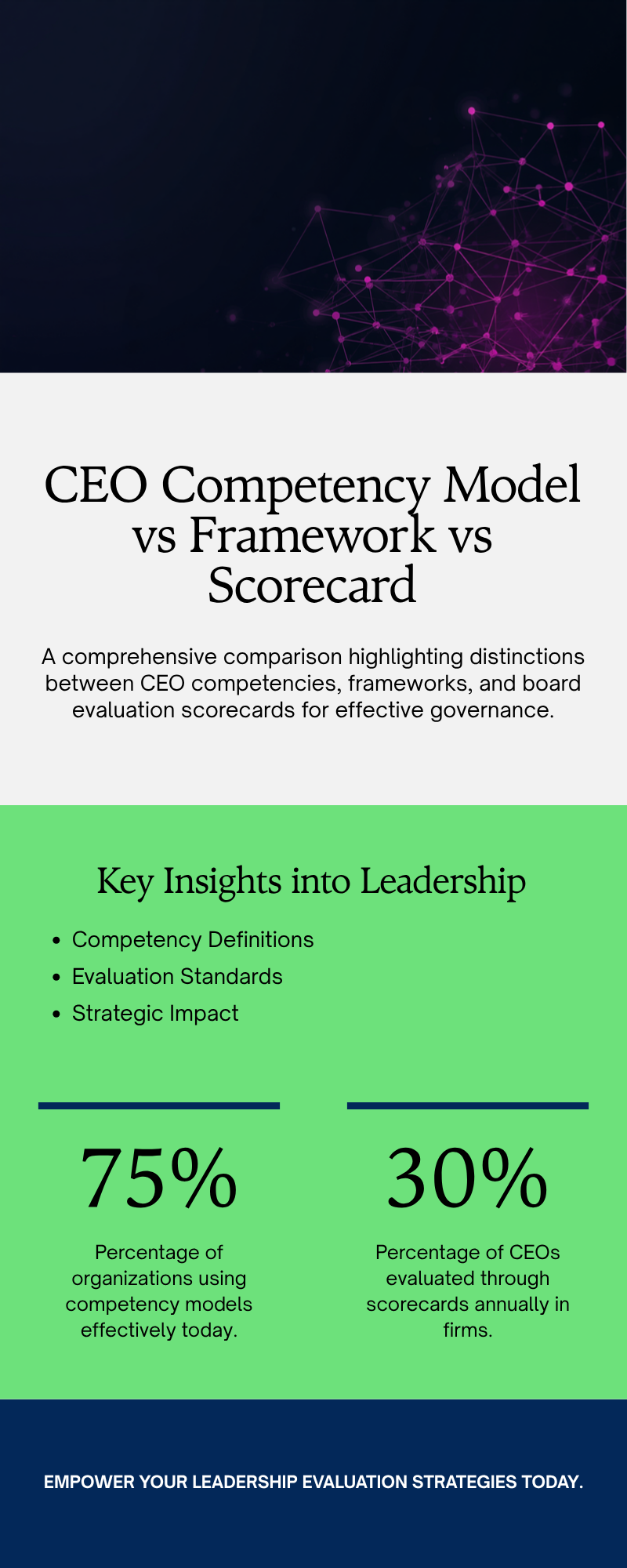
It is not a board evaluation scorecard. A scorecard is usually weighted toward financial and operational targets set for a specific year. A competency model describes the behavioural standard the CEO is expected to meet regardless of which targets are in play that year.
It is not a personality profile. Traits like charisma, confidence or extroversion are not competencies. A competency is observable behaviour applied effectively in context. A confident CEO who cannot make a defensible decision under uncertainty has not demonstrated the competency, no matter how the room reads them.
It is not a capability statement. Capability is broad, durable potential a person carries across roles and contexts. A competency model is role-specific by design, calibrated tightly to what this organisation needs from this seat, not to what the individual might be capable of elsewhere.
Named Frameworks Behind CEO Competency Models
Most CEO-level models are not built from scratch. They draw on established competency research and adapt it to executive scope.
The SHRM leadership competency work separates competencies into leading the organisation, leading others, and leading self, a structure that maps cleanly onto CEO-level design because it forces a distinction between enterprise-wide strategic competencies and the personal discipline competencies that sit underneath them. Much of this traces back to the Boyatzis competency model, which established the behavioural event interview method for identifying which competencies actually differentiate superior performers, still the most credible way to build a CEO model rather than guessing at traits.
Government sector equivalents are instructive here too. Senior public sector executives, secretaries and directors-general, are effectively CEOs of large public organisations, and frameworks built for them show the same pattern. OECD research on leadership for a high-performing civil service identifies competencies weighted heavily toward managing change, navigating political and stakeholder complexity, and building institutional capacity rather than technical delivery, exactly the shift in emphasis a private sector CEO model needs from a general management competency set.
The CIPD's guidance on competency frameworks makes the same point for a general audience: a competency framework only adds value when it establishes a clear, defensible link between individual behaviour and organisational performance. At CEO level, that link has to be airtight, because the cost of getting the evaluation wrong is higher than at any other level in the organisation.
Where CEO Competency Models Fail
The most common failure is importing a generic executive competency list, usually from a search firm or a consulting deck, without calibrating it to the organisation's actual strategic period. A model built for a turnaround needs different weighting on risk tolerance and decisive action than a model built for a stable, mature business focused on steady execution. A generic list flatters everyone and differentiates nobody.
A second failure is building the model without board involvement, then wondering why it is never used in evaluation or succession discussions. If the people who will use the model to make a succession decision were not involved in defining "ready," the model sits in a folder and the board reverts to gut feel.
A third failure is treating the model as permanent. Strategy shifts, market conditions change, and a competency set calibrated for growth-stage expansion will misjudge a CEO who is right for the next, more consolidative phase. A model that is never revisited becomes a historical artefact rather than a live evaluation tool.
A fourth is conflating competencies with results. A competency model exists precisely to separate how outcomes were achieved from the outcomes themselves. If the model quietly becomes a rebadged financial scorecard, it has stopped doing its job.
Trade-Offs and Constraints
A CEO competency model earns its cost when there is real succession planning at stake, when a board needs a shared evaluation language that goes beyond financial results, or when internal candidates need to be assessed against an explicit, defensible standard rather than informal impression. It is genuinely useful ahead of any planned or unplanned leadership transition.
It is less useful, and often skipped for good reason, in small or founder-led organisations where the CEO role is deeply personalised, governance is informal, and there is no realistic succession pool to evaluate against. Building a formal model in that context tends to produce a document nobody consults rather than a tool anyone uses.
Because the role is single-incumbent, the model also has a shelf life tied to the organisation's strategic cycle rather than to individual performance reviews. It needs a scheduled revisit, typically aligned to strategy refresh points, not an annual tick-box update.
FAQ: CEO Competency Model
What is a CEO competency model?
A CEO competency model is the applied set of competencies, drawn from an organisation's broader competency framework, that defines what effective performance looks like specifically in the chief executive role, at the highest level of scope and accountability in the organisation.
How is a CEO competency model different from a CEO competency framework?
The framework is the broader governing structure defining CEO competence across different organisational contexts. The model is the single applied instance built for one organisation's actual CEO role, using competencies drawn from that framework.
What competencies are usually included in a CEO competency model?
Most models include a mix of enterprise-wide strategic thinking, decision-making under uncertainty, stakeholder and board management, change leadership, and organisation-wide accountability, typically between six and ten competencies with written behavioural indicators.
Who builds a CEO competency model?
It should be built jointly by the board, or a designated committee, together with HR or organisational design expertise, rather than by either group alone. Board involvement is what makes the model usable in real evaluation and succession decisions.
How is a CEO competency model used in succession planning?
It gives the board an explicit, behavioural standard to assess internal and external candidates against, rather than relying on informal impressions, so readiness can be judged consistently across candidates and over time.
Is a CEO competency model the same as a board evaluation scorecard?
No. A scorecard is typically weighted toward financial and operational targets for a given period. A competency model describes the behavioural standard expected of the CEO regardless of which targets are in play that year.