
Most organisations that claim to use the Boyatzis competency model are not actually using it. They have borrowed a list of 19 competencies from a 1982 book and slotted them into their performance review system without engaging with the single most important thing the model introduced: the distinction between competencies that meet a minimum threshold and competencies that genuinely differentiate superior performance. Strip that distinction out and you no longer have the Boyatzis model. You have a list.
What Is the Boyatzis Competency Model?
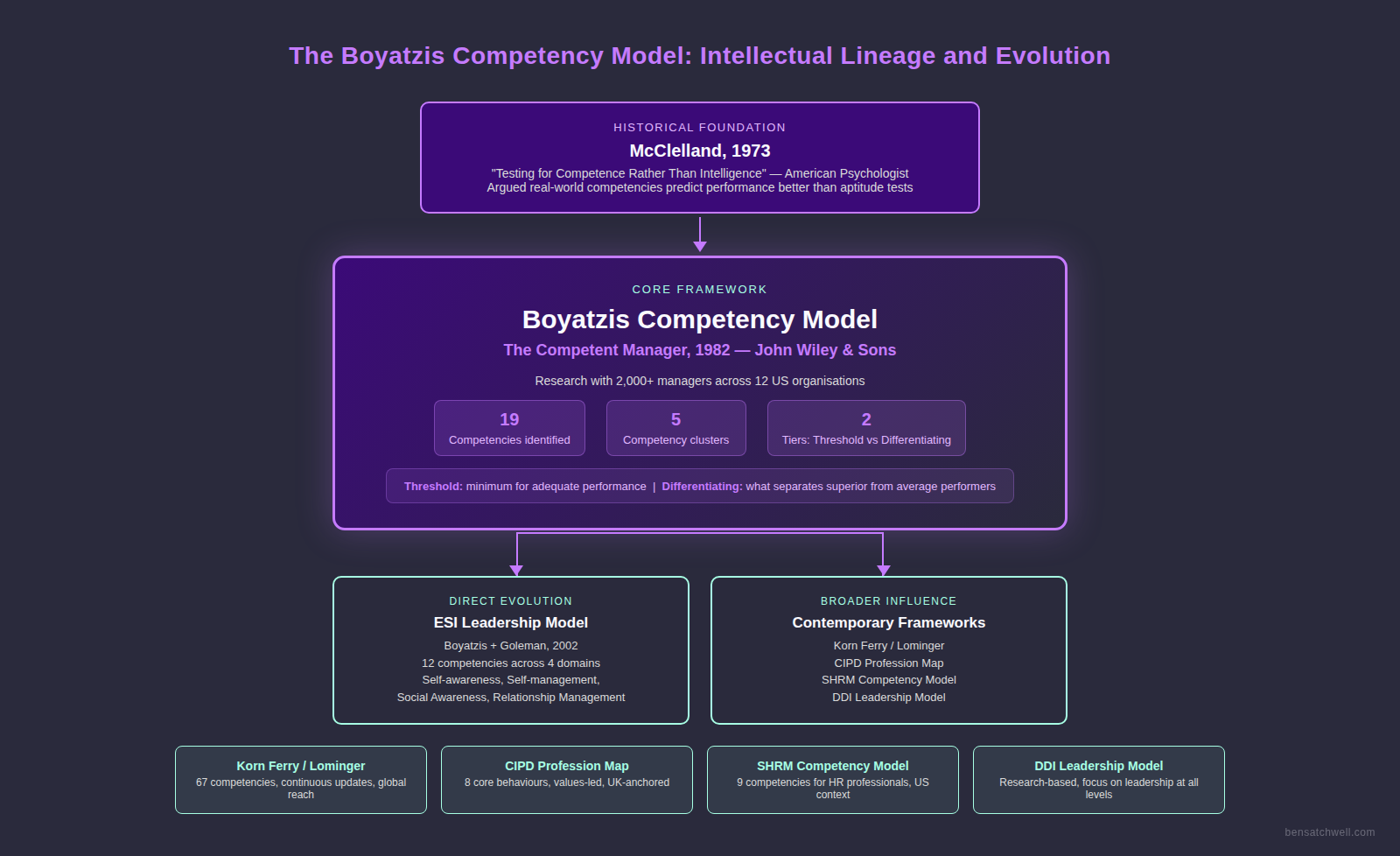
The Boyatzis competency model is an empirically grounded framework published in Richard Boyatzis's 1982 book The Competent Manager. It identifies 19 competencies across 5 clusters based on research with more than 2,000 managers across 12 US organisations, conducted for the American Management Association. The research asked a deceptively direct question: what do effective managers actually do that their average counterparts do not?
Understanding what a competency actually is matters here. Boyatzis defined a competency as an underlying characteristic of a person causally related to effective or superior performance in a role. That is a deliberate definition. It points inward, to characteristics the person holds, not to tasks they complete or skills they demonstrate on a checklist.
A note on terminology. A competency framework is also called a competency model, especially in the United States. I use competency profile for the competencies and required levels for one role, and competency matrix for the grid of required against current proficiency. Usage varies by region, and I explain the differences in this competency model definition.
Why the Boyatzis Model Was Built
The model did not emerge from theory. It emerged from dissatisfaction with how organisations selected and developed managers.
The intellectual foundation goes back to David McClelland's 1973 argument that traditional aptitude and intelligence tests fail to predict real-world job performance. McClelland proposed testing for competencies instead, the actual characteristics that produce results. Boyatzis took that argument and applied it rigorously to a specific population: middle managers in established organisations.
The problem Boyatzis was solving was selection and development by proxy. Organisations were promoting people based on technical expertise, tenure, and educational credentials, inputs with weak links to managerial effectiveness. The research set out to identify what the output-side predictors actually looked like.
How the Boyatzis Model Works in Practice
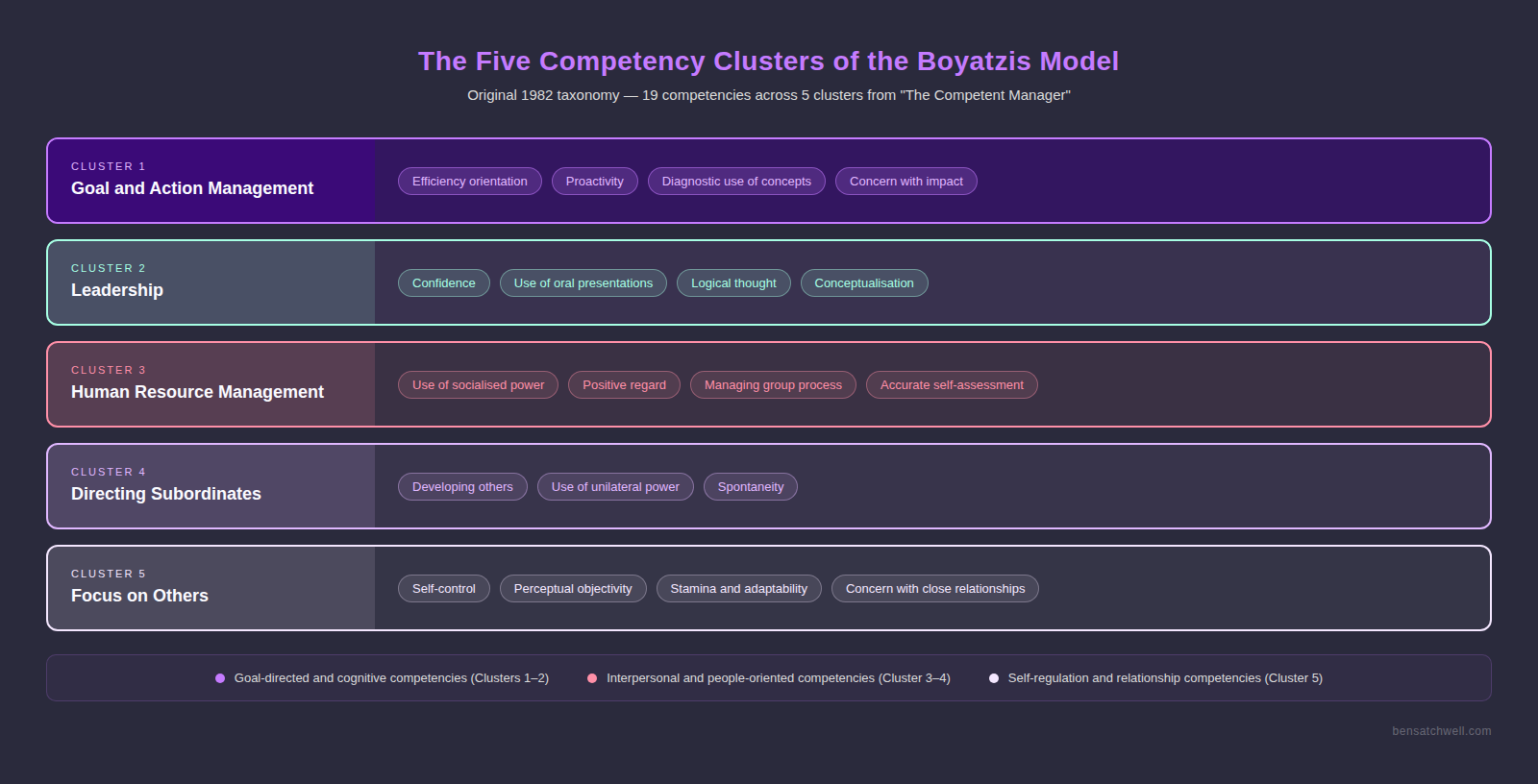
The 19 competencies are arranged across five clusters:
Cluster 1: Goal and Action Management: Efficiency orientation, proactivity, diagnostic use of concepts, concern with impact. These drive results through direction-setting and consequence anticipation.
Cluster 2: Leadership: Confidence, use of oral presentations, logical thought, conceptualisation. These predict a manager's ability to direct and inspire others through clear thinking and communication.
Cluster 3: Human Resource Management: Use of socialised power, positive regard, managing group process, accurate self-assessment. These are the interpersonal competencies for building and maintaining team effectiveness.
Cluster 4: Directing Subordinates: Developing others, use of unilateral power, spontaneity. Smaller in count, but important for day-to-day people management.
Cluster 5: Focus on Others: Self-control, perceptual objectivity, stamina and adaptability, concern with close relationships. These support sustained performance under pressure and maintain relational functioning.
The threshold/differentiating split is not uniform across clusters. Some competencies from Clusters 3 and 5 operate primarily at threshold level, you need them to function, but having more of them does not produce disproportionate returns. The differentiating competencies cluster more heavily in Clusters 1 and 2, particularly around proactivity, conceptualisation, and concern with impact.
This matters for application. If you want to identify who will be an adequate manager, focus your assessment on threshold competencies. If you want to identify who will be outstanding, the differentiating competencies are what your design needs to surface.
What the Boyatzis Model Is Not
The Boyatzis model is a framework built for a specific population: mid-level managers in US organisations in the late 1970s. It is not a general framework for every role or organisation, and treating it as one is among the most persistent errors in how practitioners reference it.
It is also not a behaviour indicator library. The model identifies underlying characteristics, not observable behavioural descriptors of the kind you would write into a behavioural interview guide or a performance rating form. Translating Boyatzis competencies into observable indicators requires a separate design step that many organisations skip.
It is not a personality framework. Competencies in the Boyatzis sense are more specific than traits and more learnable. A person is not born with or without efficiency orientation the way they might have an innate tendency toward extraversion. Competencies are developable, which is part of why the model has endured in management development contexts.
Finally, it is not a current-state representation of management roles. The research was conducted across US organisations in the 1970s. The construct is sound, but the specific competencies and their threshold/differentiating assignments may not transfer directly to a contemporary software company or public sector agency without revalidation.
How the Boyatzis Model Influenced What Came After
Boyatzis's work did not produce a static taxonomy. It produced a method and a set of constructs that evolved.
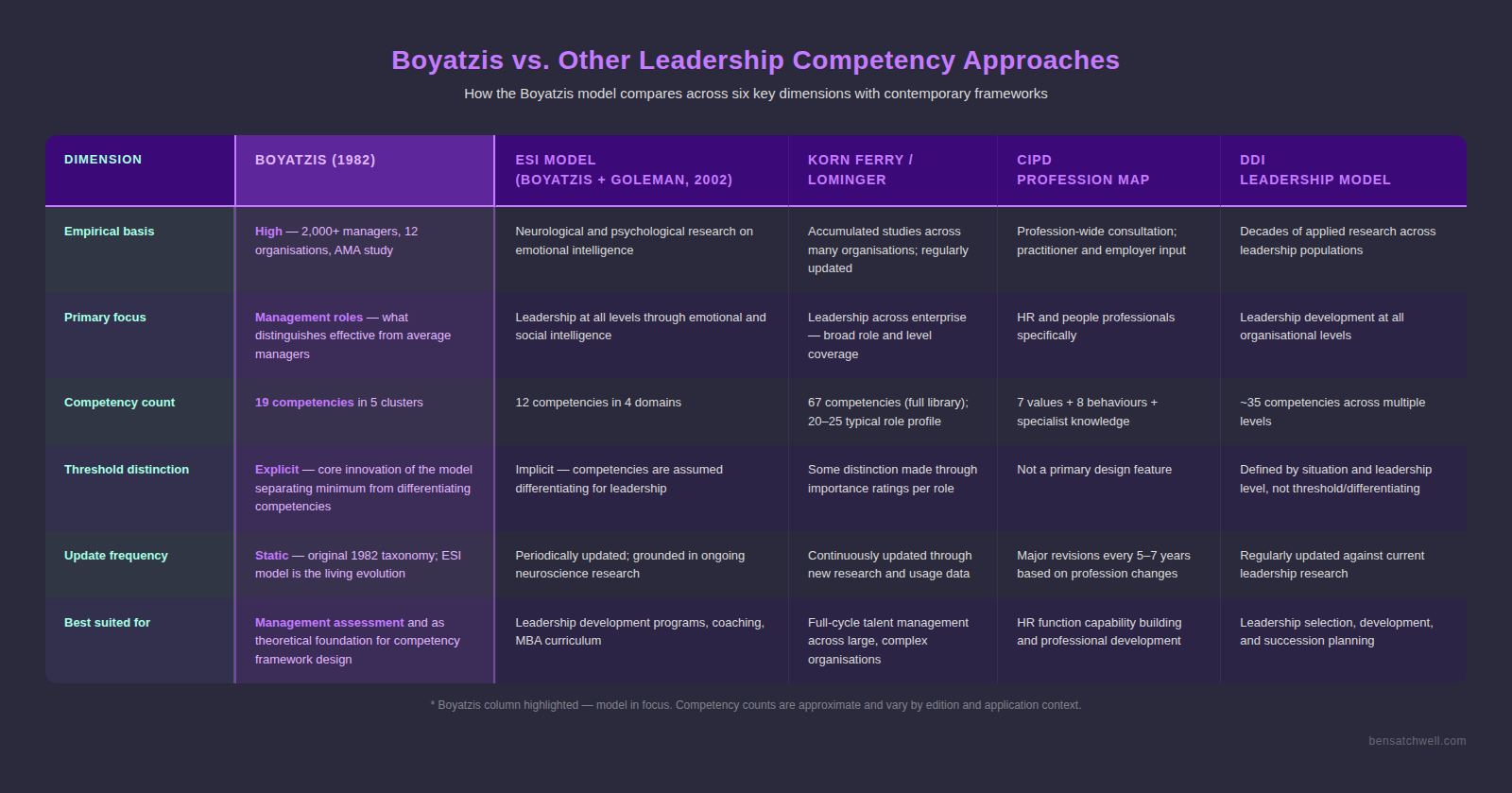
The most direct descendant is the Emotional and Social Intelligence (ESI) leadership model, developed by Boyatzis in collaboration with Daniel Goleman from 2002 onward. The ESI model reduced the competency count to 12 across four domains, self-awareness, self-management, social awareness, and relationship management, and grounded them in neuroscience research on emotional regulation. Where the 1982 model was empirically grounded in management performance data, the ESI model is grounded in psychology and neuroscience.
The broader influence on contemporary frameworks is significant. The CIPD Profession Map uses a behaviour-based structure with explicit distinctions between core and specialist capabilities. Korn Ferry / Lominger maintains a commercial library of competencies with role-level importance ratings, a direct extension of the threshold/differentiating logic into a commercial talent management product. The SHRM Competency Model organises eight behavioural competencies and one technical competency, HR Expertise, for HR professionals specifically.
The SFIA framework takes a different architectural approach, structuring competency-equivalent constructs around skill descriptors and levels rather than underlying characteristics, which illustrates how the question "what makes someone effective?" can be answered through quite different design choices.
Where Organisations Get the Boyatzis Model Wrong
The most common failure is collapsing the two-tier structure. Organisations list all 19 competencies in their performance review system and treat them as equally important, equally weighted, and equally differentiating. This is not the Boyatzis model. It is a 19-item inventory with a branded name attached.
The second failure is scope mismatch. The model was built on management roles. Applying it wholesale to individual contributors, technical specialists, or non-management roles produces assessments that feel generic and are analytically questionable. The competency research was specific to a population. Using it outside that population requires explicit validation.
The third failure is treating the model as a substitute for organisational analysis. No competency model tells you what your specific management roles require. The Boyatzis model tells you what management roles in 1970s US organisations required. Starting there is legitimate. Stopping there is not.
If you are building or reviewing role-specific competency frameworks, the Boyatzis model works well as a theoretical grounding and a source of construct validity, provided you complete the translation step that adapts its constructs to your current context.
When to Use the Boyatzis Model and When to Choose Something Else
The Boyatzis model is most useful in three situations. First, when you are designing a management competency framework and want a theoretically grounded starting point with empirical backing. Second, when you are building management assessment and selection criteria and need to distinguish characteristics that predict adequate performance from those that predict superior performance. Third, when you are in an academic or professional development context and need a foundational framework to contrast with more recent models.
It is less well-suited to organisations that need high granularity across many role levels, to technical and specialist roles without direct management responsibilities, or to rapid-deployment contexts where translation and validation work cannot be done properly.
In those cases, a capability framework or a more contemporary framework may serve better. The two constructs answer different questions and serve different design purposes, and choosing the wrong one creates problems that are hard to fix once a framework is embedded in systems and practice.