
Most organisations that say they have a business competency model have a list. They have gathered desirable qualities, usually assembled by HR and often derived from a personality framework, and laid them out in a document nobody references. That is not a competency model. A business competency model is a structured way of saying what good performance looks like across a business's roles, levels and functions. Built correctly, it connects expectations to real work, scales across the workforce and gives managers, practitioners and employees a shared language for what capability means in context. This article is about scoping: how to decide what a business profile covers and how rigorous it needs to be.
What Is a Business Competency Model?
A business competency model is a selection of competencies drawn from the organisation's competency framework and configured for a specific role, level, function or job family. I call each selection a competency profile. The framework provides the organisation-wide structure, definitions and proficiency levels. The profile names which competencies apply, at what level and for which part of the workforce.
A competency is the integration of skills, knowledge, judgement and behaviour applied effectively in the context of a role. A business profile makes that operational: it says what effective performance looks like for a business analyst at a given level, a sales manager or an operations lead. It moves from abstract definition to role-specific expectation. For the general build, see my guide to the competency model.
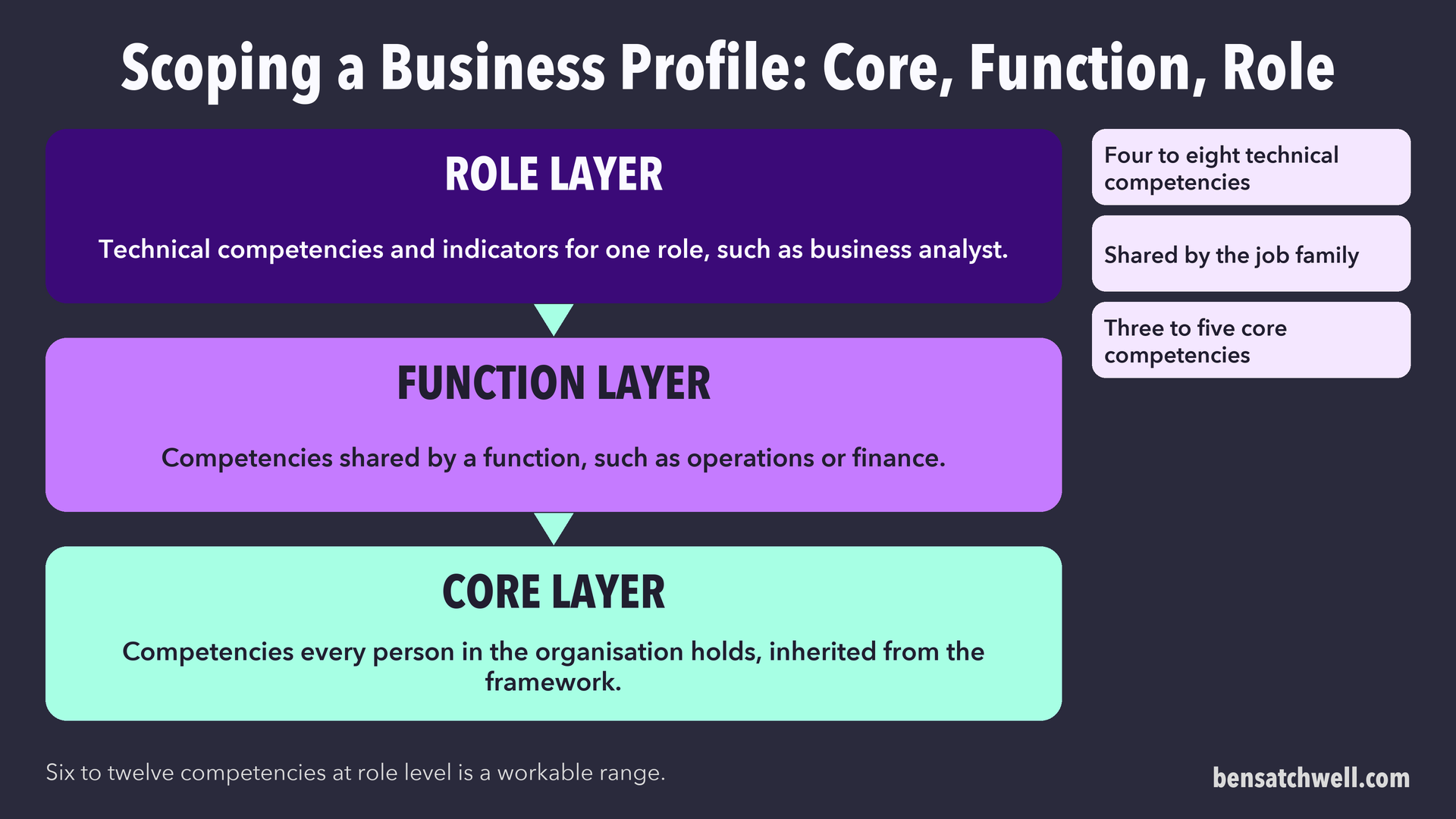
Six to twelve competencies at role level is a workable range.
A note on terminology. A competency framework is also called a competency model, especially in the United States. I use competency profile for the competencies and required levels for one role, and competency matrix for the grid of required against current proficiency. Usage varies by region, and I explain the differences in this competency model definition.
Why Businesses Build Them
The purpose is a consistent, shared basis for people decisions. Without one, expectations are informal and manager-dependent, and two managers assessing the same role reach different conclusions because they are measuring different things. Large organisations can develop dozens of parallel understandings of what good looks like, especially when each business unit sets its own standards. A shared profile anchors performance conversations in observable behaviour instead of personality, potential or impression.
There is a development case as well. When the profile defines the gap between current and required proficiency at each level, it supports targeted capability investment. People can see what they need to develop, and the business can see where it has systemic gaps.
Scoping: Core, Function and Role
A business profile sits above the individual role and below the framework. The framework holds the catalogue of competencies, definitions, indicators at each level and governance rules. The profile assembles the subset for one role, function or level. Four decisions shape it:
- which competencies apply, including core competencies all roles carry
- at what level each is required
- how entry, mid and senior expectations differ
- how it connects to assessment, performance review, recruitment and development
A sound profile carries two types of competency. Core competencies are demonstrated by everyone regardless of role. Technical competencies are specific to a role or function. That dual structure gives coherence across the organisation and precision at role level. Most role-level profiles hold six to twelve competencies, with three to five core and four to eight technical. Profiles above fifteen are rarely used well.
The scope has to be real. Organisations that try to cover the whole workforce with one profile produce one that is vague enough to apply everywhere and specific enough to apply nowhere. Share a core layer, and design the functional layer for the role or cohort it serves.
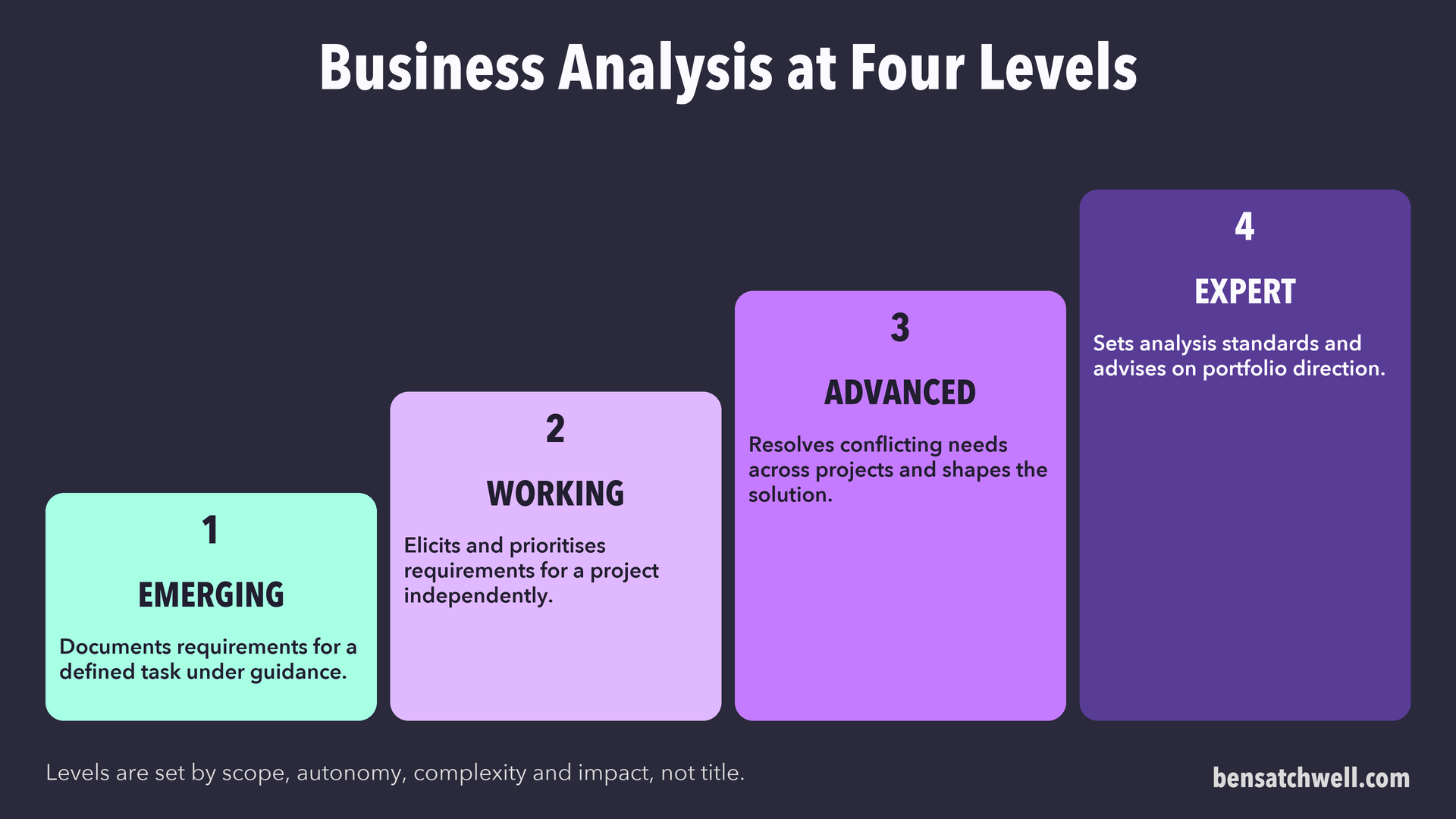
Levels are set by scope, autonomy, complexity and impact, not title.
Assessment-Grade or Development-Grade
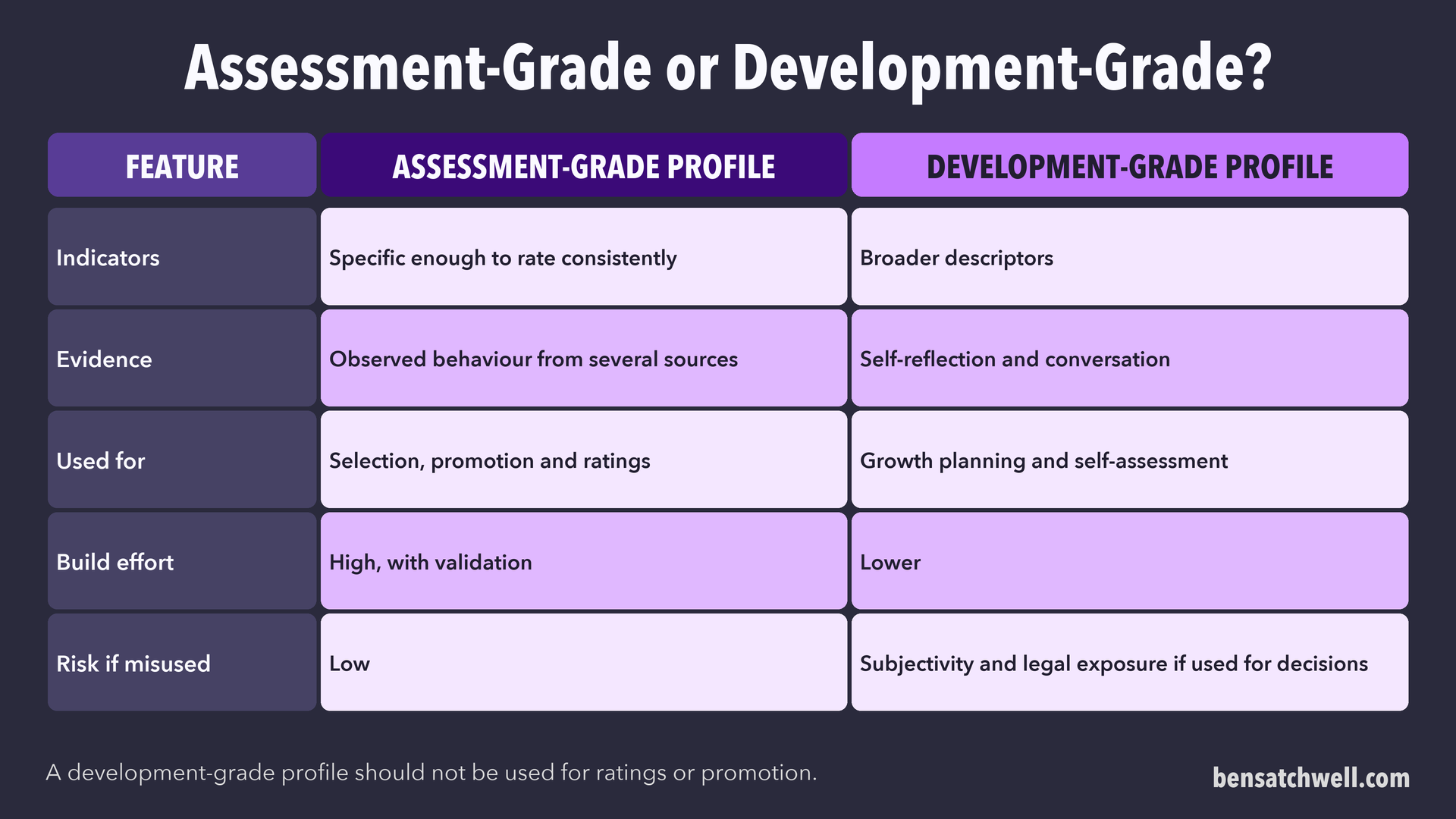
A development-grade profile should not be used for ratings or promotion.
An assessment-grade profile needs validated behavioural indicators specific enough to be rated consistently. A development-grade profile can use broader descriptors and suits self-assessment and growth planning. Using a development-grade profile for ratings or promotion introduces subjectivity and legal risk. Decide which you are building before you start, because the effort differs. The role analysis, stakeholder consultation, indicator validation and governance design that an assessment-grade profile needs take time, and organisations that treat it as a documentation task produce outputs that do not survive contact with real work.
What a Business Profile Is Not
- Not the framework. An organisation has one framework and can have many profiles built from it. See the competency framework guide.
- Not a values statement. A value such as integrity must be translated into competencies with behavioural indicators before it works as an expectation.
- Not a job description. A job description lists accountabilities. The profile describes what a person needs to carry them out well.
- Not a personality profile. Tools such as MBTI or DISC describe style preferences. Profiles assess observable performance against role expectations. The CIPD's factsheet on competency and competency frameworks is a sound reference on the limits of conflating the two.
Named Sources
The Korn Ferry Leadership Architect, which grew out of the Lominger library, is widely used in large enterprises to build profiles for senior commercial, strategic and general management roles, and it includes proficiency levels. SHRM's Body of Applied Skills and Knowledge shows function-specific design: a defined set of competencies levelled by career stage and mapped to role requirements. The CIPD Profession Map applies the same logic to people practice roles, separating core behaviours, specialist knowledge and values. Treat them as source libraries to select from, not profiles to adopt whole.
Common Failure Modes
- Starting from a generic list. Competency language borrowed from a consultant or peer, without governance, gives a list with no levels, no indicators and no application standard. It looks like a profile and does not work like one.
- Scale without specificity. One profile for everyone fits no one.
- Built without job analysis. Profiles are more valid when developed from analysis of the work with incumbents and subject matter experts than when borrowed. See my guide to how profiles sit in a competency framework.
- Disconnected from use. A profile that never touches recruitment, performance conversations or development is a document, not a system.
Trade-Offs and Constraints
A profile needs maintenance. A set built years ago may still be applied to roles that have changed substantially, so build a review cycle in from the start, typically every two to three years and sooner when role design, technology or strategy changes. Organisations that build profiles with no parent framework often end up with several that conflict, with different business units using different language, and that blocks cross-functional comparison. A framework underneath prevents the fragmentation. Building one properly takes real investment, and the result is only as strong as the analysis behind it.
FAQ
What is the difference between a business competency model and a competency framework?
There is no difference in structure. Competency model is the usual US name for the organisation-wide system and competency framework is more common in the UK and Australia. The selection for one role or function is a competency profile.
How many competencies should a business profile include?
Six to twelve at role level, with three to five core and four to eight technical.
Does it need proficiency levels?
Yes. A competency without a level is a label, not an expectation. Levels are what make a profile usable for assessment, development and role design.
Can it be used for recruitment?
Yes. Competency-based recruitment uses the profile to set selection criteria and structure assessment around them, which gives more consistent and defensible decisions than unstructured approaches.
What is the relationship with a core competency framework?
A core framework defines competencies everyone holds. A business profile adds the functional and technical layer on top. The core layer is inherited and the functional layer is configured for the role.
How often should it be reviewed?
Every two to three years, and sooner when role design, technology or strategy changes materially.