
Most practitioners searching for the AHRI competency framework are looking for the same thing: a structured picture of what good HR practice looks like at each stage of a career in Australia. What AHRI actually publishes is called the Australian HR Capability Framework, or AHRCF. The naming difference matters. AHRI's use of "capability" rather than "competency" is deliberate, and it shapes how the framework is structured, what it includes, and how it should be used. Understanding that distinction is part of understanding the framework itself.
What Is the AHRI Competency Framework?
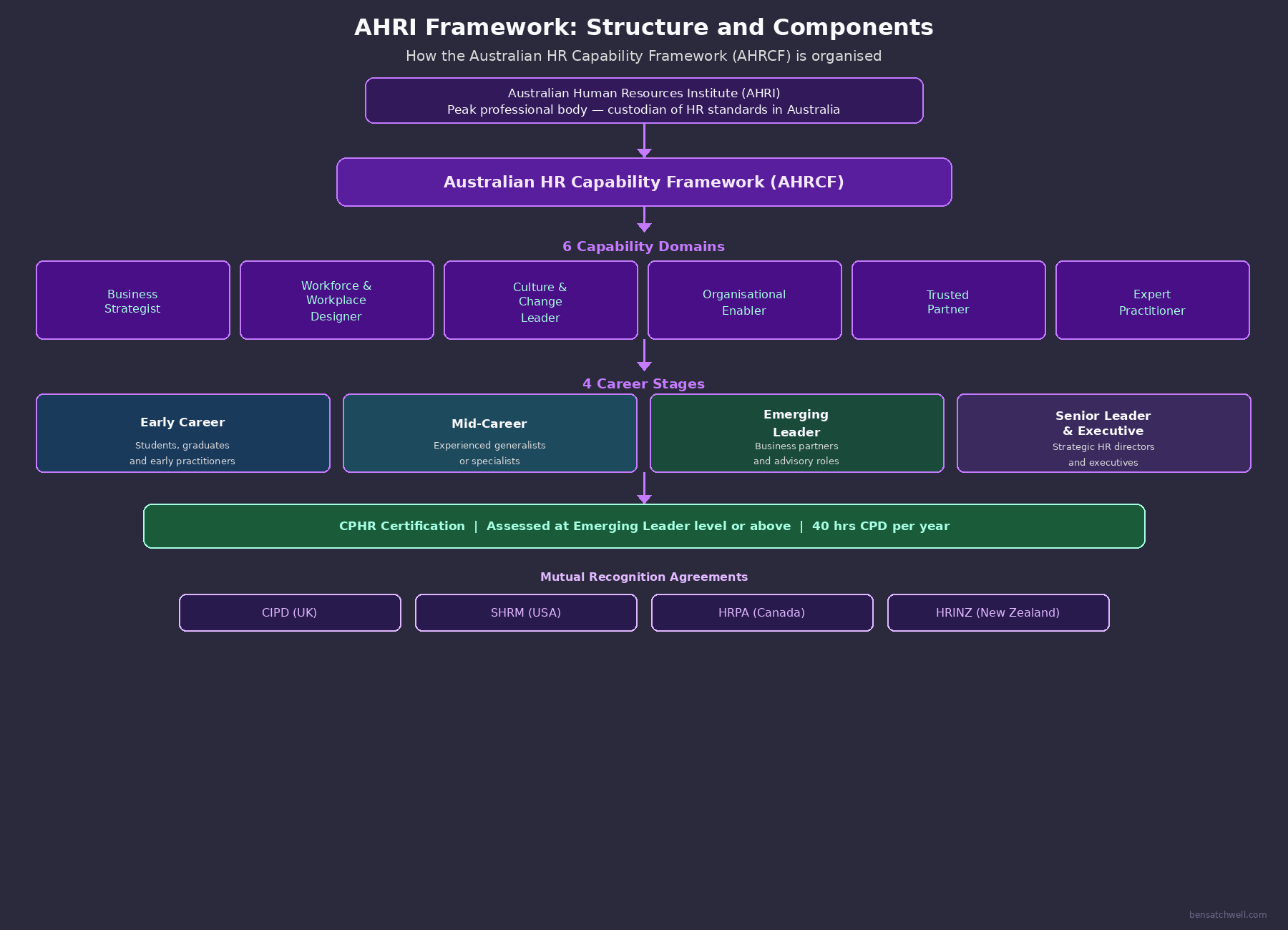
The Australian HR Capability Framework (AHRCF) is AHRI's authoritative structure defining what HR professionals at each career stage need to know, do, and demonstrate. It organises human capability across six domains and four career stages, from practitioners just entering the profession through to senior HR leaders operating at an organisational strategy level.
The AHRCF underpins the Certified Practitioner in Human Resources (CPHR) designation, which is AHRI's peak professional credential for the HR profession in Australia. To achieve CPHR, a practitioner must demonstrate capability against the framework at the appropriate career stage.
Despite the "competency framework" label commonly used in search queries, AHRI made a considered choice to call this a capability framework. A capability is a broad, durable area of ability that a practitioner owns and develops, carrying it across roles and contexts. A competency is typically a more narrowly defined, role-specific integration of skill, knowledge and behaviour. Capability frameworks are built for portability and longevity; competency frameworks are often built for a specific role or function. The AHRCF reflects that choice at every level of its design.
A note on terminology. A competency framework is also called a competency model, especially in the United States. I use competency profile for the competencies and required levels for one role, and competency matrix for the grid of required against current proficiency. Usage varies by region, and I explain the differences in this competency model definition.
Why the AHRI Competency Framework Exists
The AHRCF exists to solve a problem that every professional body faces: variation in what counts as good HR practice. Without a shared reference point, HR departments, hiring managers, and individual practitioners all develop their own definitions of competence. Standards diverge. Learning and development becomes disconnected from role requirements. Credentials become difficult to compare.
A profession-level framework solves this by establishing a common language. It tells practitioners what they are expected to develop. It tells organisations what to look for when recruiting, assessing, and developing HR talent. And it gives AHRI the means to credential practitioners against an agreed standard rather than a subjective assessment.
The AHRCF also reflects something specific about how AHRI views the HR profession: it is not primarily a technical function. HR professionals need business acumen, strategic thinking, and leadership capability alongside their technical HR knowledge. The framework captures both, which is why AHRI uses capability rather than competency as its primary construct.
How the AHRI Competency Framework Works in Practice
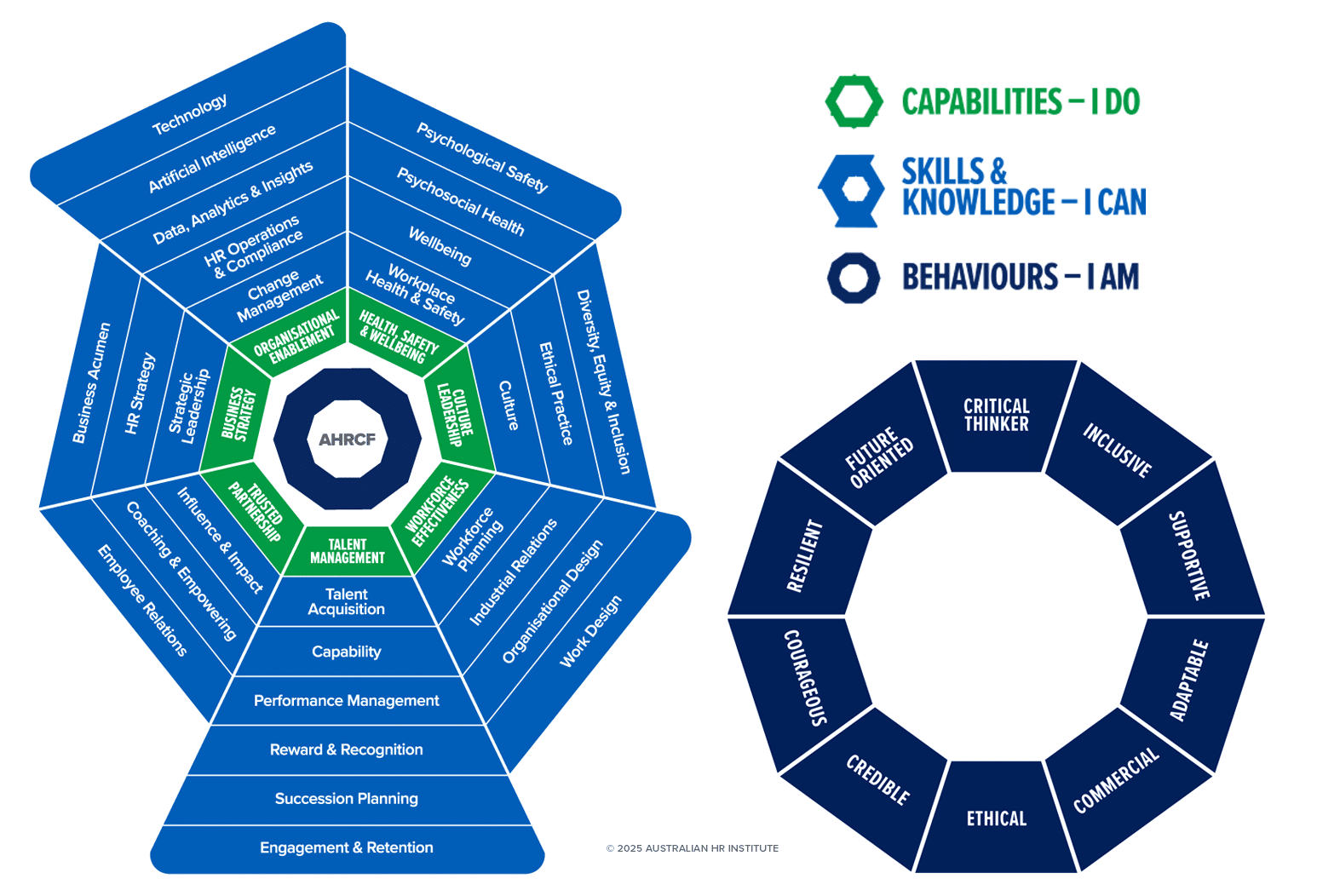
The AHRCF is structured around six capability domains. These domains span the breadth of what an HR professional needs to operate effectively.
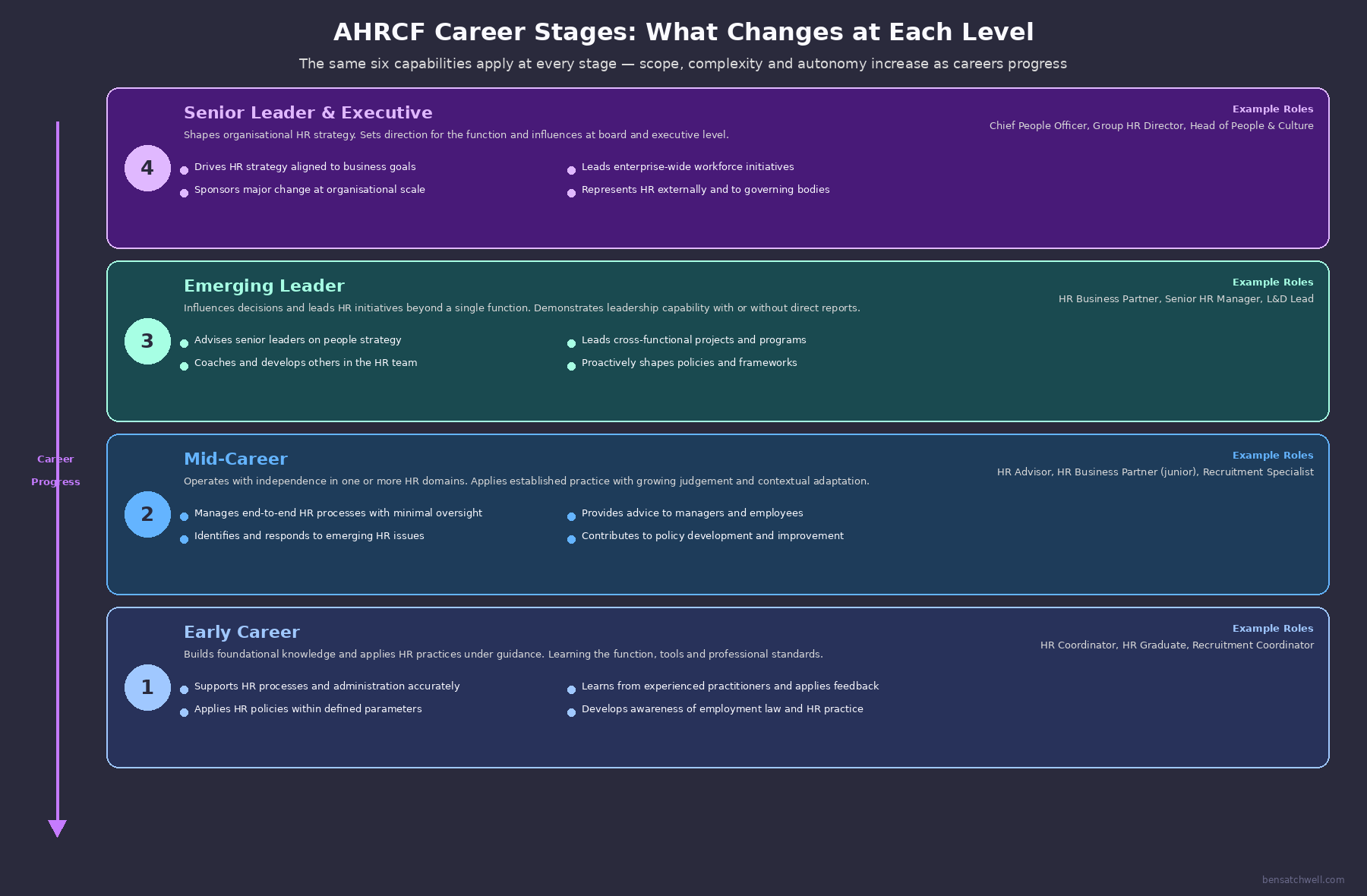
Across each domain, the AHRCF defines four career stages: Emerging, Developing, Experienced, and Senior. Each stage carries its own behavioural expectations and proficiency standards. The shift between stages is characterised by increasing scope, autonomy, and complexity, not simply time in role or seniority title.
The CPHR credential sits at the Experienced and Senior levels. To become certified, a practitioner demonstrates capability against the AHRCF requirements at their stage through a combination of academic qualification, professional experience, and assessment. The framework is the assessment reference point, not an internal employer standard.
In practice, organisations that use the AHRCF typically map it against their internal HR roles to create a competency profile for each HR role. This gives them a bridge between AHRI's profession-level standard and their own role requirements. The mapping process is where most of the design work sits.
What the AHRI Competency Framework Is Not
The AHRCF is not a job description template. It defines capability expectations for the HR profession broadly, not the specific responsibilities or outputs of any particular HR role. Using it as a job description produces something too general to be useful at the role level.
It is also not equivalent to a competency framework for an organisation's wider workforce. The AHRCF applies to HR practitioners specifically. Organisations building a framework that covers all roles and functions need a different structure entirely, one designed from the organisation's strategic context rather than a profession-level standard.
Finally, the AHRCF is not a skills inventory. It does not list individual skills or task-level requirements. It defines capability at a broader level, which means it requires translation into more granular role requirements when used for workforce planning, recruitment, or performance management.
How the AHRI Competency Framework Compares to International Standards
The AHRCF sits alongside similar frameworks from international HR bodies. The CIPD Profession Map, published by the Chartered Institute of Personnel and Development in the UK, uses a comparable structure with core knowledge, core behaviours, and specialist knowledge areas across career stages. The SHRM Body of Applied Skills and Knowledge (BASK), used by the Society for Human Resource Management in the United States, maps HR competencies across similar functional domains. For the US equivalent, see how the SHRM BASK is structured.
The three frameworks differ in their balance of technical and behavioural content, their regional focus, and the credential structures they support. The CIPD Profession Map places significant emphasis on values and ethical practice as a foundational layer running beneath all other content. The SHRM BASK reflects US labour law and a business-partner model of HR delivery. The AHRCF is calibrated for Australian workplace legislation, enterprise bargaining, and the specific HR challenges of Australian organisations.
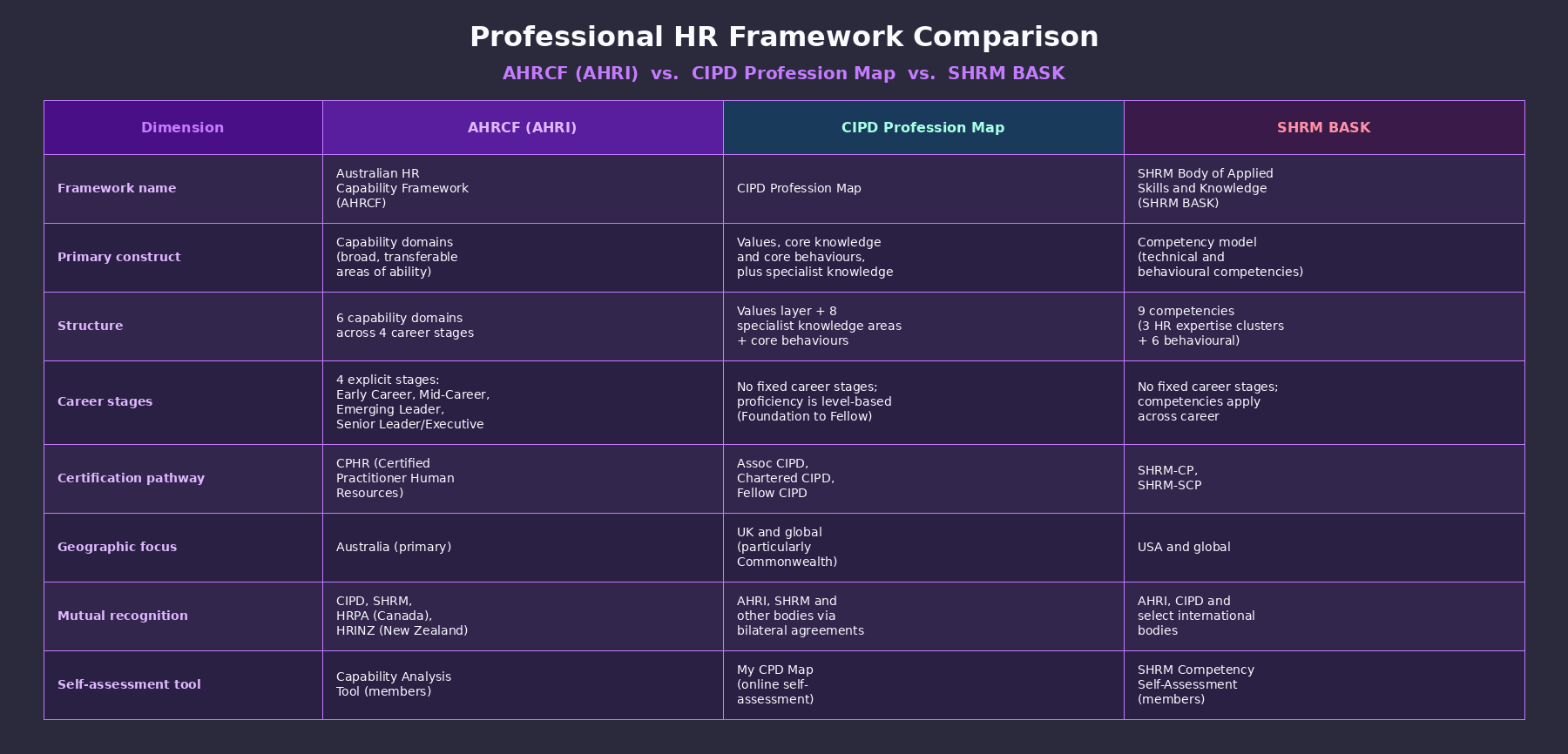
None of these frameworks is universally superior. The right reference point depends on where the organisation operates, which credentials it values, and which professional body its HR practitioners are aligned to. For organisations operating primarily in Australia, the AHRCF is the most contextually appropriate starting point. AHRI and CIPD have mutual recognition arrangements for their credentials, acknowledging significant structural overlap between the two frameworks.
Where the AHRI Competency Framework Commonly Fails
The most common failure I see with the AHRCF is treating it as a complete HR framework for the organisation rather than a profession-level reference standard. Organisations lift the AHRCF directly into their HR capability framework without adapting it to their specific strategic context, industry requirements, or role structure. The result is a framework that looks credible on paper but does not actually reflect what good looks like in that particular organisation.
A second failure is applying it at the wrong level of granularity. The AHRCF works at the profession level. It is not designed to differentiate between an HR Business Partner in a manufacturing business and one in a financial services firm. That work requires additional specification beyond what the AHRCF provides, which means building a skills framework or detailed capability profiles on top of the AHRCF rather than using it as a finished product. To apply these standards to HRBPs, see the HR business partner competency framework.
Third, organisations sometimes treat the AHRCF as a skills taxonomy by pulling individual capability statements out of context. Capability frameworks and skills frameworks serve different purposes and operate at different levels of specificity. Using them interchangeably produces ambiguity in assessment, learning design, and role profiling.
Trade-offs and Constraints
The AHRCF's strength is also its constraint. Its broad capability language gives it longevity and transferability across a diverse HR profession, but it requires significant translation work before it is useful at the role level. Organisations without strong capability framework design expertise often struggle with that translation, which means the framework stays at the conceptual level rather than driving real practice.
The CPHR credential gives the AHRCF credibility as an assessment standard, but it also means the framework is primarily designed around a certification pathway rather than the full range of HR workforce planning needs. Organisations looking for a framework to drive recruitment scoring, performance ratings, or learning pathway design need to build additional layers on top of it.
The AHRI CPHR credential also introduces mutual recognition arrangements with international bodies including CIPD and HRPA (Canada), which is relevant for organisations managing global HR talent pipelines and wanting a portable professional standard across borders.
Frequently Asked Questions About the AHRI Competency Framework
What is the difference between the AHRI competency framework and the Australian HR Capability Framework?
They refer to the same thing. "AHRI competency framework" is the common search term; the Australian HR Capability Framework (AHRCF) is AHRI's official name for it. AHRI uses "capability" deliberately to distinguish it from narrower role-specific competency frameworks.
What are the six domains of the AHRI competency framework?
The AHRCF covers HR Foundations, Business and Commercial Acumen, People and Culture, Leadership and Management, Digital and Data Literacy, and Professional and Ethical Practice. These domains span the full breadth of what an HR professional is expected to develop across their career.
How does the AHRI competency framework relate to the CPHR credential?
The AHRCF is the assessment reference point for the CPHR. To achieve CPHR certification, practitioners must demonstrate capability against the framework at the Experienced or Senior career stage. The framework defines what good looks like; the CPHR process assesses whether a practitioner meets that standard.
What does FCPHR mean?
FCPHR stands for Fellow Chartered Professional in Human Resources, AHRI’s highest membership and credentialling tier. It is awarded to CPHR holders who demonstrate sustained, senior-level application of the AHRI competency framework over an extended career, rather than a one-off assessment.
Can an organisation use the AHRI competency framework for non-HR roles?
No. The AHRCF is specific to the HR profession. Organisations needing a framework for a broader workforce, covering all roles and functions, need to design or adopt a separate capability or competency framework. The AHRCF is a profession-level standard, not an organisation-wide workforce architecture.
How does the AHRI competency framework compare to the CIPD Profession Map?
Both are profession-level capability frameworks for HR practitioners. The CIPD Profession Map reflects UK employment context and regulation; the AHRCF reflects Australian workplace legislation and practice. AHRI and CIPD have mutual recognition arrangements for their credentials, acknowledging the significant structural overlap between the two frameworks.
Is the AHRI competency framework freely available?
AHRI publishes overview information about the AHRCF publicly on its website. Detailed framework documentation is typically accessible to AHRI members or through the CPHR assessment process. The six domains and four career stages are publicly described as part of AHRI's credential information.