
The 9 box grid has been a fixture of corporate talent reviews for decades. It plots employees on a three by three grid against current performance and future potential. In theory it makes succession and development decisions more systematic. In practice it often makes them more confident without making them more accurate. The version that works anchors the performance axis to the competency profile for the role. Without that anchor, the grid is a visual that flatters a subjective conversation. This article is for the HR professional who facilitates the talent review.
What Is a 9 Box Competency Model?
A 9 box competency model is a talent review tool that places employees on a three by three grid using two dimensions: current performance, assessed against the competencies for their role, and future potential, rated against explicit organisational criteria. The competencies and required levels for the role are the competency profile, selected from the organisation's competency framework.
Performance here is not a rating number. It is the degree to which a person demonstrates the competencies their role requires, at the required level. That needs a profile to exist and to have been applied consistently across the cohort. Without one, performance on the grid defaults to impression. Potential is the projected capacity to perform at greater scope, complexity or seniority. Most organisations assess it across several dimensions, such as learning agility, leadership appetite and strategic thinking, and some add an explicit factor for alignment with the direction of the business.
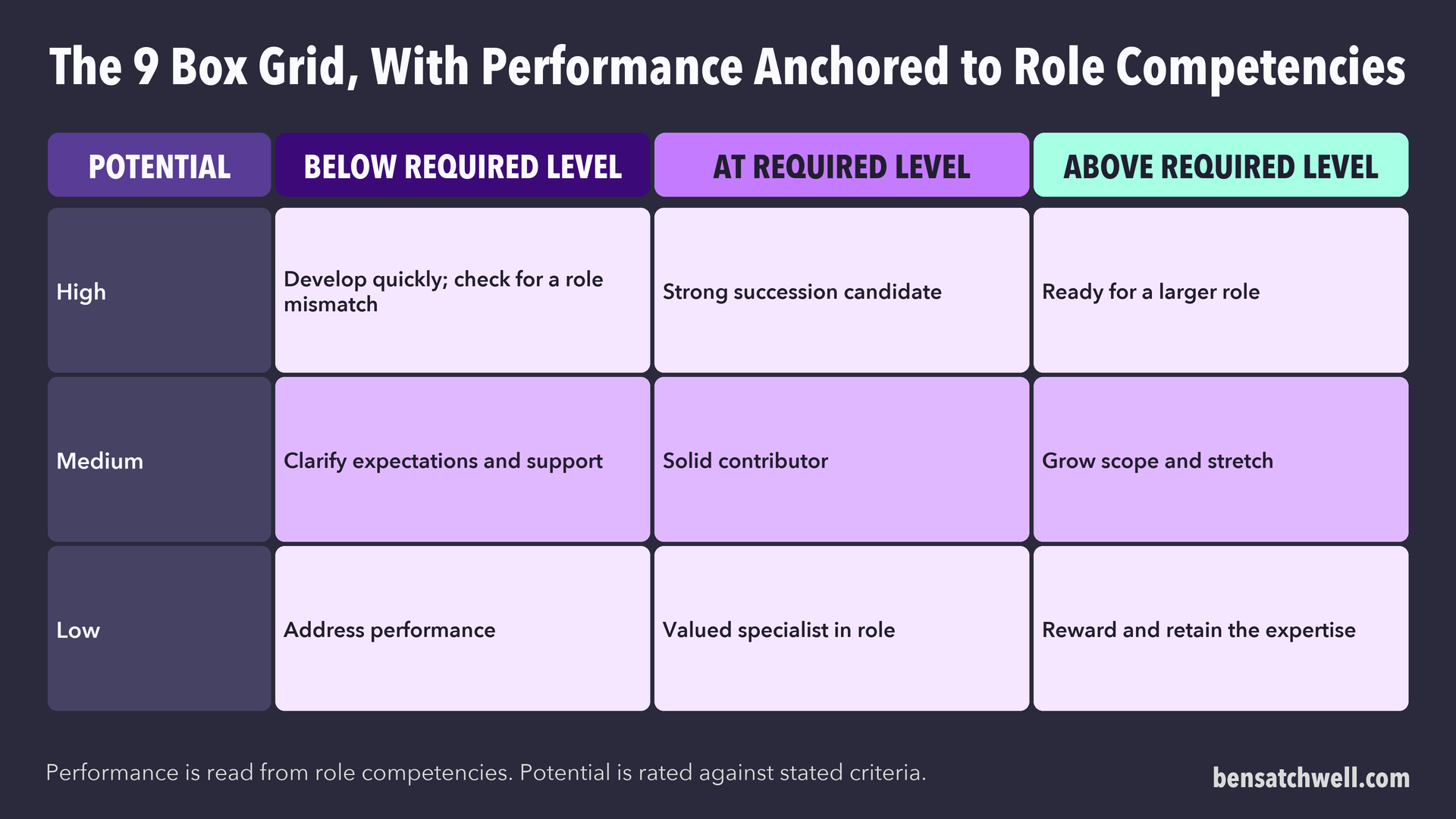
Performance is read from role competencies. Potential is rated against stated criteria.
A note on terminology. A competency framework is also called a competency model, especially in the United States. I use competency profile for the competencies and required levels for one role, and competency matrix for the grid of required against current proficiency. Usage varies by region, and I explain the differences in this competency model definition.
Why Anchor the Grid to Competencies
Organisations have always needed to tell talent apart. The problem with informal differentiation is that it encodes bias. When managers assess performance without defined competencies, they assess against themselves or an undeclared norm. The anchor does two jobs. It sets a common standard across managers and business units, so a strong performer in one function means the same as in another. It also gives an assessment that can be explained to employees and defended in a development conversation.
Succession planning without that anchor produces lists, not insight. An anchored grid produces a talent picture: who performs well now and why, who could take on more and what that potential looks like, and where the organisation is fragile.
How a Review Runs

The grid is an input to talent decisions, not the decision.
Confirm the profile
The profile must already exist and be relevant to the role. If you are assessing a cohort of HR business partners, rate them against the competencies for that role. Many implementations break here: the profile was built for one purpose and then applied to another. A HR competency model built for development is not automatically fit to anchor a talent review.
Rate performance and potential separately
Performance ratings come from direct observation and evidence, checked across managers to reduce variation. Potential is rated separately, usually in calibration sessions where managers discuss evidence of each person's demonstrated capacity for broader scope. Many organisations use a role-specific profile for the performance axis and a broader leadership profile for potential, because performance is tied to the current role while potential looks forward. A sales competency framework gives a far more precise performance baseline for commercial roles than a generic leadership list.
Calibrate and decide
The completed grid is reviewed in a calibration session, usually at function or executive level. The output is a set of talent decisions: who enters the succession pool for which roles, who receives which development investment and where the organisation carries risk if key roles fall vacant.
What the 9 Box Is Not
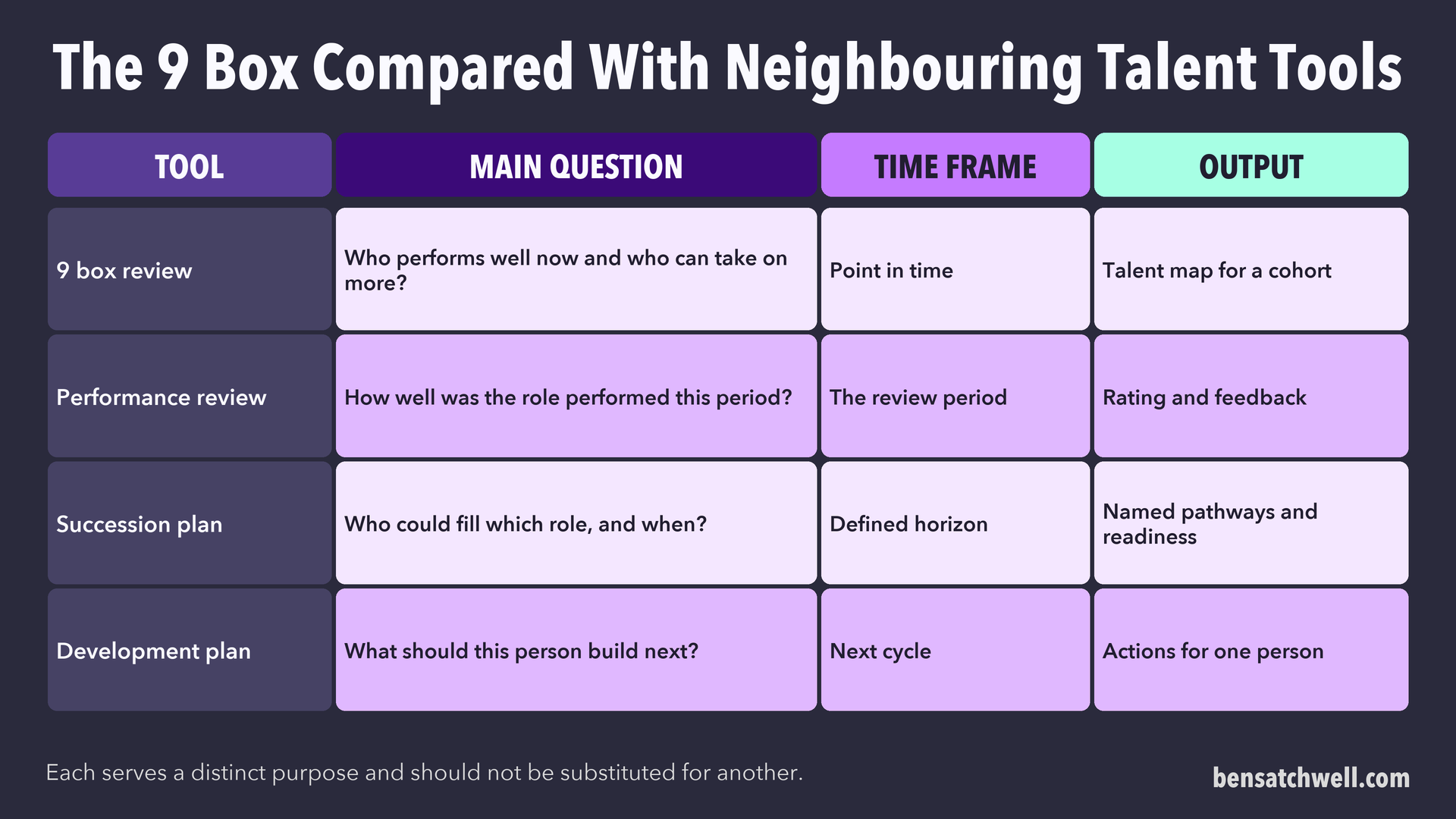
Each serves a distinct purpose and should not be substituted for another.
- Not a performance management system. It is a talent review tool. It draws on performance data but does not replace a process with ongoing feedback, goals and formal review.
- Not a succession plan. Placing someone in the high performance, high potential box puts them in consideration. A succession plan names the role, the timeframe and the readiness criteria.
- Not an HR tool for HR use. HR designs and facilitates the process, makes sure the profile is applied consistently and challenges calibration where bias appears. The conclusions belong to the business.
- Not permanent. A position on the grid reflects one point in time. Update it regularly instead of treating an earlier assessment as fixed.
Standards and References
The CIPD's succession planning factsheet is a sound starting point for the wider talent process the grid sits inside. For technology roles, the SFIA framework offers an externally maintained set of skills and levels that can supply the performance axis. Narrow role-level profiles, such as those for Scrum Master competencies, show how a tight profile sharpens assessment on that axis.
Common Failure Modes
- Skipping the profile. Managers rate against an implicit standard, so the grid reflects each manager's view and not a calibrated picture.
- Treating potential as fixed. Potential is contextual. Locking someone into a cell and leaving them there is worse than not doing the exercise.
- Using the grid directly in development conversations. Most organisations keep it confidential. Raising it without context creates confusion and can damage trust. The output should inform decisions. The individual conversation needs more nuance.
- Doing nothing with the output. A review that leads to no succession, investment or risk decisions is a map with no destination.
Trade-Offs and Constraints
The grid works well where role profiles are already in place, calibration happens regularly and managers can have honest conversations about relative performance and potential. It works poorly where profiles are absent or inconsistently applied, where the culture avoids differentiation or where HR lacks the credibility to facilitate honest calibration. In those settings the grid clusters everyone in the middle and has no discriminating value.
Scale matters too. It is designed for a defined cohort, such as high-potential pools, leadership pipelines or specific job families. Applying it across a whole organisation creates an administrative burden that outweighs the value and thins the quality of each session. It also needs psychological safety. If managers believe a low potential rating will disadvantage someone permanently, they will not rate honestly, so sessions must be diagnostic rather than punitive. For the wider context of terms, see the competency guide.
FAQ
What is the difference between the 9 box and a competency framework?
The framework is the organisation-wide system that defines competencies, levels and indicators. The 9 box is a talent review process that uses a role-level competency profile drawn from it to assess current performance.
Who should be included in a 9 box review?
Defined populations such as senior leaders, high-potential cohorts or specific job families. A whole-workforce review is resource-heavy and lowers calibration quality.
How often should it be updated?
Most organisations run it annually, often aligned with the performance cycle. Some add a mid-year review for succession-critical roles.
Can you run a 9 box without a competency framework?
You can, but quality drops. Without a defined profile for the roles reviewed, the performance axis defaults to managerial impression. Build the profile first.
Is the 9 box still relevant in a skills-based organisation?
Yes. The vocabulary has changed, but the need to identify who performs well now and who can take on more remains. An anchored grid is still a practical tool for that conversation.
What is a 9 box competency model?
A talent review tool that plots performance against role competencies and potential against stated criteria on a three by three grid.