
Project managers are routinely hired for their domain expertise and assessed on whether projects were delivered on time. Neither tells you whether someone can manage projects well. The first confuses familiarity with a sector for the ability to lead work within it. The second confuses outcomes with capability, when outcomes depend on conditions the project manager often does not control. A project management competency model answers a different question: what does a person need to do, and at what level, to manage projects well? This article is for the HR professional building that standard.
What Is a Project Management Competency Model?
A project management competency model defines the observable competencies required to perform the project manager role effectively, expressed at proficiency levels and applicable across the project lifecycle. I call the selection for a role a competency profile, drawn from the organisation's competency framework. It is not a list of techniques. It describes how a competent project manager thinks, behaves, communicates and decides, in terms that can be assessed. It moves talent decisions away from credential-checking and tenure toward demonstrated competence.
Most well-designed profiles organise project management competence into three domains: technical project management, leadership and interpersonal competence, and business or strategic competence. The balance shifts with seniority. Junior project managers are mainly assessed on the technical domain, while senior ones are expected to work across all three.
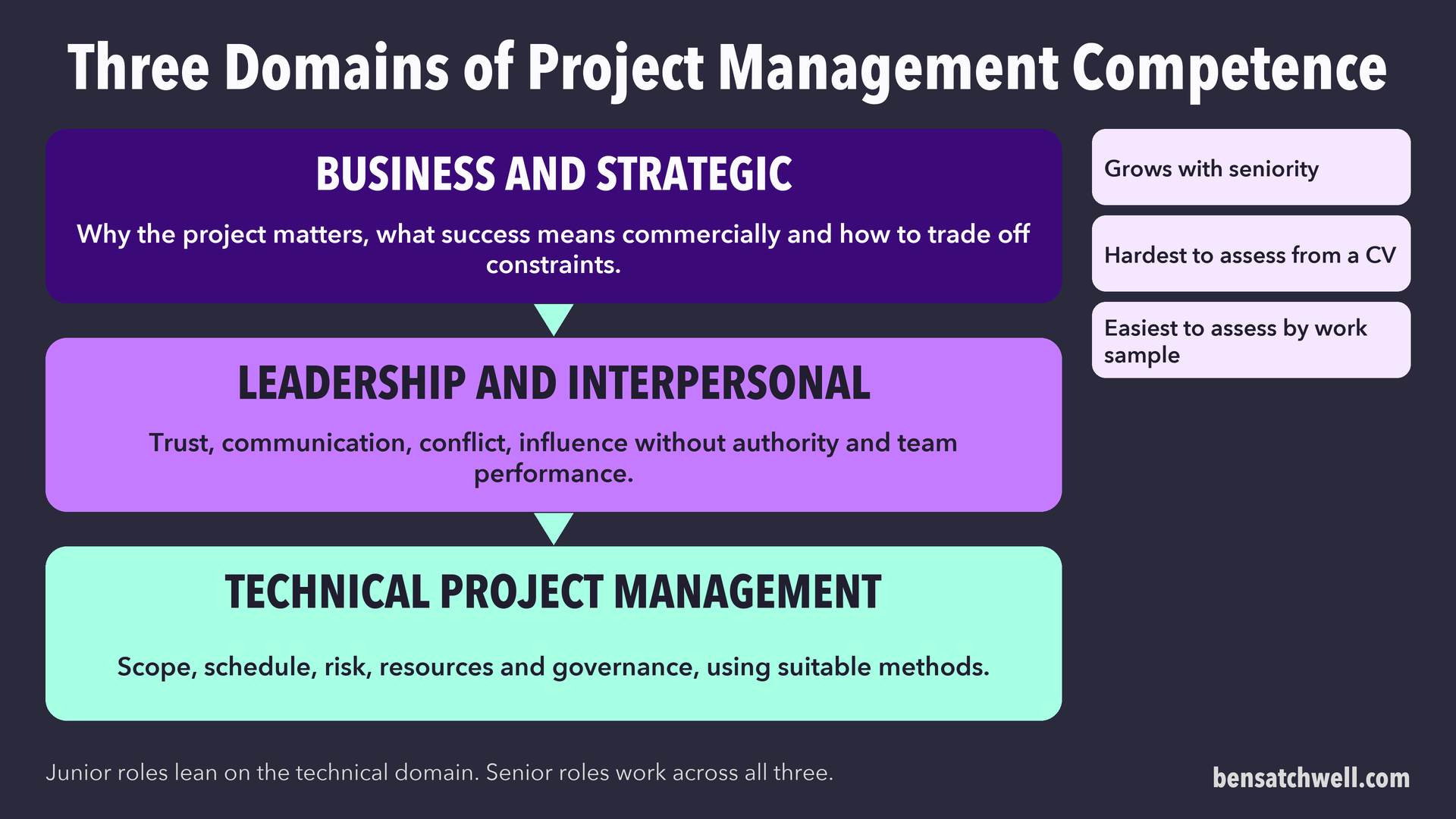
Junior roles lean on the technical domain. Senior roles work across all three.
A note on terminology. A competency framework is also called a competency model, especially in the United States. I use competency profile for the competencies and required levels for one role, and competency matrix for the grid of required against current proficiency. Usage varies by region, and I explain the differences in this competency model definition.
Why Organisations Need One
The core problem is inconsistency. Project management competence varies widely across individuals and teams, often without anyone being able to say why or where the gaps are. Without a profile, organisations hire on certifications and past project exposure. Neither predicts performance reliably. A PMP credential shows that someone has studied PMI's body of knowledge. It does not show that they can lead a difficult project through ambiguity, manage a fractious stakeholder group or decide well with incomplete information.
A paper on a project management competency framework is one place to see why a defined standard matters. A profile gives a common standard, makes expectations assessable and ties development to real performance gaps instead of generic interventions.
The Three Domains in Practice
Technical project management
Planning, monitoring and controlling projects with suitable methods and tools: scope, schedule, risk, resources and governance. This is the most concrete domain and the easiest to assess through work samples or scenario-based interviews.
Leadership and interpersonal
Building trust, communicating across audiences, managing conflict, influencing without authority and keeping team performance up under pressure. These are harder to see in a credential or interview and are better observed through structured behavioural interviewing and 360-degree feedback. My guide to defining behaviours shows how to write observable indicators.
Business and strategic
Placing the project in its organisational and strategic context: why it matters, what success looks like commercially and how to trade off project constraints against wider goals. Profiles designed mainly for technical project management often leave this domain underdeveloped.
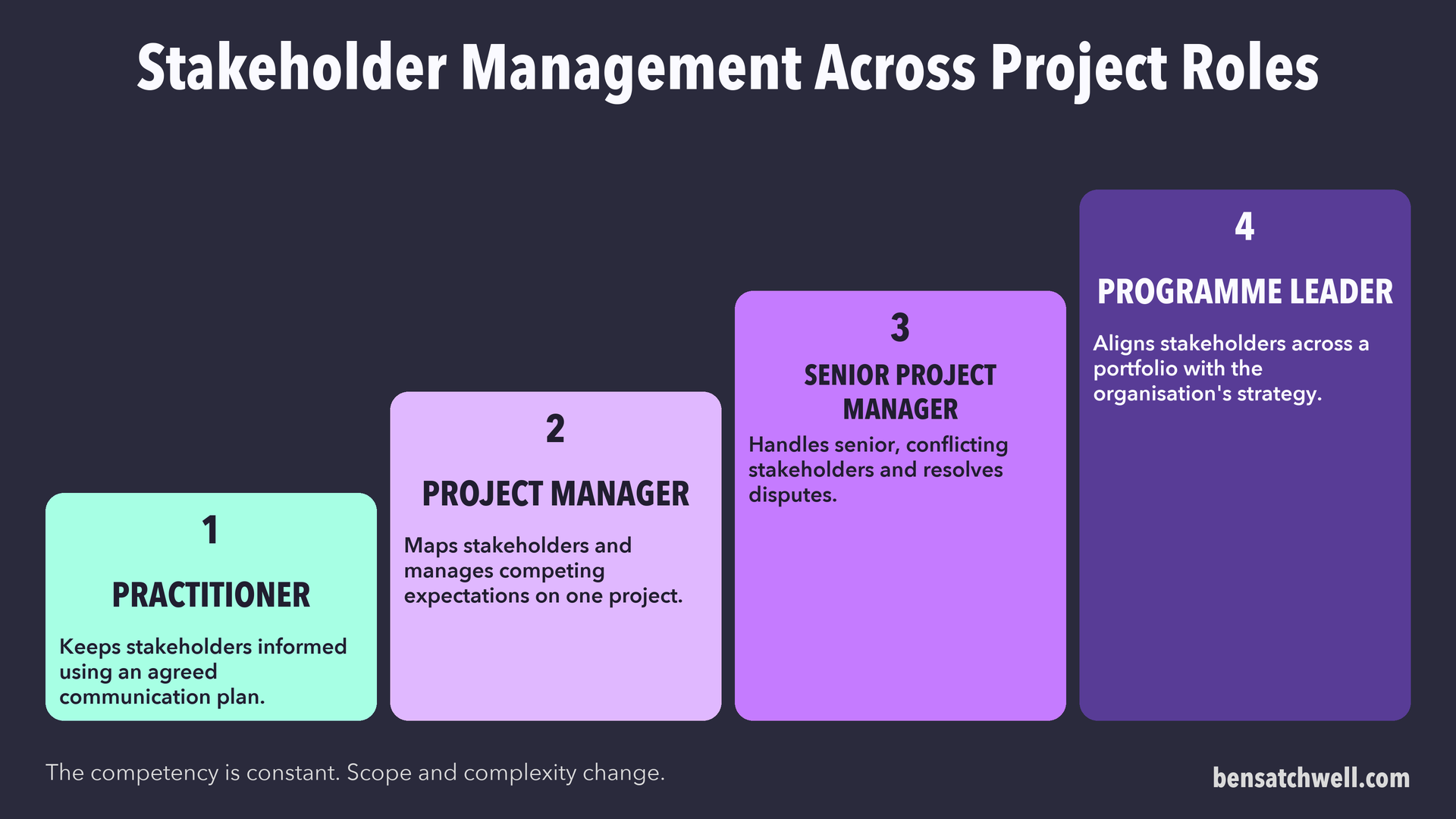
The competency is constant. Scope and complexity change.
What a Project Profile Is Not
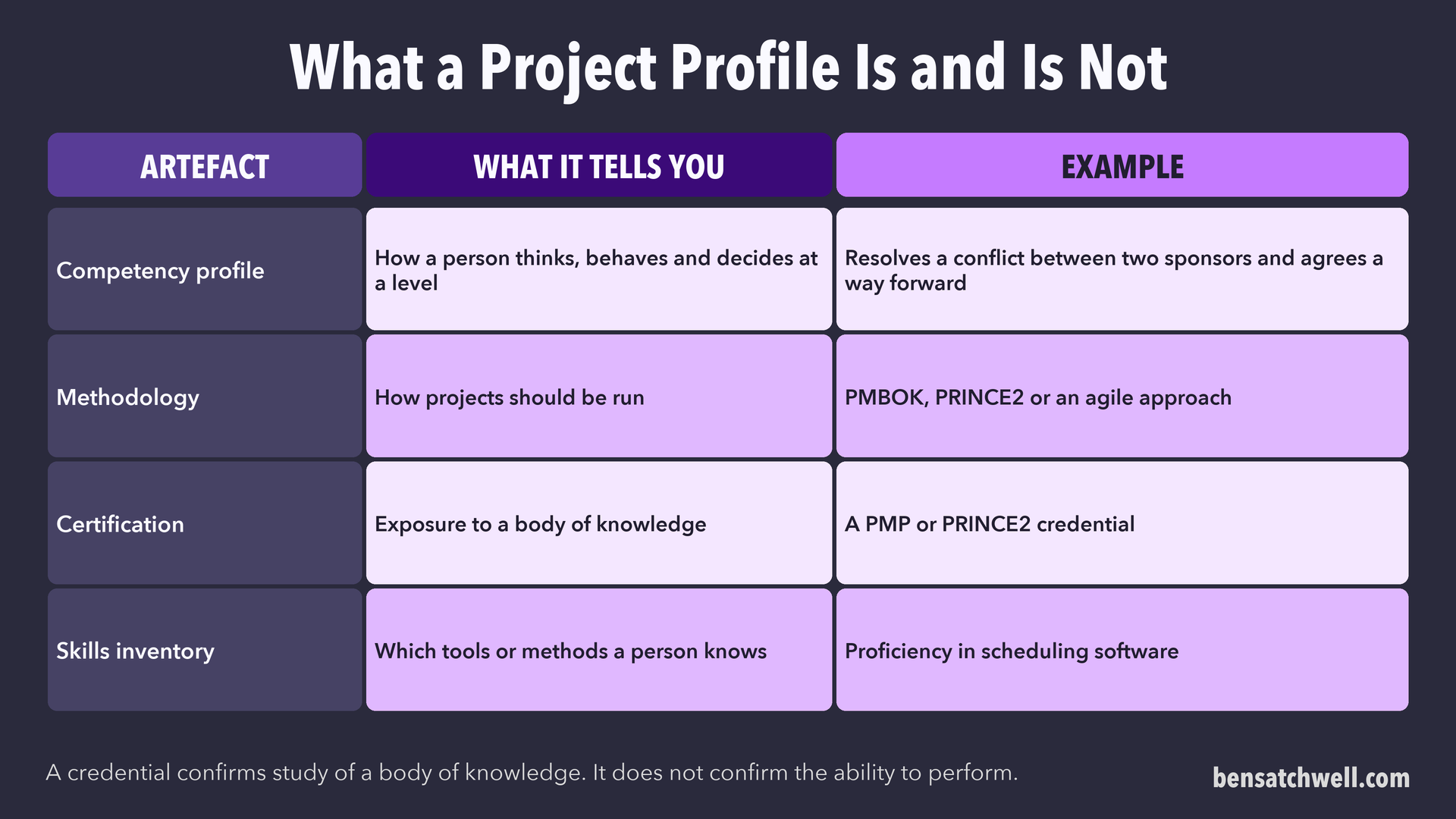
A credential confirms study of a body of knowledge. It does not confirm the ability to perform.
- Not a methodology. PMBOK, PRINCE2 and agile approaches describe how projects should be run. The profile describes what a person needs to do to run them well. Confuse the two and you describe process adherence, not competence.
- Not a skills inventory. An inventory records whether someone has a technical ability, such as scheduling software. The profile describes how they apply it, the judgements they make and the quality of their thinking.
- Not a role description. A role description sets accountabilities. The profile describes the behaviours needed to discharge them.
- Not a leadership profile. A leadership competency model describes what is needed to lead organisations or functions. Project work has distinct demands that a generic leadership set will not capture.
Named Standards
Two standards dominate. The PMI Project Manager Competency Development Framework organises competence into knowledge, performance and personal competence, and is used widely where PMI standards are the main reference. The IPMA Individual Competence Baseline, ICB 4, organises competence into perspective, people and practice, and is widely used in European and public sector settings. Both are meant to be adapted, not adopted whole. They differ in orientation, one more process-centred and the other more behavioural, but they reach a broadly similar architecture of technical, interpersonal and contextual competence. Organisations choosing between them are choosing an emphasis, not a different view of what project management requires.
Common Failure Modes
- Too technical. Project management grew from engineering and construction, where technical rigour was the main differentiator. In most contemporary projects, the limiting factor is interpersonal and strategic competence.
- One project type only. A profile built for waterfall programmes will not describe good in an agile setting, and one built for capital construction will miss the demands of transformation work. State which contexts it covers.
- Certification as a proxy. Hiring or promoting on a credential alone substitutes a credential for a judgement you have to make directly.
Trade-Offs and Constraints
A profile for all project types is accurate at an abstract level and may feel generic in any one setting. One calibrated to a project type is accurate for that population and needs adaptation elsewhere. That is why project management profile design belongs inside your wider capability framework design and should stay consistent with it. There is also a real tension between agile and waterfall traditions. Rapid adaptation, continuous prioritisation and collaborative decisions carry more weight in a sprint-based environment than in a structured programme with formal gates, so organisations working across both need a profile that says so explicitly.
FAQ
What is a project management competency model?
A set of competencies and proficiency levels, with observable indicators, that define what a project manager needs to do to manage projects effectively. It is used for hiring, assessment and development.
What are the main domains?
Technical project management, leadership and interpersonal competence, and business or strategic competence.
What is the difference between PMI's framework and IPMA's ICB?
Both cover similar ground and weight it differently. PMI's is more process-oriented and aligned with the PMBOK Guide. IPMA's ICB 4 is more behavioural and more widely used in Europe and the public sector.
Can it be used for recruitment?
Yes. Structured behavioural interviews built around the profile give better hiring decisions than unstructured ones or credential checking.
Does it apply to agile roles?
Yes, with adaptation. Agile work puts more weight on adaptive planning, collaborative decisions and continuous improvement, which a waterfall-only profile would underweight.
How often should it be reviewed?
Every two to three years in a stable environment, sooner if the delivery method changes, such as a shift from waterfall to agile.
What is the difference between a competency model and a competency framework?
There is no difference in structure. Competency model is the usual US name and competency framework is more common in the UK and Australia. The competencies and levels for one role are a competency profile.