
Most organisations have a view on what good management looks like. Very few have written it down in terms that can be applied consistently. The result is a familiar cycle: managers are hired for technical expertise, assessed on output and developed only when something goes wrong. A management competency model is the missing piece. It defines the behaviours, knowledge and judgement that separate effective managers from ineffective ones and gives HR a shared, assessable standard for each level of the management pipeline. This article sets out the competencies themselves and how they change from first-line manager to director.
What Is a Management Competency Model?
A management competency model is a role-level selection of competencies, drawn from the organisation's competency framework, that describes what effective management performance looks like in observable terms. I call it a management competency profile. It is expressed as behavioural indicators at each proficiency level, so it can be used consistently for hiring, performance assessment, promotion decisions and development planning.
It distinguishes the competencies needed at different management levels. First-line manager competencies look different from senior manager or director competencies, even when the broad categories match. A profile that treats all managers as equivalent is too abstract at every level to be useful. Management profiles also sit beside leadership competency models without being the same. Management profiles focus on team and function: directing work, developing people, making operational decisions and managing performance. Leadership profiles focus on strategic orientation, organisational influence and the external side of the role.
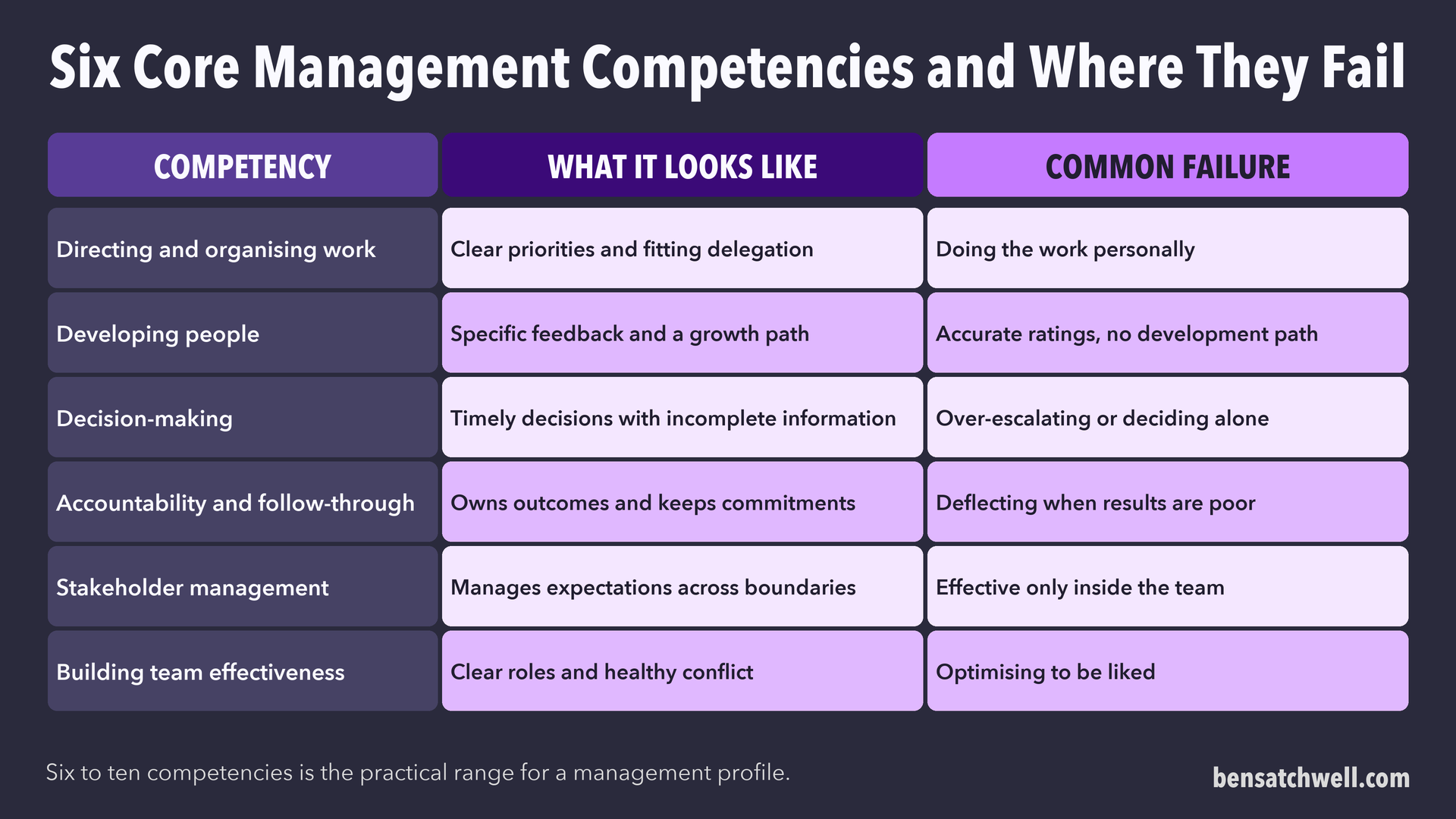
Six to ten competencies is the practical range for a management profile.
A note on terminology. A competency framework is also called a competency model, especially in the United States. I use competency profile for the competencies and required levels for one role, and competency matrix for the grid of required against current proficiency. Usage varies by region, and I explain the differences in this competency model definition.
Why Management Needs a Defined Standard
Without one, management quality is largely luck. Some managers are naturally effective. Most need development, and many get none because there is no shared standard to show what they need. Without a profile, an organisation cannot see which managers fall short on which dimensions, cannot design targeted development and cannot calibrate promotions against one standard. A paper on developing a managerial competency model is one place to see how such standards are built.
The CIPD's guidance on competency frameworks stresses that these tools work best when built into the full range of HR processes and not used as a standalone assessment. That integration is what turns a document into a standard.
The Core Management Competencies
Directing and organising work
Clarifying priorities, allocating work, setting clear expectations and keeping the team focused on the right things. Effective managers separate urgency from importance and delegate instead of doing the work themselves. This is where strong individual contributors most often fail after promotion, because the instinct to do the work personally does not disappear with the title.
Developing people
Assessing each person's capability and development needs, giving specific and constructive feedback and creating the conditions for growth. It includes both day-to-day coaching and structured development conversations. A manager who rates performance accurately but cannot articulate a development path has only half the competency.
Decision-making
Making timely, sound decisions with incomplete information, and knowing when to decide quickly, when to gather input, when to escalate and when to let the team decide. Poor management decisions usually take one of two forms: excessive caution and escalation of decisions that belong at team level, or overconfident unilateral decisions that needed wider input.
Accountability and follow-through
Taking responsibility for team outcomes, keeping commitments and holding team members to agreed standards. It means not deflecting when results are poor, being open about what went wrong and making the adjustments needed. It is closely tied to psychological safety. Managers who hold themselves accountable are more likely to build teams where people raise problems early.
Stakeholder management and communication
Representing the team's work, managing expectations across the organisation, adapting communication to different audiences and building productive relationships with peers, senior stakeholders and other functions. A manager who is effective inside the team but cannot work across boundaries limits what the team can get done.
Building team effectiveness
Creating the conditions for team performance: clear roles, productive norms for conflict, shared accountability and an environment where people can do their best work. That is not the same as being liked, and managers who optimise for being liked often undermine the conditions that produce performance.
How the Competencies Change by Level

Front-line and senior managers need different descriptors, even with the same competencies.
The competencies stay the same across levels. What changes is scope, complexity and autonomy. My guide to defining behaviours shows how to write indicators that tell levels apart.
What a Management Profile Is Not
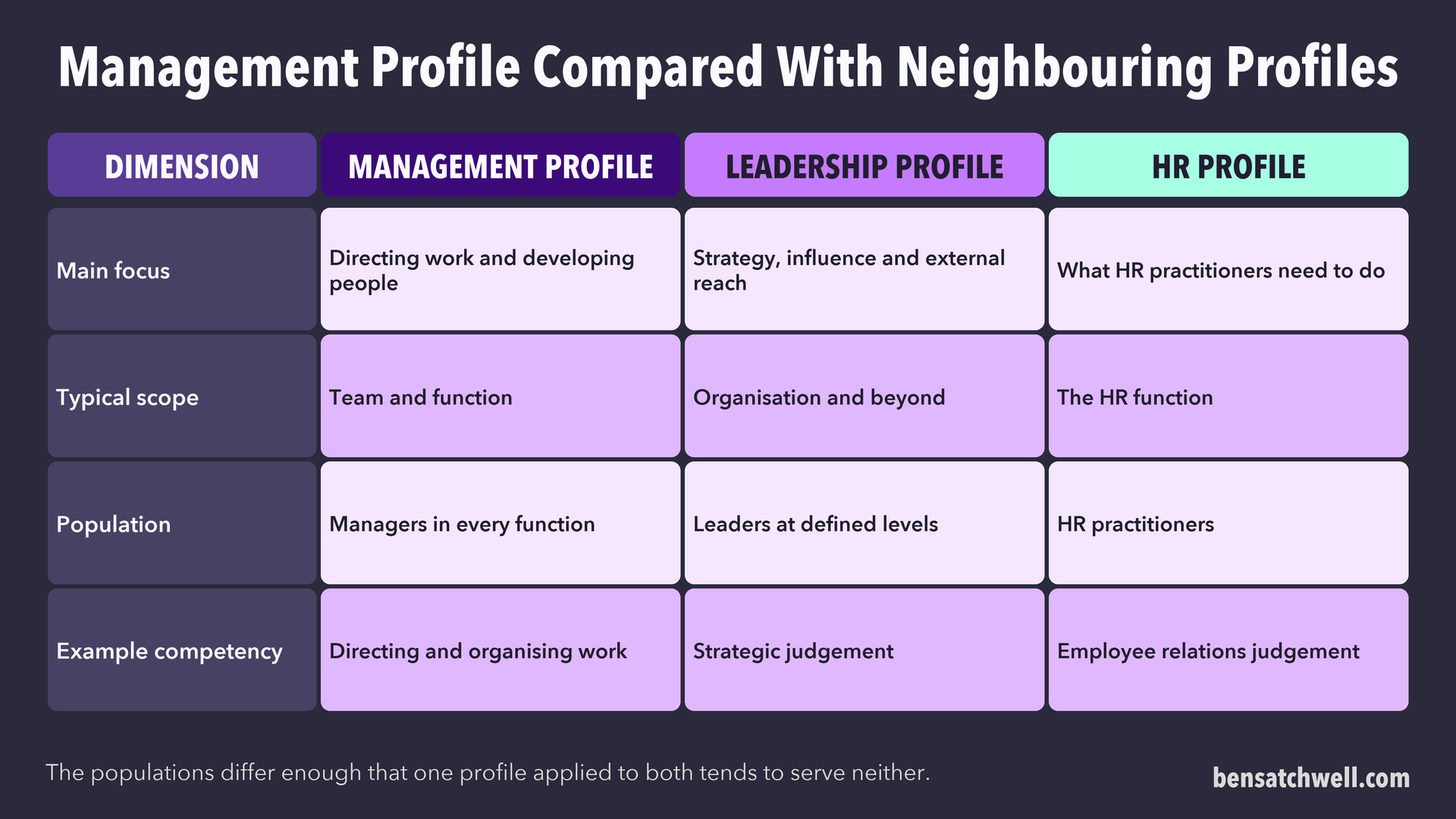
The populations differ enough that one profile applied to both tends to serve neither.
- Not a list of activities. Running team meetings, completing reviews and approving leave are activities. The profile describes the behaviours that make them effective or ineffective.
- Not a personality profile. Introversion and extroversion are not management competencies. The profile describes what someone does, not who they are.
- Not an HR competency set. HR sets describe what HR practitioners need to do. A management profile describes what managers in every function need to do.
- Not a development programme outline. The profile says what is required. A programme is how people build it. Conflating them gives a structure shaped like a curriculum, not a standard.
Named Sources
The Korn Ferry Leadership Architect, which grew out of the Lominger library, is the most widely referenced commercial source and is organised around four factors: Thought, Results, People and Self. It offers behavioural indicators at several levels, and its depth is also its complexity, so it takes real implementation investment. DDI's leadership work differentiates what leaders must do for their direct team, across their function and for the wider organisation, which suits a profile that scales from first-line management to executive. The CIPD's people management standards give a UK and Australian reference point for management behaviour. Treat each as a library to select from. For the framework underneath, see the competency framework guide.
Common Failure Modes
- A communication exercise, not a standard. Polished documents not linked to performance processes are not used.
- Aspirational management. Competencies needing wisdom or maturity that most current managers lack demoralise people instead of developing them.
- One profile for all managers. Front-line and senior managers need different descriptors. A single set fits almost nobody precisely.
Trade-Offs and Constraints
Management profiles need ongoing maintenance, because the behaviours that distinguish effective management change with the organisation. Remote and distributed work, for example, changed what effective communication and team building require. There is also a choice between an established source and a custom build. Established sources give a rigorous foundation and save design time, while custom builds fit the organisation more precisely. Most land between the two by adapting a published source. Finally, a profile is only as good as the people applying it. Managers who cannot assess behaviour accurately will produce inconsistent results however good the design, so calibration and assessor preparation are not optional.
FAQ
How many competencies should a management profile include?
Six to ten. Fewer misses important dimensions. More makes it too complex for managers and their teams to engage with.
Should management and leadership profiles be separate?
In most organisations, yes. Management focuses on directing work, developing people and operational accountability. Leadership focuses on strategy, influence and external reach. One profile applied to both tends to serve neither.
How do management profiles differ across industries?
The core competencies are broadly consistent, but the standards and context vary. Validate the profile against the setting where it will be used. Commercial functions often need a sales-specific extension.
How are management competencies assessed?
Typically through structured behavioural interviews, 360-degree feedback and direct observation. Self-assessment alone is unreliable, because managers tend to over-rate themselves on the competencies they value most.
Can a management profile be used for recruitment?
Yes, and it is one of the highest-value uses. Structured behavioural interviews built around the profile give better hiring decisions than unstructured ones, particularly for first-time managers.
What is the difference between a management competency model and a framework?
There is no difference in structure. Competency model is the usual US name and competency framework is more common in the UK and Australia. The competencies and levels for management roles are a competency profile.