
Most organisations that have invested in diversity, equity and inclusion have done so through programs, initiatives and declarations of intent. Far fewer have defined what DEI looks like as behaviour that employees, managers and leaders are expected to demonstrate. A DEI competency model is the instrument that moves DEI from aspiration to expectation. Without one, DEI stays a value that people can endorse without anyone being able to say whether it shows up in how they work. This article sets out the competencies and how they scale by level, for the HR professional who has to build them into real processes.
What Is a DEI Competency Model?
A DEI competency model is a set of diversity, equity and inclusion competencies expected of the workforce, expressed at proficiency levels that reflect the different expectations of individual contributors, managers and senior leaders. I call the selection of DEI competencies and required levels for a role a competency profile. It describes what DEI looks like in real work situations, not what the organisation believes about DEI as a value.
A competency is different from a value. We value diversity states an intent. Seeks diverse perspectives before deciding, challenges assumptions when one view dominates and advocates for equitable processes when gaps appear is a behavioural competency with an indicator. A well-designed DEI profile holds three to six core competencies with specific indicators at each level. It separates what is expected of anyone in a role, what is added for people managers and what is added for senior leaders with organisational influence.
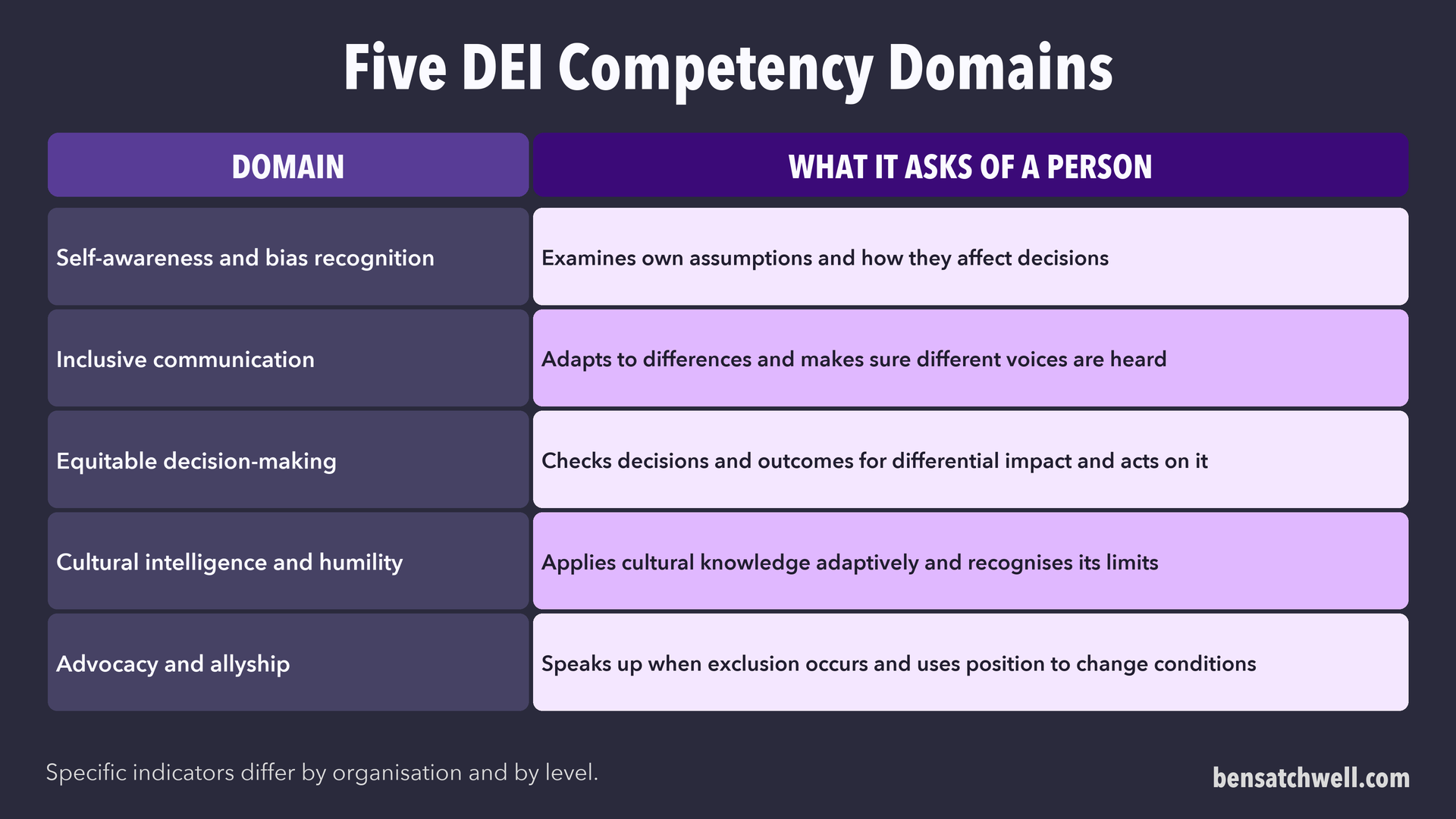
Specific indicators differ by organisation and by level.
A note on terminology. A competency framework is also called a competency model, especially in the United States. I use competency profile for the competencies and required levels for one role, and competency matrix for the grid of required against current proficiency. Usage varies by region, and I explain the differences in this competency model definition.
Why DEI Needs Competencies
The problem the profile solves is ambiguity. When DEI is defined at the level of values or intent, there is no basis for assessing whether the workforce is demonstrating the behaviours that lead to more equitable and inclusive outcomes. Recruitment decisions stay open to unexamined bias, performance conversations avoid DEI as a dimension and development has nothing specific to target.
A paper on diversity, equity and inclusion competencies across the learning continuum in medicine argues that turning commitment into defined competency expectations is a precondition for embedding DEI in an organisation's systems instead of running it as a parallel initiative. Competencies make DEI discussable, assessable and developable in the same way as other professional capabilities. They also create accountability. When DEI behaviours are defined at levels and built into performance assessment, they become part of how people are evaluated and not an optional extra.
Core DEI Competency Domains
- Self-awareness and bias recognition: recognising and examining one's own assumptions, biases and cultural reference points and how they affect decisions. At foundation level this is a willingness to examine one's own view. At advanced levels it means actively identifying and reducing sources of bias.
- Inclusive communication: communicating in ways that respect diverse perspectives, adapting across cultural and interpersonal differences and making sure different voices are heard. For managers it extends to structuring team interactions for equitable participation.
- Equitable decision-making: examining decisions, processes and outcomes for differential impact across groups and acting where inequitable patterns appear. This is not treating everyone the same. Equity means attending to different starting conditions.
- Cultural intelligence and humility: working effectively across cultural differences, approaching unfamiliar contexts with curiosity and recognising the limits of one's own cultural knowledge. It is not the same as cultural awareness, because it requires applying knowledge adaptively.
- Advocacy and allyship: supporting colleagues from under-represented groups, speaking up when exclusion occurs and using position to create fairer conditions. At senior level it extends to structural advocacy, changing systems and policies rather than responding only to individual incidents.
How the Levels Differ
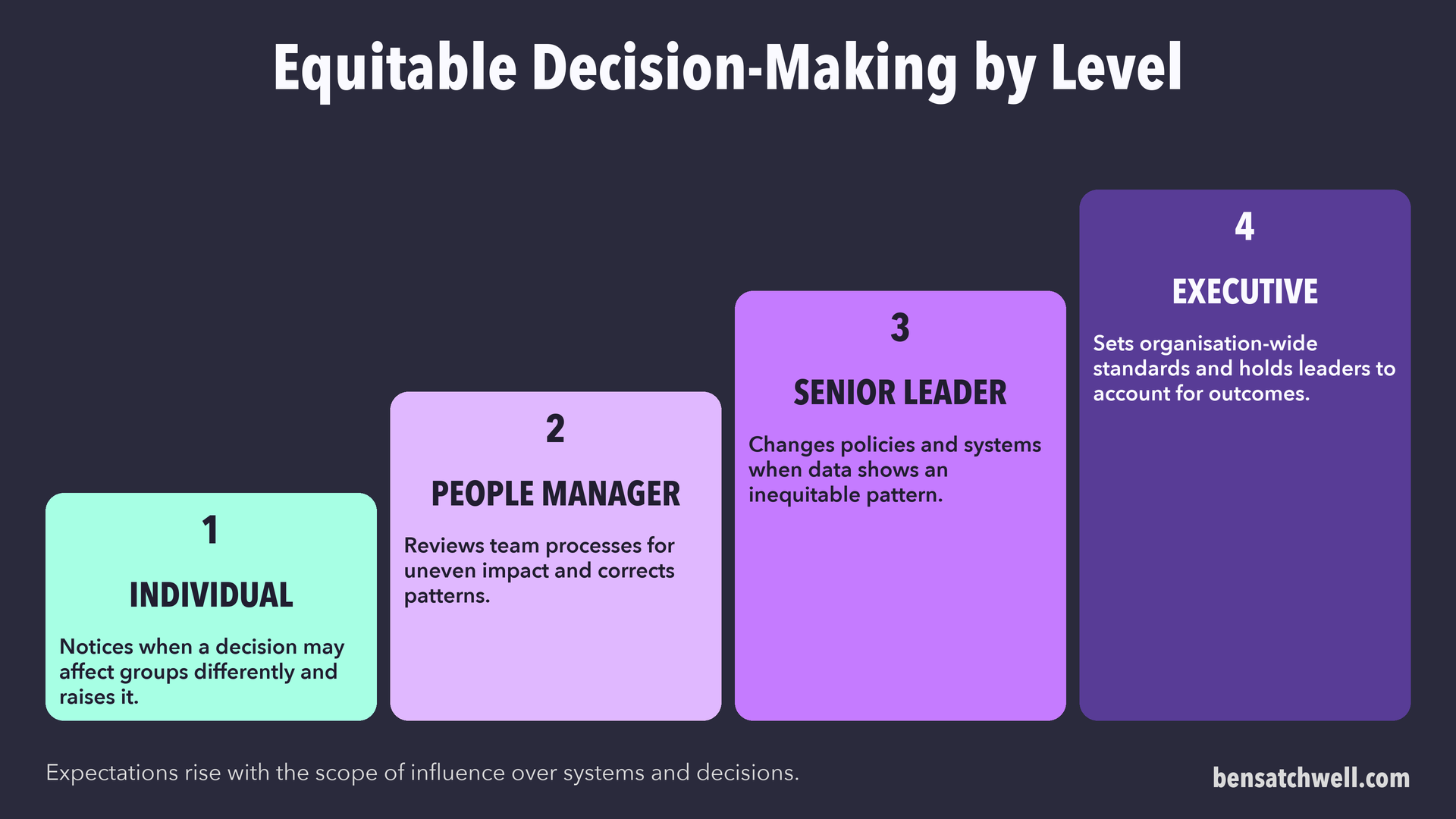
Expectations rise with the scope of influence over systems and decisions.
Individuals are assessed on their own behaviour in their immediate environment. People managers are also assessed on how they create inclusive team conditions and address inequitable patterns. Senior leaders are assessed on how they shape systems, policies and culture. Applying one expectation uniformly ignores that senior leaders carry far more responsibility for DEI outcomes than individual contributors. Three to five levels is a workable range, each with its own indicators.
Putting It to Work
The profile has most impact when it is built into existing HR processes and not run as a standalone construct. In practice that means DEI competencies as explicit criteria in leadership recruitment, DEI indicators in performance reviews, development plans that name specific gaps and succession planning that treats DEI competence as a readiness factor beside technical and strategic ability. In my experience, leadership competency models that include DEI as an explicit domain produce more sustained change than those that treat it as a separate strand, because it is assessed as part of how leaders are expected to perform.
What the DEI Profile Is Not
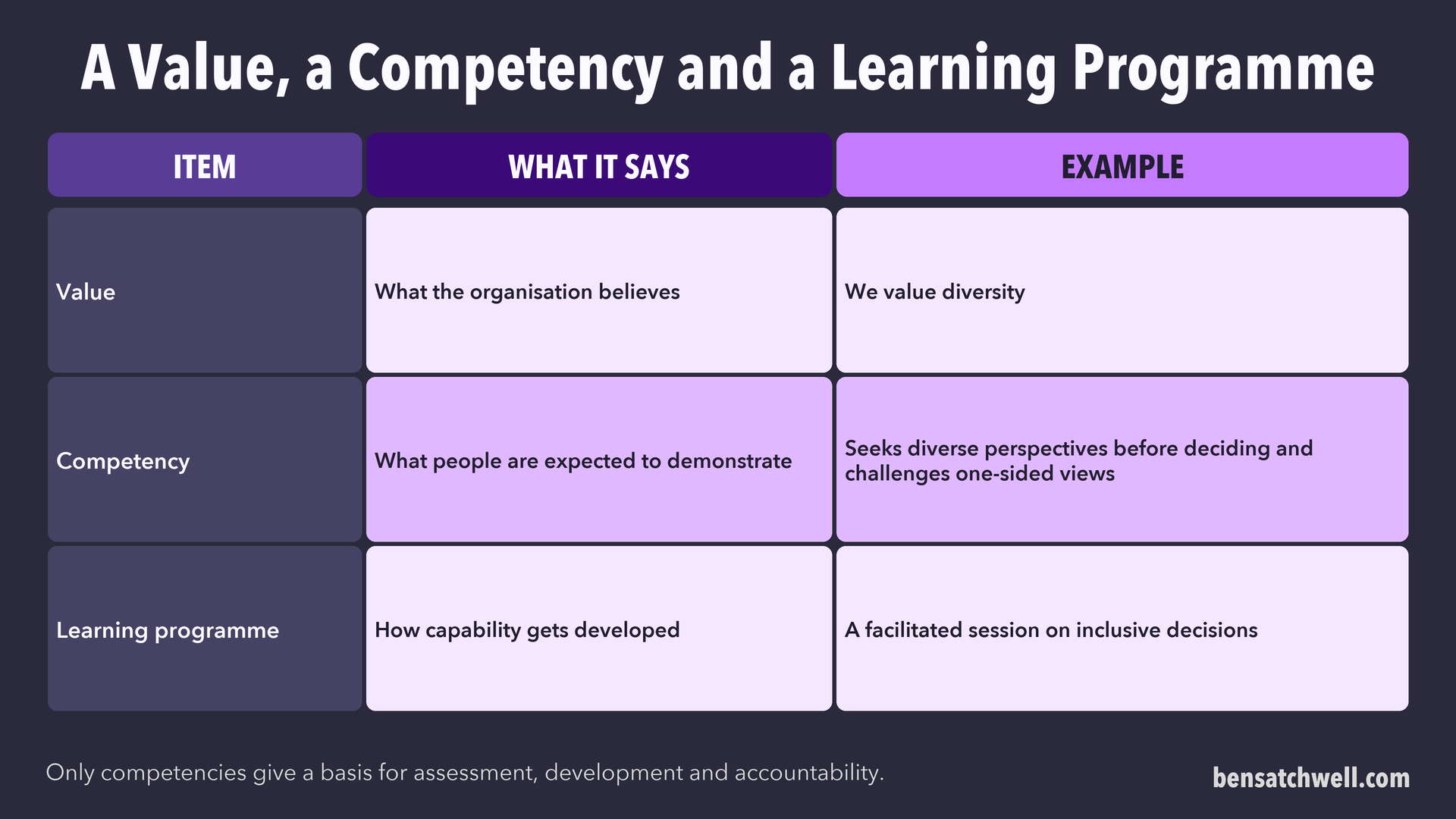
Only competencies give a basis for assessment, development and accountability.
- Not a learning curriculum. A learning programme is how DEI competence is developed. The profile defines what is to be developed. Organisations that confuse the two count hours of learning consumed instead of the capability that results.
- Not the organisation's whole competency framework. It defines competencies in one domain and sits within the broader competency framework, as any other profile does.
- Not a values statement. An organisation can hold clear DEI values and still have no way to assess whether they are enacted in behaviour.
- Not a separate design discipline. It applies the same principles as any other profile: levels, behavioural indicators and integration with workforce decisions. See how profiles sit in a competency framework.
Common Failure Modes
- Aspiration without specificity. Demonstrates inclusive behaviour is not an indicator. An indicator describes specific, observable behaviour on which two assessors could independently agree.
- A parallel system. When DEI competencies sit in a separate document assessed on a separate timeline, they stay outside how people are really assessed and developed.
- One level for everyone. Senior leaders have materially greater responsibility for outcomes than individual contributors, and the profile should say so.
Trade-Offs and Constraints
A profile tightly integrated with performance and development infrastructure creates the most accountability, but it needs the organisation's wider framework to be mature enough to absorb a new domain without becoming unwieldy. DEI profiles also face a specific challenge. The behaviours in them may be contested, either because the organisation has not reached consensus on what DEI requires or because the indicators touch beliefs people hold strongly. That does not make DEI competencies less suitable for a workforce standard, but it does mean the indicators need careful drafting, consultation and clear connection to the organisation's legal obligations and stated commitments.
FAQ
What is a DEI competency model?
A set of diversity, equity and inclusion behaviours expected of employees, managers and leaders, expressed at proficiency levels, and used to recruit for, assess and develop DEI capability.
What competencies does it include?
Commonly self-awareness and bias recognition, inclusive communication, equitable decision-making, cultural intelligence and humility, and advocacy and allyship. Indicators vary by organisation and level.
How is it different from a DEI learning programme?
The profile defines the behavioural standard. A learning programme is one way to build capability against it.
Should DEI competencies be assessed in performance reviews?
Yes, if the organisation treats DEI as a leadership expectation and not only a stated value. Assessing them only in separate DEI processes keeps them outside how performance is judged.
How many levels should it have?
Three to five, aligned to the different expectations of individual contributors, people managers and senior leaders.
What is the difference between a competency model and a competency framework?
There is no difference in structure. Competency model is the usual US name and competency framework is more common in the UK and Australia. The DEI competencies and required levels for a role are a competency profile.