


Competency Standards Examples
Most people who search for competency standards examples want a template to copy. That is the wrong starting point, because a competency standard is not a template. It is a written statement of the performance a person must demonstrate, to a defined level, in a defined area of work. This article uses real, published examples to show what a standard actually contains and how it differs from the framework it sits inside.
What Is a Competency Standard?
A competency standard is a written specification of the performance required in a discrete area of work, expressed as observable criteria against which a person can be assessed.
That is my working definition, and it is narrower than most people expect. A competency, as I use the term, is the integration of skills, knowledge, judgement and behaviour applied effectively in the context of a role. The standard is the written benchmark for that integrated performance. It tells an assessor what good looks like, so that two assessors looking at the same person reach the same conclusion.
The Australian vocational system is the clearest public example. The Australian Skills Quality Authority describes units of competency as specifying the knowledge and skills required to perform effectively in the workplace, along with the standard of performance expected. Each unit describes one discrete work function and states how it will be assessed.
Why Do Competency Standards Exist?
Standards exist to remove ambiguity from judgement. Without one, "competent" means whatever the most senior person in the room believes it means. That produces inconsistent hiring, inconsistent promotion and assessment outcomes that cannot be defended.
A standard fixes the benchmark outside any individual's opinion. It also makes the benchmark portable. A unit of competency written once can be used by different providers, employers and regulators, and everyone reads the same expectation. That portability is the functional reason standards need to exist, and it is why they are usually written at the level of a single unit of work rather than a whole role.
How Do Competency Standards Work in Practice?
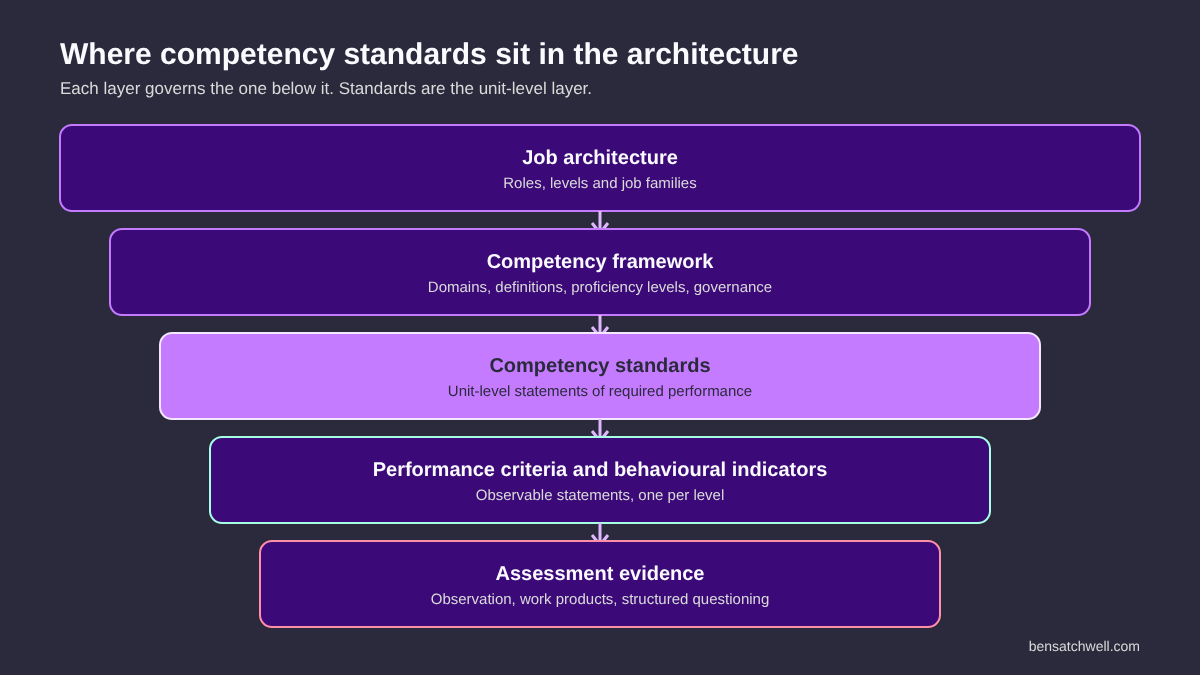
A well-formed standard has a small, predictable anatomy. Most published examples contain the same parts:
- Title and descriptor. A short name for the unit of work and one sentence on what it covers.
- Elements. The main outcomes within the unit, written as things a person achieves.
- Performance criteria. Observable statements under each element that describe what is done and to what standard.
- Required knowledge and skills. What a person must know and be able to do to meet the criteria.
- Assessment requirements. The evidence needed, such as observation, work products or structured questioning.
Performance criteria do the same job that behavioural indicators do in a framework. They are observable, contextual and descriptive rather than evaluative. If a criterion cannot be witnessed or evidenced, it is not doing its job.
An Illustrative Example
To make this concrete, here is a constructed example for a unit called "Prepare a project status report". It is an illustration, not a published standard.
- Element: Gather project information.
- Performance criterion: Progress data is collected from at least three sources and checked for consistency before it is reported.
- Performance criterion: Discrepancies are raised with the data owner and resolved or recorded.
- Evidence: Two completed reports with source notes, plus observation of one reporting cycle.
Notice what is absent. There is no personality trait and no vague aspiration. Everything stated can be checked.
What Are Real Examples of Published Competency Standards?
Australian Units of Competency
Australia's nationally endorsed units are the most thoroughly documented example of the form. The Western Australian Government explains how units of competency relate to the Australian Qualifications Framework, showing how unit-level standards roll up into qualifications. The unit is the standard. The qualification is a collection of units.
Organisation-Specific Standards
Many organisations write their own standards for regulated or safety-critical work. These usually follow the same anatomy, with elements, criteria and evidence requirements, but they are written in the organisation's language. The test of quality is the same as for any public example: can an assessor read the criterion and decide, from evidence, whether it has been met?
What Is a Competency Standard Not?
This is where most confusion sits, so it is worth being precise.
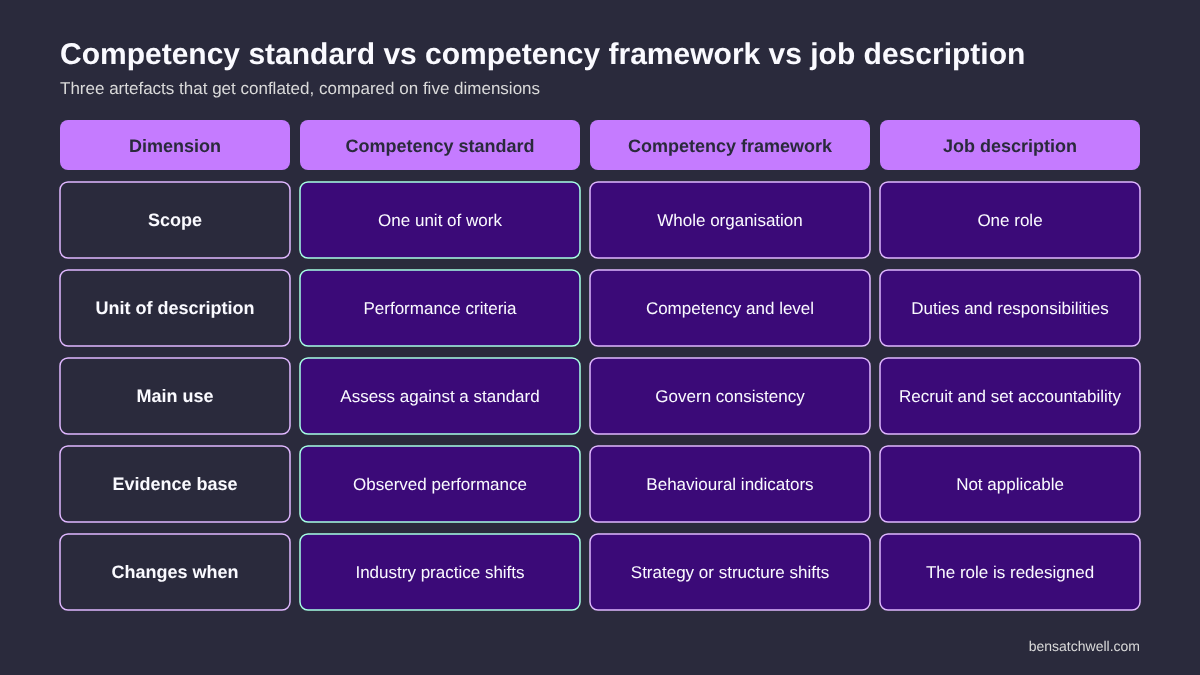
- It is not a competency framework. A competency framework is the organisation-wide system that defines, groups and governs competencies, with proficiency levels and rules for how they are applied. A standard is a unit-level benchmark that can sit inside it.
- It is not a competency model. A model is an applied selection of competencies for a role, level or job family. A standard describes performance for one unit of work.
- It is not a job description. A job description lists duties and accountabilities for a role. It does not state the performance standard or how to evidence it.
- It is not a skill. A skill is a discrete learned ability. A standard describes integrated performance, which draws on skills, knowledge, judgement and behaviour together.
What Are Common Failure Modes With Competency Standards?
I see the same failures repeatedly.
- Criteria that cannot be observed. Phrases such as "demonstrates a positive attitude" cannot be evidenced. Rewrite them as behaviour that someone could witness.
- Standards written at the wrong grain. A standard covering an entire role is too coarse to assess. One covering a single keystroke is too fine to be useful.
- No link to levels. A standard with no proficiency level cannot distinguish a new starter from an expert. Readers then assume everyone is held to the same bar. The competency framework levels article covers how to set levels properly.
- Standards without an assessment method. A criterion with no stated evidence turns assessment back into opinion. See the competency based assessment framework article for how evidence is structured.
- Copying a standard without adapting it. A published standard reflects the work of the organisation that wrote it. Copy it blindly and you inherit assumptions that do not match your context.
When Should You Use Competency Standards, and When Not?
Use a competency standard when the work is discrete, repeatable and needs a defensible pass or fail judgement. Regulated tasks, safety-critical procedures and certified qualifications are the natural fit.
Do not use one when the thing you need to describe is broad and transferable. Capabilities such as critical thinking or adaptability belong to the person across roles, and they are better expressed in a capability framework with levelled behavioural indicators. Forcing them into unit-level standards produces long documents that date quickly.
The trade-off is precision against maintenance. Standards give you assessable clarity, but each one needs to be reviewed as tools and methods change. If you want broader context, the competency framework examples article shows how standards fit into whole-of-organisation structures.
Frequently Asked Questions
What is an example of a competency standard?
An Australian unit of competency is a published example. It names a discrete work function, breaks it into elements and performance criteria, and states the evidence needed to assess it.
What is the difference between a competency standard and a competency framework?
A competency standard is a unit-level benchmark of required performance. A competency framework is the organisation-wide system that defines, groups and governs competencies, including their levels and indicators.
What are the parts of a competency standard?
Most include a title, elements, performance criteria, required knowledge and skills, and assessment requirements. Together they state what is done, to what standard and how it is evidenced.
How do you write a performance criterion?
State an observable action, the object it applies to and the standard it must meet. If an assessor cannot see or evidence it, rewrite it until they can.
Can I copy a published competency standard for my organisation?
You can use one as a reference, but adapt it. The wording reflects the original context, and unreviewed copies often carry assumptions that do not apply to your work.
