
There are more named leadership competency models than most HR professionals need to know, and that abundance creates its own problem. Organisations spend months evaluating which one to adopt when the better question is whether any of them is the right starting point. This article is a selection guide. It compares five well-known models on who they were built for, how they are structured and how you get access, then sets out how to decide.
What Is a Leadership Competency Model?
A leadership competency model is a role-level selection of competencies tailored to leadership roles across a defined part of the organisation. It states which competencies matter for leaders, what each means in that context and how it scales across proficiency levels. I call the selection a competency profile for leadership. It is drawn from the organisation's competency framework, the system that defines, groups and standardises competencies across the whole workforce.
The distinction matters when you buy a named product. A licensed model such as Korn Ferry Leadership Architect arrives as a complete system that acts as both the governing structure and the application layer, which is why the terms get blurred around proprietary products. Buying one does not give you a framework of your own. If you want to be sure what a competency is before comparing them, my article on what a competency is covers it.
A note on terminology. A competency framework is also called a competency model, especially in the United States. I use competency profile for the competencies and required levels for one role, and competency matrix for the grid of required against current proficiency. Usage varies by region, and I explain the differences in this competency model definition.
Why Leadership Models Exist
Leadership behaviour varies widely inside organisations, and the variation causes uneven performance management, subjective promotion decisions, development spend that cannot be targeted and succession planning that rests on intuition. A leadership profile gives HR a shared, observable language for what good leadership looks like and defines expected behaviour at each level before a decision has to be made.
The second benefit is comparability. Two leaders can be assessed against the same standard, which supports legitimate conclusions from the comparison. Without one, every assessment reflects the assessor's personal theory of leadership.
The Five Best-Known Models

Treat each as a source to select from, not a profile to adopt whole.
Korn Ferry Leadership Architect
Formerly the Lominger library, it is one of the most comprehensive proprietary leadership models, with 38 competencies grouped in 12 clusters and 4 factors. It is widely used in large enterprises. The limitation is access. It is a licensed product, and meaningful use depends on the vendor's assessments, benchmarks and development tools. Organisations without the infrastructure to support a licensed platform often buy more than they can operationalise.
SHRM Body of Applied Skills and Knowledge
This is built for HR professionals, not general leadership. The SHRM Body of Applied Skills and Knowledge, formerly the SHRM Competency Model, defines behavioural competencies plus a technical knowledge domain, and SHRM publishes it on its website. It is a strong reference for HR competency design, but should not be applied to a wider leadership population without substantial change. My guide to the SHRM competency model goes deeper.
CIPD Profession Map
The CIPD Profession Map covers the people profession, including HR, learning and development and organisational development. It is public, and it blends behaviours, values and knowledge in a more holistic way than a strict competency model, which makes it harder to use for standardised assessment. The CIPD's competence factsheet gives background on the approach behind it.
DDI Leadership Framework
DDI's work is research-driven and organises leadership behaviour into clusters rather than a fixed count. That gives flexibility but makes independent use harder. As with Korn Ferry, meaningful use is tied to the vendor's assessment and development products.
The Great Eight
The Great Eight identifies eight broad dimensions of work behaviour. Bartram's 2005 paper in the Journal of Applied Psychology, The Great Eight Competencies, is the peer-reviewed source. It has a strong research base and is used in selection, but it is optimised for that purpose and does not give the granularity needed for level-by-level development design.
How to Decide: Adopt, Adapt or Build

The decision rests on population size, governance capacity and infrastructure.
A licensed model gives validated content, benchmarking and tool integration. It costs more and creates dependency on a vendor. A custom profile gives ownership, flexibility and fit with your language and strategy, and it needs design effort and ongoing governance. Neither is better in general. Three factors decide it: the size and diversity of the leadership population, your capacity to govern a framework internally and the maturity of the HR and learning infrastructure available to put it to work.
The Australian Public Service Commission's Integrated Leadership System guide shows what a large government-sector leadership framework looks like in practice.
What a Leadership Profile Is Not
- Not a competency framework. The framework governs. The profile applies it to leaders.
- Not a values statement. Values describe what an organisation believes. A competency describes observable behaviour. Mixing them produces profiles too abstract to assess.
- Not a list of personality traits. Traits are stable dispositions. Competencies are applied behaviours that can be developed and evidenced.
- Not a function-specific profile. Role-specific profiles sit beside the leadership layer, as in my guide to sales competency frameworks.
Leadership Levels in Practice
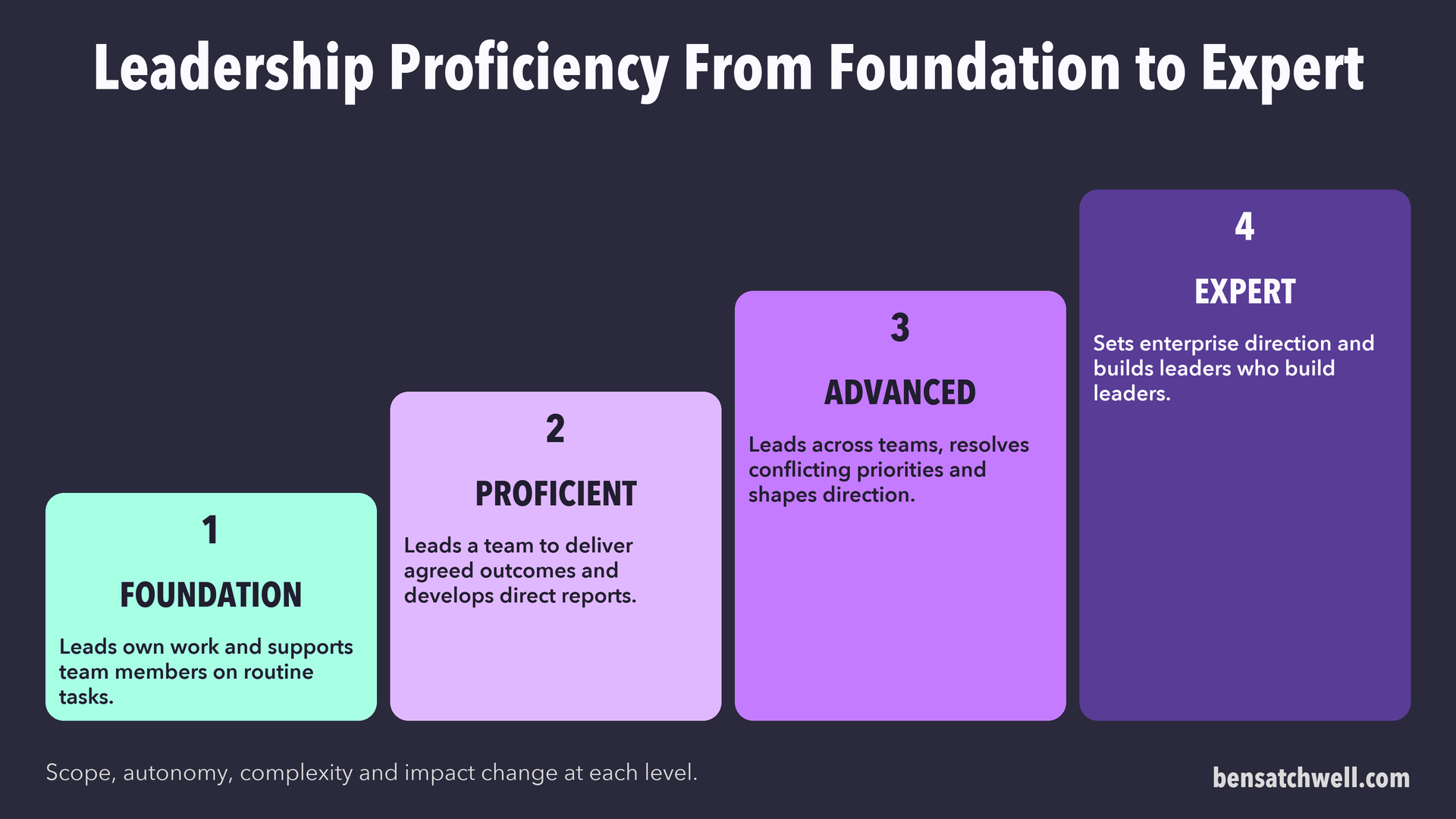
Scope, autonomy, complexity and impact change at each level.
Whichever source you choose, the level descriptors are where a leadership profile succeeds or fails. They should differ by scope and complexity, not by title, and they should describe behaviour a panel could observe. For worked profiles, see these competency model examples.
Common Failure Modes
- A list instead of a system. A profile that lives in a policy document and never touches assessment, development or selection changes nothing.
- Too broad for the population. Thirty-eight competencies applied to first-time managers produce overload. Most emerging leaders need six to ten done well.
- Model mistaken for framework. Organisations that buy a named model and treat it as their framework have no governing structure. When they need role profiles or new populations, they find nothing to build from. See the competency framework guide.
FAQ
What is the most widely used leadership competency model?
Korn Ferry Leadership Architect is among the most widely deployed proprietary models in large enterprises. The Great Eight is common in selection research. SHRM and CIPD are reference points for HR populations.
Can I use a named leadership model without a licence?
The SHRM and CIPD materials are published openly, and the Great Eight is documented in peer-reviewed literature. Korn Ferry and DDI products require a commercial relationship for meaningful use.
How many competencies should a leadership profile include?
Six to ten for most levels. Beyond about twenty, assessment becomes inconsistent and development planning overloads.
What is the difference between a leadership model and a leadership framework?
There is no difference in structure. Competency model is the usual US name and competency framework is more common in the UK and Australia. The selection of competencies for leaders is a competency profile.
How often should a leadership profile be reviewed?
Every three to five years, or when strategy shifts significantly.
Should the same competency set be used at all leadership levels?
Yes, if level descriptors differentiate expectations at each stage. Separate, unconnected sets for each level make succession planning across levels very difficult.