

The ADB Competency Framework is frequently cited in job advertisements and performance conversations, but rarely explained with any precision. Most references treat it as a checklist of desirable qualities rather than what it actually is: a structured, behavioural standard that defines the performance expectations of Asian Development Bank staff at every level. If you work in or alongside multilateral development institutions, understanding how this framework is built matters more than knowing it exists.
What Is the ADB Competency Framework?
The ADB Competency Framework is the Asian Development Bank's organisation-wide system for defining and assessing the behavioural performance expected of its international staff. It describes, at each proficiency level, the observable behaviours that constitute effective performance. It is not a values statement and not a list of personal attributes. It is a structured competency system with defined indicators.
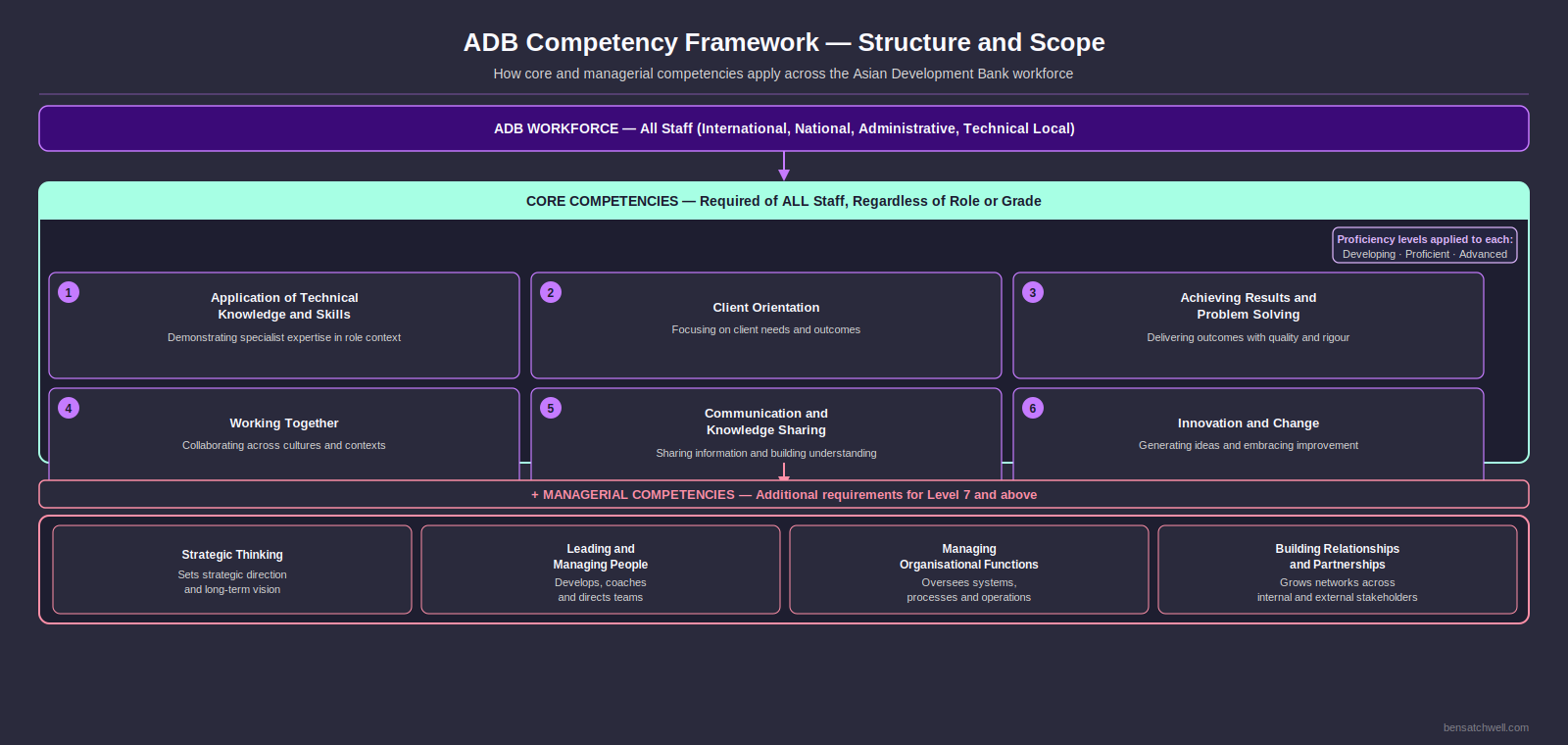
The framework organises competencies into two categories: core competencies, which are behaviours expected of all staff regardless of role or level, and managerial competencies, which are additional behavioural expectations for staff in supervisory or leadership positions.
The six core competencies are: Delivering Results and Accountability, Learning and Self-Development, Client Orientation, Achieving Results Through Others, Innovation, and Integrity. The four managerial competencies are: Leading Teams, Developing Others, Strategic Thinking, and Managing Performance and Resources.
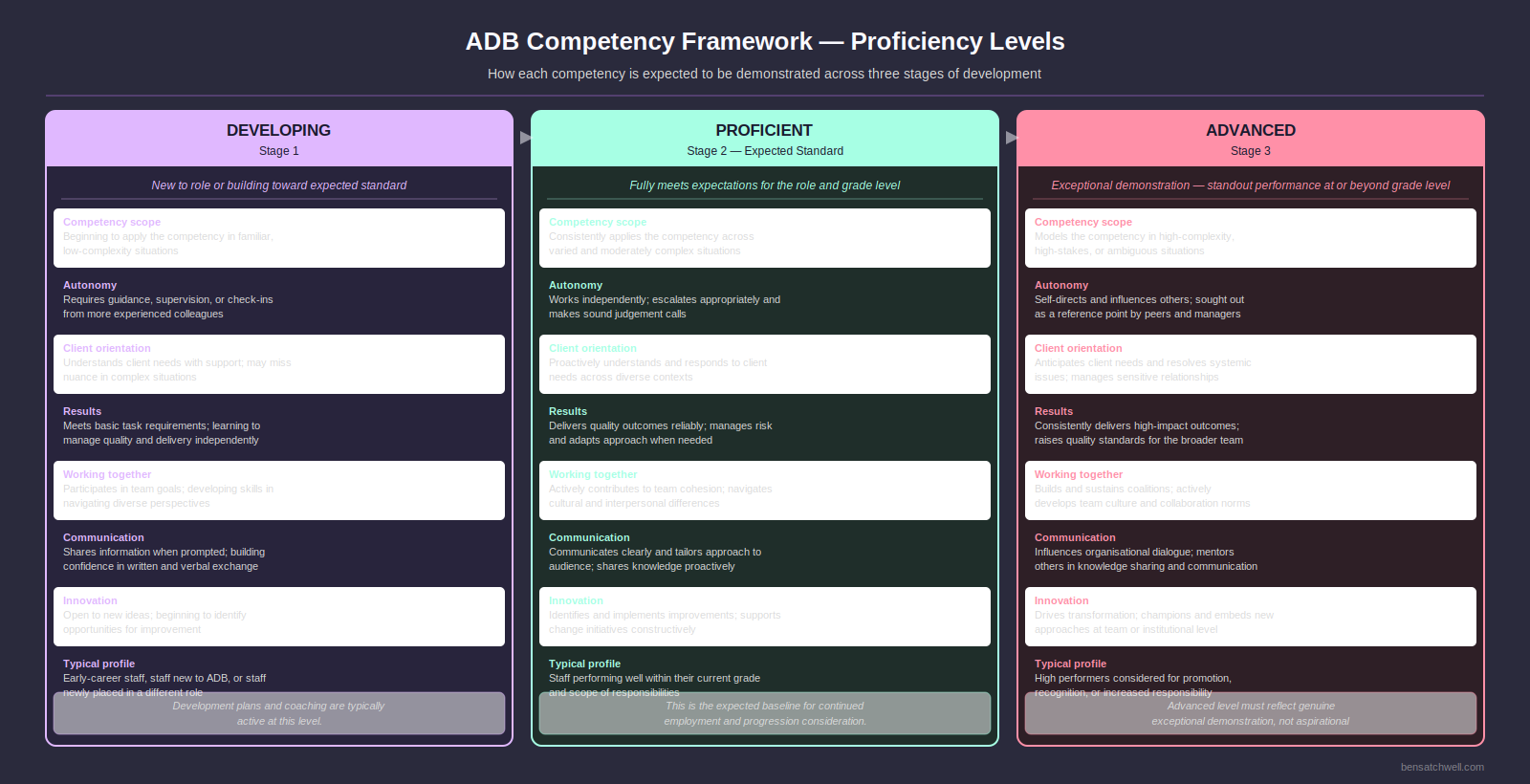
Each competency is levelled. The ADB applies three proficiency levels corresponding to internal staff grades, with behavioural indicators describing what the competency looks like at each level. An entry-level staff member and a senior director are both assessed against Client Orientation, but the expected behaviours differ significantly in scope and autonomy.
A note on terminology. A competency framework is also called a competency model, especially in the United States. I use competency profile for the competencies and required levels for one role, and competency matrix for the grid of required against current proficiency. Usage varies by region, and I explain the differences in this competency model definition.
Why Does a Multilateral Development Bank Need a Competency Framework?
Development banks like the ADB operate across dozens of countries, with staff drawn from more than sixty member economies. Without a shared behavioural standard, performance assessment defaults to subjective judgment, which is inconsistent, legally risky, and practically useless for workforce decisions.
The competency framework solves several distinct problems. First, it gives managers and staff a common language for what good performance looks like. Second, it makes performance reviews defensible: assessments can reference specific behavioural indicators rather than general impressions. Third, it supports workforce planning across a genuinely international staff base, where career development, promotion decisions, and deployment need a consistent framework to operate across.
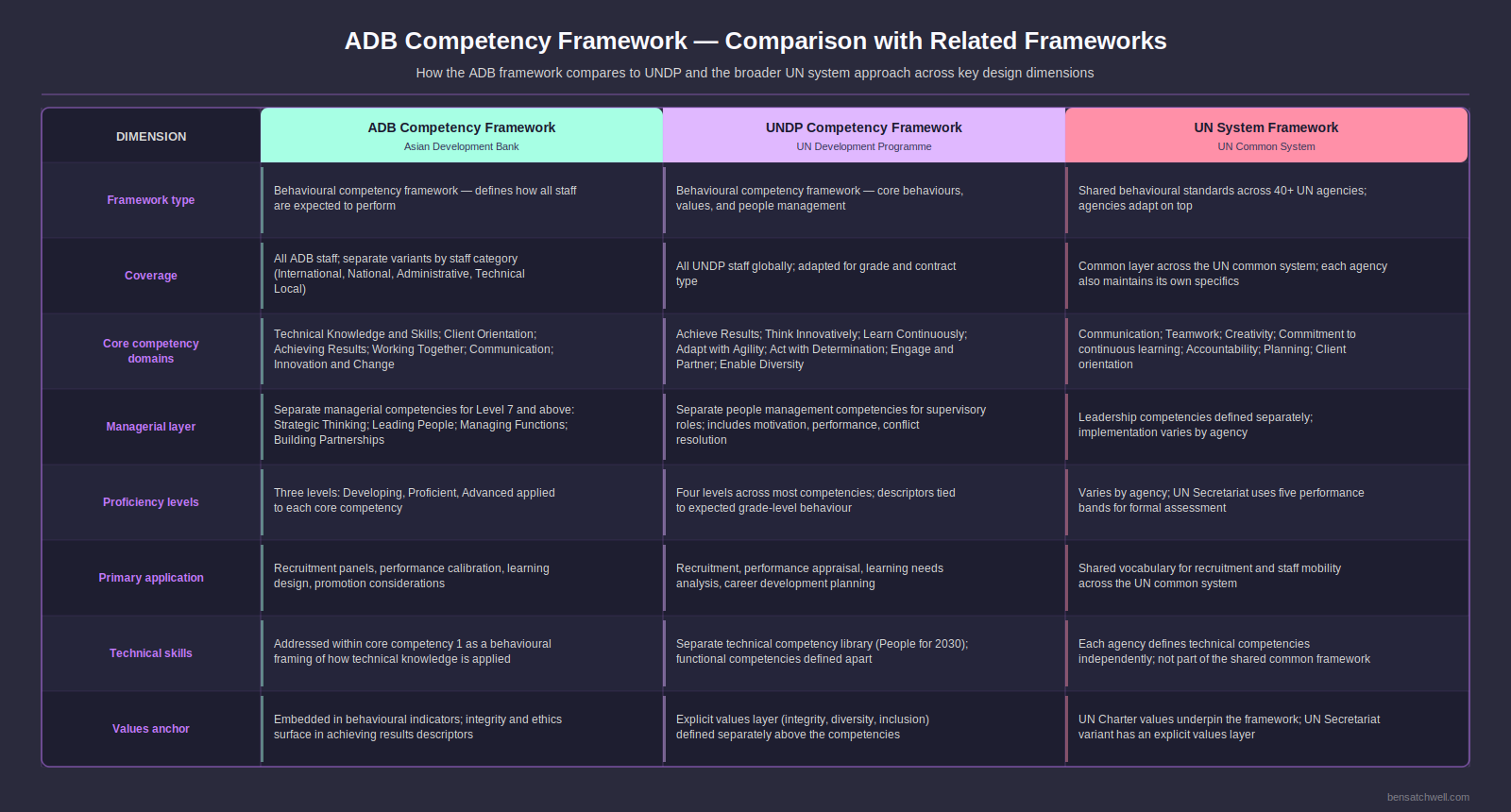
This is a common design rationale across major intergovernmental organisations. The UNDP's Core Behavioural Competencies framework, the UN System's competency model, and the ADB framework share a common structural logic: universal core competencies, proficiency levels, and behavioural indicators. The specific content differs by organisational mandate, but the architecture is consistent.
How the ADB Competency Framework Works in Practice
The framework operates across three primary use cases: performance management, recruitment, and professional development.
In performance management, the framework provides the behavioural dimension of the review process. ADB staff are assessed on both what they deliver (results and outputs) and how they deliver it (the competencies). This dual assessment reduces the risk of pure output-based evaluation, which can reward problematic behaviour if results are achieved by the wrong means.
In recruitment, competency-based interviewing structures the selection process. Job postings reference the specific core competencies relevant to the role, and structured interview questions test for evidence of past behaviour against those indicators. This is consistent with what ADB publishes for international staff positions, where the competency profile expected at each IS level is defined.
In professional development, managers use the framework to identify where staff are performing below expected proficiency and to structure development conversations. The levelled indicators give specificity: rather than a vague suggestion to improve stakeholder management, the framework points to precise behavioural expectations at the next proficiency level.
How ADB Competencies Differ from Capabilities
Understanding what competency actually means in practice is essential before applying this framework, because the term is used differently across frameworks and contexts. A competency is the integration of skills, knowledge, judgement and behaviour applied effectively in the context of a role. The ADB framework uses the term in this sense, and structures its indicators around observable behaviour rather than abstract qualities.
What the framework does not describe is capability in the broader sense. A competency, in this framework, is a role-level behavioural expectation. A capability, properly defined, is a durable, transferable area of human ability that a person carries across roles and contexts. The ADB framework does not attempt to map the latter. It is firmly a competency framework, and understanding that distinction matters when interpreting assessment results or comparing it with other frameworks.
This is the same architecture used by frameworks like the PSC Capability Framework in the Australian Public Service, though the APS framework uses the term "capability" for what are structurally competencies. The labelling is different; the underlying design logic is comparable.
What the ADB Competency Framework Is NOT
The ADB Competency Framework is not a values statement. The ADB has separate organisational values. The competency framework describes how those values manifest as observable behaviour at work, but it is not an aspirational document. It is a performance standard.
It is also not a role-by-role specification. The core competencies apply universally. The framework does not define unique competencies for every job family or discipline. Technical and functional competencies specific to roles like economists, engineers, or procurement specialists sit outside the behavioural framework and are typically managed through separate technical standards or job requirements.
Nor is it a skills taxonomy. A skills taxonomy classifies discrete, specific abilities, like the SFIA framework, which maps skills across the technology profession at seven levels. The ADB framework operates at the behavioural level, not the skill level. It asks how this person approaches their work, not what specific techniques they can apply.
Common Failure Modes
The most common failure is treating competency indicators as boxes to tick. When managers assess competencies by asking whether a person has demonstrated a behaviour at some point, rather than at what proficiency level they consistently demonstrate it, the framework loses its discrimination power. Everyone scores adequately. Meaningful differences in performance become invisible.
The second failure mode is competency inflation: inflating assessments to avoid difficult conversations. This is structurally easier in behavioural frameworks than in output-based ones, because behaviours are harder to measure and evidence. The solution is to require specific behavioural examples at the assessment level claimed, not general characterisations.
A third failure is using the framework only in formal performance reviews and ignoring it in development conversations. The indicators are most valuable when used formatively throughout the year, not as a retrospective scoring exercise conducted once annually.
Trade-offs and Constraints
A universal behavioural competency framework has inherent trade-offs. It covers common ground well and specialist territory poorly. The ADB framework will tell you how a staff member engages with clients and accounts for results. It will not tell you whether their technical economics or infrastructure judgement is sound. Those are separate assessments.
The framework also assumes cultural equivalence in how competencies are expressed. "Delivering results" looks different in a Japanese institutional context than in an Australian one. Organisations using behavioural frameworks across genuinely multicultural staff bases need to be careful not to treat the indicators as culturally neutral when they are not.
Finally, a framework like this is only as useful as the managers applying it. Without calibration discussions, without consistent standard-setting across teams, and without a genuine commitment to honest assessment, even a well-designed competency framework produces unreliable data.
For organisations adapting these principles to their own context, the design considerations are similar to those in a data analytics competency framework: the framework must be specific enough to discriminate performance meaningfully, and general enough to apply consistently across varied roles.
Frequently Asked Questions
What are the core competencies in the ADB Competency Framework?
The ADB Competency Framework has six core competencies: Delivering Results and Accountability, Learning and Self-Development, Client Orientation, Achieving Results Through Others, Innovation, and Integrity. These apply to all international staff regardless of role or grade.
How many proficiency levels does the ADB Competency Framework use?
The framework uses three proficiency levels, corresponding to ADB's international staff grade bands. Behavioural indicators describe what each competency looks like at each level, with increasing scope, autonomy, and complexity expected at higher grades.
What is the difference between core competencies and managerial competencies in the ADB framework?
Core competencies apply to all ADB staff. Managerial competencies, which include Leading Teams, Developing Others, Strategic Thinking, and Managing Performance and Resources, apply specifically to staff in supervisory or leadership roles.
How does the ADB Competency Framework relate to performance management?
The framework provides the behavioural dimension of ADB performance reviews. Staff are assessed on both what they deliver and how they deliver it. The competency indicators give managers and staff a shared, evidence-based basis for performance discussions, alongside output and delivery assessments.
Is the ADB Competency Framework the same as a capability framework?
No. The ADB framework is a competency framework: it defines behavioural expectations at specific proficiency levels for roles within the organisation. A capability framework, in the proper sense, maps durable, transferable human abilities that people carry across roles and contexts. The two are distinct constructs, though the terms are often used interchangeably in practice.
Can organisations outside the ADB adapt its competency framework?
The ADB Competency Framework is publicly available. Organisations may draw on its structural logic, particularly the pairing of core and managerial competency layers, but it is designed for the specific context of a multilateral development bank. Adapting it to a different sector requires significant redesign of the behavioural indicators to reflect the relevant organisational context.