
Most organisations writing adaptive leadership into their competency frameworks are not describing adaptive leadership at all. They are describing a vague collection of traits, resilience, agility, open-mindedness, that could apply to almost anyone in almost any role. Genuine adaptive leadership, the kind Ronald Heifetz and Marty Linsky developed at Harvard Kennedy School, is a precise concept. It concerns what leaders do when problems cannot be solved with existing knowledge. Getting that specificity into a competency framework requires more than copying a list of desirable traits.
What Are Adaptive Leadership Competencies
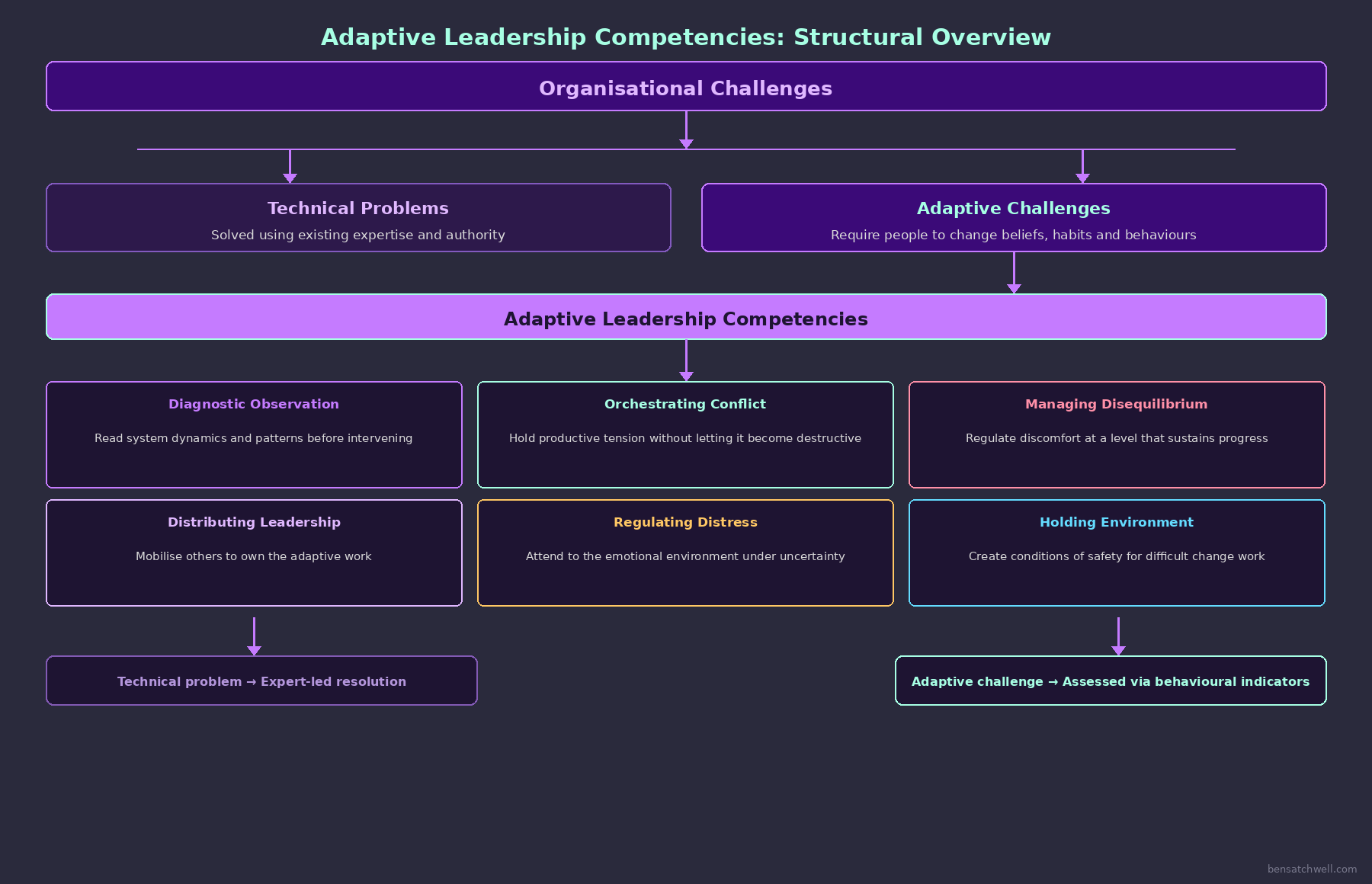
Adaptive leadership competencies are the defined, observable behaviours a leader needs to help an organisation navigate problems that have no known solution. They are not generic leadership competencies with the word "adaptive" added. They describe what a leader does when the organisation faces an adaptive challenge, a situation where technical solutions are unavailable or insufficient, and where progress depends on changing how people think, what they value, or how they work.
The concept originates with Heifetz's distinction between technical problems and adaptive challenges. Technical problems can be solved by applying existing knowledge and authority. Adaptive challenges require the people involved to change. Adaptive leadership competencies are the behavioural repertoire a leader draws on to manage that second type.
A competency in this space is not "demonstrates resilience." It is an observable behaviour at a specified proficiency level, something a leader does that can be described, observed, and assessed. For a precise definition of what a competency actually is, this article on what constitutes a competency outlines the construct and why generic trait language fails.
A note on terminology. A competency framework is also called a competency model, especially in the United States. I use competency profile for the competencies and required levels for one role, and competency matrix for the grid of required against current proficiency. Usage varies by region, and I explain the differences in this competency model definition.
Why Adaptive Leadership Competencies Exist
Most leadership competency frameworks were built for stable environments. They capture what effective leaders do when the path is known: executing strategy, motivating teams, managing performance. Those competencies are useful. They are not sufficient for environments where the strategy itself is uncertain, or where the organisation must rethink its assumptions about how it operates.
The problem is that many organisations face an increasing proportion of adaptive challenges: digital disruption, workforce restructuring, cross-sector complexity, and the kind of change that cannot be delivered through a project plan. Standard leadership competencies do not capture what leaders need to do in that environment. Adaptive leadership competencies exist to fill that gap.
This is particularly evident in public sector settings. The PSC Capability Framework in New South Wales includes capabilities related to navigating complexity and leading adaptively, though the framing tends to soften the harder edges of what that actually requires in practice.
How Adaptive Leadership Competencies Work in Practice
In practice, adaptive leadership competencies cluster around a small number of underlying functions: reading the environment accurately, making progress on problems that generate resistance, managing productive tension in the system, and holding steady under pressure.
Get on the Balcony
The signature adaptive leadership behaviour is the ability to step back from operational activity and observe the system, who is aligned, who is resisting, what the real sources of resistance are, and what the work actually requires. This is usually described in frameworks as systems thinking or strategic awareness, but it has a more specific meaning in adaptive leadership: deliberate self-observation and situational diagnosis.
Distinguish Adaptive from Technical
A leader who applies a technical solution to an adaptive problem accelerates failure. This competency requires accurate diagnosis of the type of problem being faced before choosing how to respond. It is one of the hardest competencies to build because organisations structurally reward fast technical responses.
Manage the Heat
Adaptive work generates discomfort. Progress requires the leader to hold a productive level of tension in the system, enough to motivate change, not so much that the organisation shuts down or fragments. This is specific, behavioural, and assessable. It is not the same as "manages stress" in a generic competency model.
Give the Work Back
Adaptive change cannot be delivered by the leader alone. The leader's role is to help the organisation do the adaptive work, not to resolve it on the organisation's behalf. This competency involves strategic authority divestment: deliberately returning responsibility to those who need to do the changing.

The CIPD's work on leadership capability points to a similar cluster of requirements under complexity and ambiguity, though without the Heifetz conceptual grounding. Their resources on leadership development outline the professional standards context in which these frameworks are typically deployed.
At an organisational level, adaptive leadership competencies are usually built as an additional layer within a broader leadership competency framework, rather than replacing it. The technical and transactional leadership competencies remain; adaptive competencies extend the framework to cover the circumstances where those competencies are insufficient.
What Adaptive Leadership Is Not
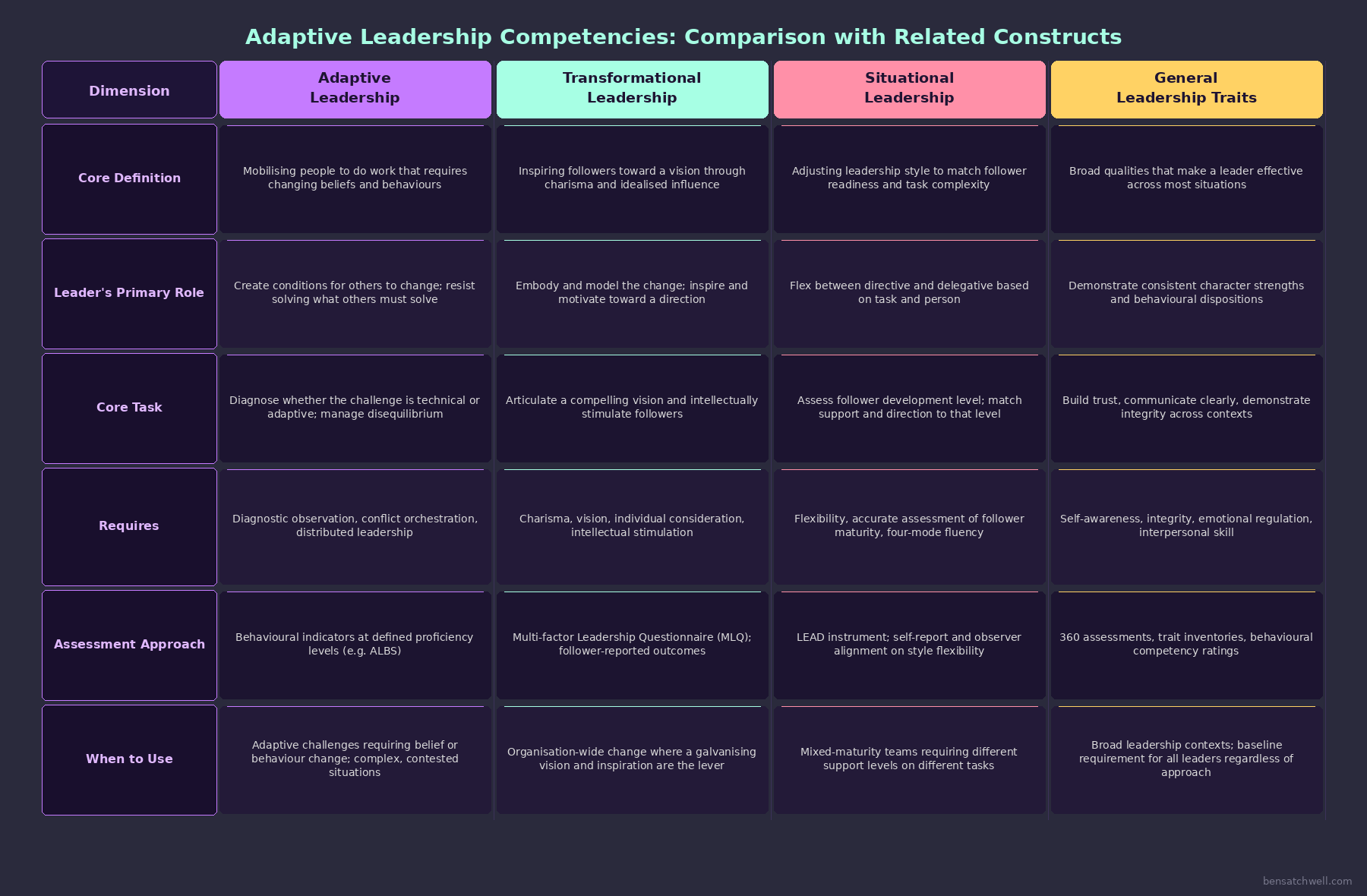
Adaptive leadership is not synonymous with agile leadership, resilient leadership, or what the management literature calls transformational leadership. These constructs share similar vocabulary but describe different things.
Agile leadership refers primarily to leading in agile delivery environments. It concerns operating rhythms, team structures, and decision-making at pace. Adaptive leadership concerns the nature of the problem, not the pace of the work.
Resilient leadership describes the capacity to recover from setbacks. It is a personal capability, not a description of what the leader actively does with complexity.
Transformational leadership (Bass and Burns) describes a leadership style that inspires followers through vision and emotional engagement. Adaptive leadership is a practical framework for what leaders do with specific types of problems. The constructs are not interchangeable.
Misapplying these labels leads to frameworks that describe desirable traits rather than the actual behaviours adaptive work requires. A well-designed role-specific competency framework should be precise about which leadership construct is being applied and why.
Named Frameworks and Standards
Several formal frameworks incorporate adaptive leadership competencies explicitly or implicitly. Heifetz and Linsky at Harvard Kennedy School developed the foundational model and the diagnostic vocabulary. The OECD has noted the relevance of adaptive leadership capacity in its reviews of public sector leadership development across member countries, particularly in complex policy environments. Their comparative work on leadership provides useful evidence on how different systems build this capability.
The Australian Public Service Commission integrates adaptive leadership requirements into its SES leadership model, with specific behavioural expectations around systemic thinking and leading through uncertainty. Their Integrated Leadership System guide reflects the public sector application of these principles in an Australian context.
CIPD includes leadership of change and navigating ambiguity within its professional map, relevant to HR and L&D practitioners designing these frameworks.
Common Failure Modes
The most common failure is treating adaptive leadership as a trait to hire for rather than a competency to develop and assess. Frameworks that include "demonstrates adaptive thinking" without specifying what that behaviour looks like at each proficiency level have not described a competency. They have described an aspiration.
A second failure is confusing adaptive capability with general comfort with change. Many people are comfortable with change in the abstract yet cannot do the specific work adaptive leadership requires: holding tension in a system, giving work back, resisting the pull to resolve uncertainty prematurely. These are learnable but demanding behaviours, and they need to be assessed against real situations, not self-reported preferences.
A third failure is applying adaptive leadership concepts to technical problems. Not every challenge requires adaptive leadership. Frameworks that position all change work as adaptive misrepresent the model and create unrealistic expectations for leaders operating in environments where the right technical expertise, applied with authority, would be sufficient.
Trade-offs and Constraints
Adaptive leadership competencies are most valuable in environments where an organisation genuinely faces adaptive challenges at a significant scale. For organisations operating in stable, predictable contexts, a robust set of technical and transactional leadership competencies will serve better. Including adaptive leadership competencies in a framework for all leaders, regardless of whether they face adaptive challenges, dilutes the model and creates assessment complexity with no compensating benefit.
The conceptual grounding in Heifetz's framework is a constraint as well as a strength. It gives the model precision, but it also means the model is less legible to practitioners who have not worked with that framework. Implementation requires investment in conceptual fluency across the leadership cohort, not just the framework designers.
Frequently Asked Questions
What is the difference between adaptive leadership competencies and general leadership competencies?
General leadership competencies describe what effective leaders do in stable, known-solution environments: things like strategic thinking, communication, and delivery management. Adaptive leadership competencies describe what leaders need to do specifically when the problem has no known solution and progress requires people to change their values, assumptions, or behaviours. The distinction is about the nature of the challenge, not the quality of the leader.
Can adaptive leadership competencies be assessed in standard performance reviews?
Standard rating scales applied to observable behaviours can assess adaptive leadership competencies, but only if the behavioural indicators are specific and observable. Assessment works best against real situations, where the leader can describe a specific adaptive challenge they faced and demonstrate what they actually did. Generic competency ratings against vague traits are not meaningful assessments of this construct.
Are adaptive leadership competencies relevant to all levels of leadership?
They are most relevant to senior leaders and those who frequently operate at the interface between strategy and complexity. At more operational levels, technical and transactional competencies dominate. A well-designed framework is explicit about which competency layers apply at which levels, rather than cascading adaptive leadership requirements down the whole organisation.
What is an adaptive challenge compared to a technical problem?
An adaptive challenge is a situation where the solution is unknown, where the people involved must change their thinking or behaviour to make progress, and where leadership authority alone cannot resolve it. A technical problem has a known solution that can be applied by someone with the appropriate expertise. Most real-world challenges contain elements of both, which is why accurately distinguishing the adaptive components is itself a core capability.
How do adaptive leadership competencies differ from resilience frameworks?
Resilience frameworks describe the capacity to absorb disruption and recover from setbacks, they are fundamentally about the durability of the leader or organisation under pressure. Adaptive leadership competencies describe what a leader actively does to help an organisation navigate complex, uncertain challenges. One is about endurance; the other is about method.