

Most organisations talk about competency models as if the term is self-explanatory. In my experience, it rarely is. People conflate competency models with competency frameworks, treat job descriptions as models, or apply the term to any document that lists skills. Working through real competency models examples is often more instructive than definitional explanation alone, because it shows how the concept is actually structured and applied across different professional contexts.
What Is a Competency Model?
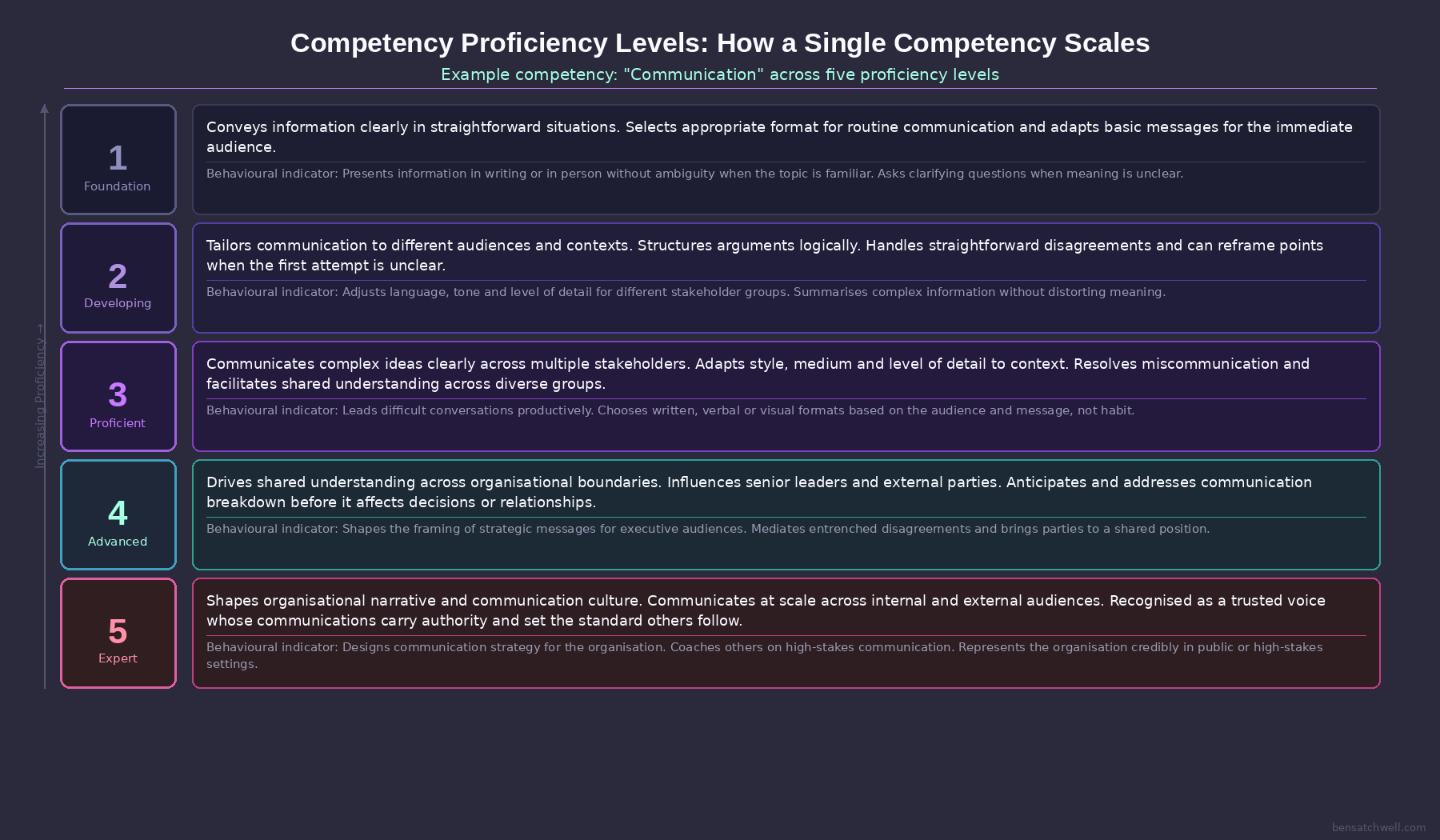
A competency model is an applied selection of competencies, drawn from a broader competency framework, and tailored to a specific role, level, function or job family. If the framework is the organisation's governing system, the model is an instance of it, built for a particular context and purpose.
Understanding what a competency model is and how it differs from a framework is the starting point for using any of the named examples in this article effectively. The difference is not semantic. It has practical consequences for how you design, govern, and apply these tools inside an organisation.
Each model typically includes a defined set of competencies, proficiency level descriptors for each, and the behavioural indicators that describe what performance looks like at each level. The model is the instrument people use for performance conversations, development planning, and hiring decisions.
Named Competency Models Examples
There are several well-established, publicly documented competency models that practitioners reference regularly. Understanding what each one contains and how it is structured helps you make an informed decision about whether to adopt, adapt, or build from scratch.
SHRM Body of Applied Skills and Knowledge (SHRM BASK)
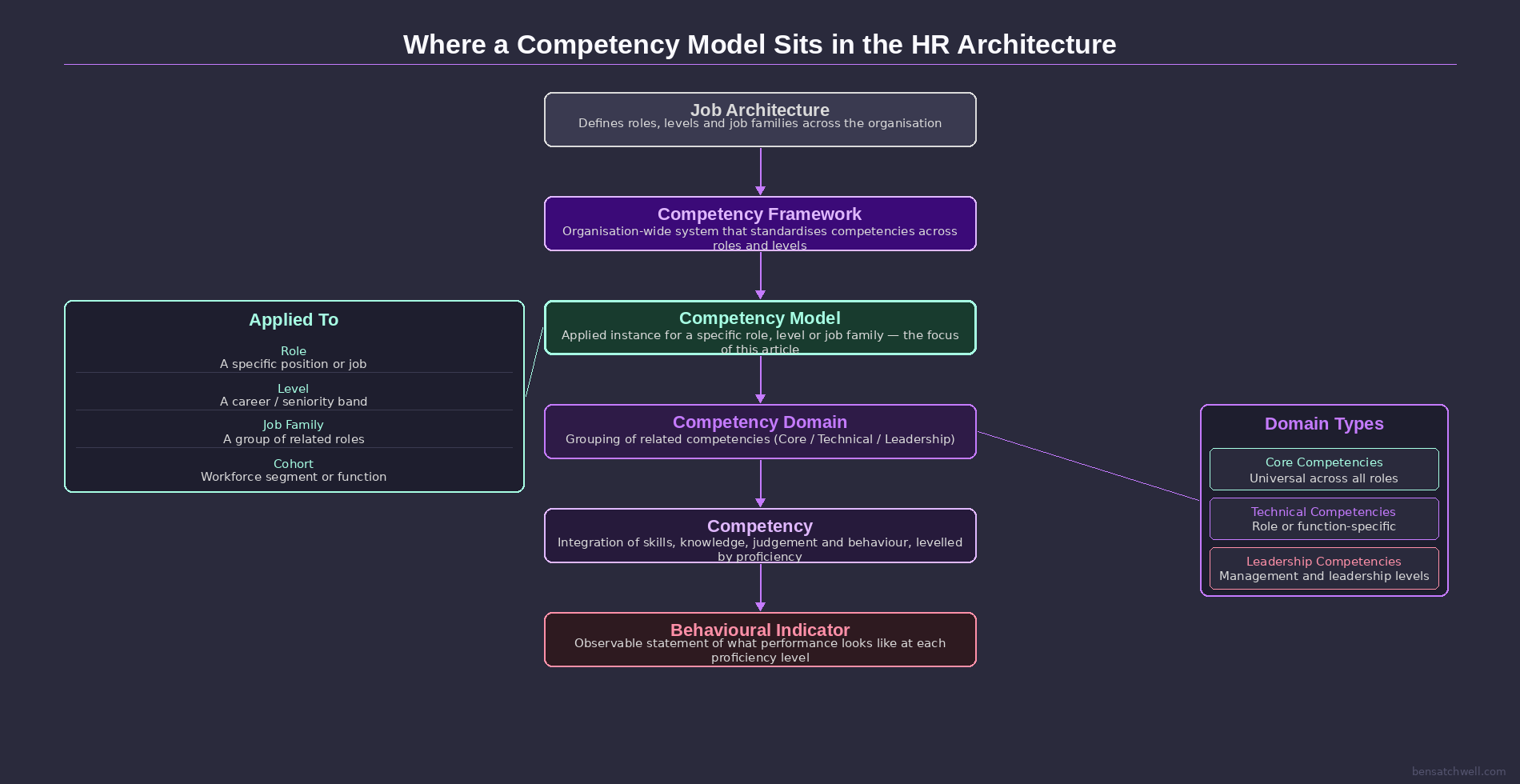
The SHRM Body of Applied Skills and Knowledge is published by the Society for Human Resource Management and defines the competencies expected of HR professionals globally, with a strong North American foundation. It organises 23 total competencies into two layers: nine behavioural competency domains and 14 functional competency areas. The behavioural layer covers ethical practice, communication, and relationship management, among others. The functional layer covers specialist domains including talent acquisition, total rewards, and HR technology.
Each competency includes proficiency descriptors that scale from early career to senior HR leader. The model underpins SHRM certification, specifically the SHRM-CP and SHRM-SCP credentials, which means it carries credentialling weight for practitioners alongside its development function.
CIPD Profession Map
The CIPD Profession Map, published by the Chartered Institute of Personnel and Development, defines the standards expected of people professionals in the UK and internationally. It is built around six core behaviours and eight specialist knowledge areas, assessed across four impact levels from Foundation to Chartered Fellow. The specialist areas include learning and development, organisational design, and employment relations.
The CIPD model is one of the most widely referenced competency framework examples built to support professional membership and continuing development, rather than purely internal performance management. The CIPD's guidance on competency frameworks makes clear how the map is intended to be applied across different levels of the profession. That distinction between external professional standards and internal management tools matters when you are deciding which model to use as your reference point.
Korn Ferry Leadership Architect
Korn Ferry's Leadership Architect is a research-backed competency library containing 67 competencies, grouped into 21 clusters and six factors. Organisations do not deploy all 67. They select 8 to 12 competencies relevant to the role or level in question and build a model from that library. Each competency carries five importance ratings and a separate learning agility assessment.
The Korn Ferry model is most widely used for leadership competency model design, succession planning, and executive development. Its structure reflects decades of research into what differentiates high performance at senior levels, which gives it credibility in leadership contexts that more generic models often lack.
O*NET
O*NET, published by the US Department of Labor, is a different kind of resource entirely. Rather than a single competency model, it is a database of occupational profiles across the entire US economy. Each profile includes the knowledge, skills, abilities and work activities associated with that occupation, with scaled importance ratings. The number of items per profile varies but typically ranges from 20 to 40 across categories.
O*NET is best used by analysts, workforce planners, and HR teams working on job design or benchmarking rather than by practitioners building development frameworks for a specific population.
How Proficiency Levels Work Across These Models
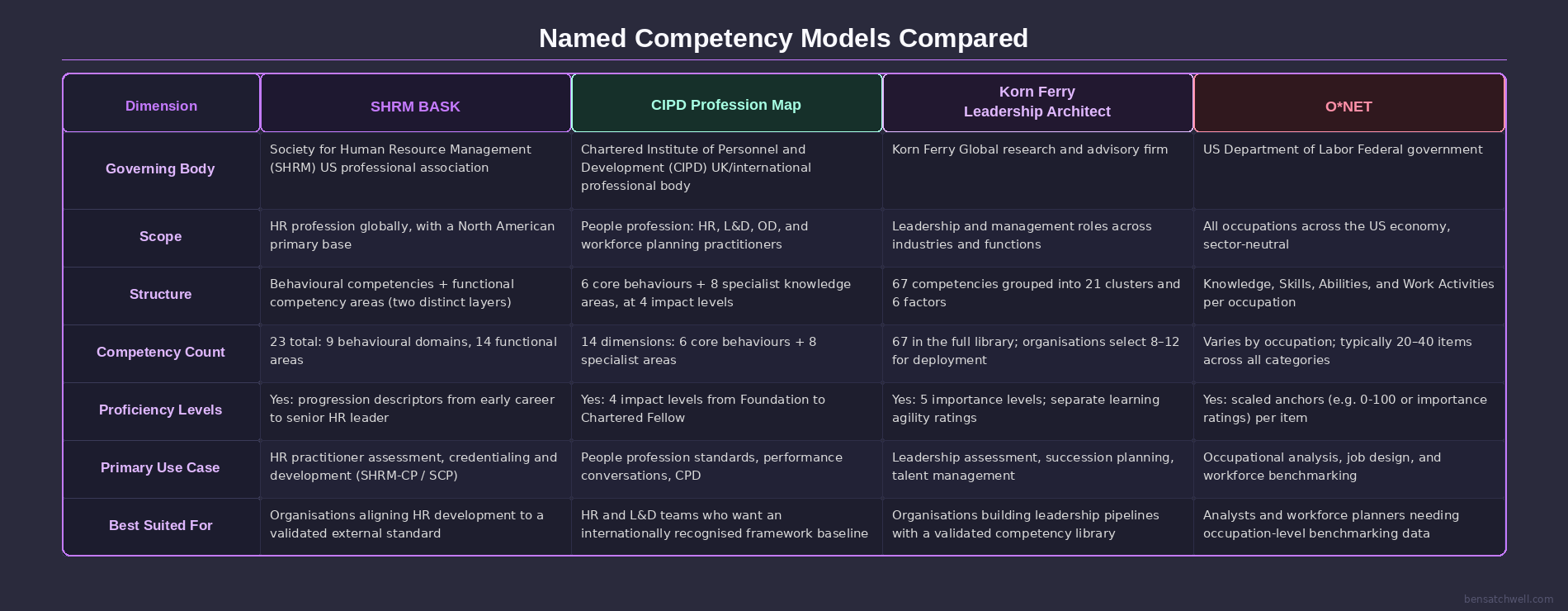
One thing that distinguishes a genuine competency model from a competency list is the inclusion of proficiency levels. All four models include them, though each implements the idea differently.
SHRM uses progression descriptors tied to career stage. CIPD uses four explicitly defined impact levels. Korn Ferry uses five importance ratings per competency. O*NET uses scaled numeric anchors, typically on a 0 to 100 range for importance and level.
Peer-reviewed research on competency model validation consistently shows that models without defined proficiency levels produce inconsistent assessment outcomes. The question assessors face is never simply whether someone has a competency. It is at what level they hold it, and whether that level matches what the role requires.
What Competency Models Are Not
This distinction is worth stating directly because the conflation is common and consequential.
A competency model is not a job description. A job description lists tasks and responsibilities. A competency model defines the knowledge, skills, judgement and behaviour required to do those tasks well.
A competency model is not a skills list. A skills list catalogues discrete, often technical abilities. A competency model integrates skills with knowledge, judgement and observable behaviour at defined proficiency levels. The distinction between a skill and a competency is not trivial: a skill is a discrete ability; a competency is an integrated pattern of behaviour that includes multiple skills alongside knowledge and judgement.
A competency model is not a competency framework. A framework is the organisation-wide governing system. A model is an applied instance of it for a specific context. Many organisations use these terms interchangeably, which creates governance problems downstream when they try to manage consistency across roles and levels. Understanding this distinction shapes the decisions practitioners make when building an HR competency model or any other role-specific model.
Common Failure Modes in Competency Model Design
Most competency models that fail in practice share recognisable patterns.
Too many competencies. A model with 25 or more competencies becomes unmanageable in performance conversations and meaningless in development planning. The Korn Ferry approach, selecting 8 to 12 from a larger library, reflects a practical reality: people can develop against a focused set, not an exhaustive taxonomy.
No proficiency levels. Without defined levels, a competency becomes a checkbox. Managers cannot differentiate between someone who is at a basic stage and someone who is expert, and development conversations lose their specificity. This is the single most common design flaw I see in internally built models.
Competencies written as tasks. When behavioural descriptors read like job tasks, such as "completes performance reviews on time," the model is assessing behaviour against the wrong unit. Competencies describe how work is done, not what tasks are completed.
Adoption without tailoring. Taking an external model such as SHRM BASK or the CIPD Profession Map and applying it verbatim inside an organisation rarely works well. These models were designed for professional standards across a broad practitioner community, not for internal role differentiation. Adapting them to your context, job families, and organisational expectations is the design work, not the shortcut.
Trade-offs in Selecting a Named Model Versus Building Custom
Adopting a named model like SHRM or CIPD gives you external credibility, alignment to a professional community, and faster implementation. You also inherit the constraints of a model designed for a general audience rather than your specific context and culture.
Building custom gives you precision and fit but requires significant design capability, validation effort, and ongoing maintenance. It also carries internal credibility risk if stakeholders trust external models more than internally developed ones.
Most effective implementations start with a named model as a structural reference and adapt it, refining competency definitions, adjusting proficiency levels, and selecting domain groupings that reflect the actual work of the population being assessed. Neither full adoption nor full custom build is automatically the right answer.
Frequently Asked Questions About Competency Models Examples
What is the difference between a competency model and a competency framework?
A competency framework is the organisation-wide governing system that defines, groups and standardises competencies across roles and levels. A competency model is an applied instance of that framework, tailored to a specific role, level or job family. Many organisations use these terms interchangeably, but they describe different things with different governance implications.
Which competency model is most widely used?
The SHRM Body of Applied Skills and Knowledge and the CIPD Profession Map are among the most widely referenced in the HR and people profession globally. Korn Ferry's Leadership Architect is widely used for leadership and senior roles. O*NET is the primary occupational database used for workforce benchmarking in the United States. The right model depends on your purpose and professional context, not on which one is most popular.
How many competencies should a competency model include?
Best practice is 8 to 12 competencies per model. More than 15 tends to become unmanageable in development and performance conversations. Korn Ferry's approach of selecting from a library of 67 reflects this principle: the library covers breadth, but the model deployed for any role is deliberately focused.
Can I use a named model like SHRM BASK without modification?
You can, but it is rarely optimal. Named models are designed for a broad professional audience. Applying one inside your organisation typically requires adapting competency definitions to your context, selecting the most relevant domains, and aligning proficiency levels to your career architecture. Adoption without tailoring is one of the most common failure modes in competency model design.
What is the purpose of behavioural indicators in a competency model?
Behavioural indicators are the observable, levelled statements that describe what performance looks like at each proficiency level. They are the unit against which assessment is conducted, because they describe behaviour that can be witnessed rather than internal traits that must be inferred. Without them, a competency model cannot be used reliably for assessment.
What is the difference between a competency model and a skills list?
A skills list catalogues discrete abilities, often technical ones, without indicating how they combine or what good performance looks like. A competency model integrates skills with knowledge, judgement and observable behaviour, levels them by proficiency, and connects them to the specific demands of a role or context. A skills list is an input; a competency model is a performance standard.