

Competency Structure
A competency structure is the part of a competency framework that most organisations skip past, and it is the reason so many frameworks collapse into a long list of adjectives. I see the same pattern repeatedly: a set of competency names, a paragraph under each, and no architecture holding them together. That is a list. It is not a structure.
What Is a Competency Structure?
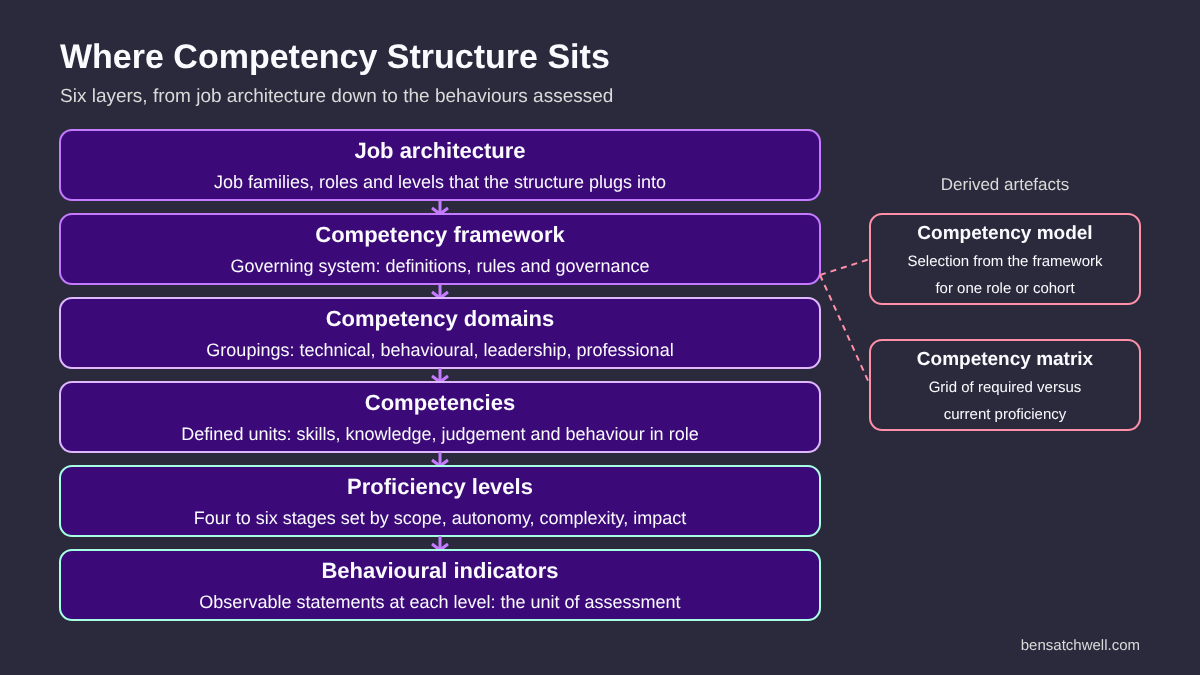
A competency structure is the organising logic of a competency framework. It defines how competencies are grouped into domains, how each is levelled by proficiency, and how observable behavioural indicators are written at every level so the whole system can be applied consistently across roles.
Using the definitions I work with, a competency is the integration of skills, knowledge, judgement and behaviour applied effectively in the context of a role. The structure is what makes a collection of those competencies usable. It answers four questions: what groups exist, what is in each group, what does good look like at each level, and what does that look like as behaviour someone can actually observe.
The Components of a Competency Structure
- Competency domains: groupings of related competencies, commonly technical or functional, behavioural, leadership, and professional or ethical.
- Competencies: the defined units within each domain, each with a name and a clear definition.
- Proficiency levels: the stages at which a competency is held or required. A workable structure uses four to six.
- Behavioural indicators: levelled statements describing what is observable at each stage. These are the unit that assessment is conducted against.
Why Does a Competency Structure Exist?
Without structure, every manager interprets "strategic thinking" or "collaboration" in their own way. The same word then means different things in different teams, and any decision built on it, whether a selection, a promotion or a development plan, becomes hard to defend.
Structure solves a consistency problem. It gives competencies a shared grammar so they can be reused across roles and compared between them. This is the purpose of a people capability system: the parts only create value when they are assembled into something coherent.
Published public sector frameworks show the same pattern. The UK civil service guidance describes behavioural indicators as showing what effective performance looks like, and states that they are not an exhaustive list (UK Government competency framework). That is a structural decision. The indicator is a defined layer with a defined job.
How Does a Competency Structure Work in Practice?
A structure works top down. You decide the domains first, then the competencies inside them, then the levels, and only then the indicators. Writing indicators before the levels are settled is the most common source of rework.
Levelling Competencies by Scope, Autonomy, Complexity and Impact
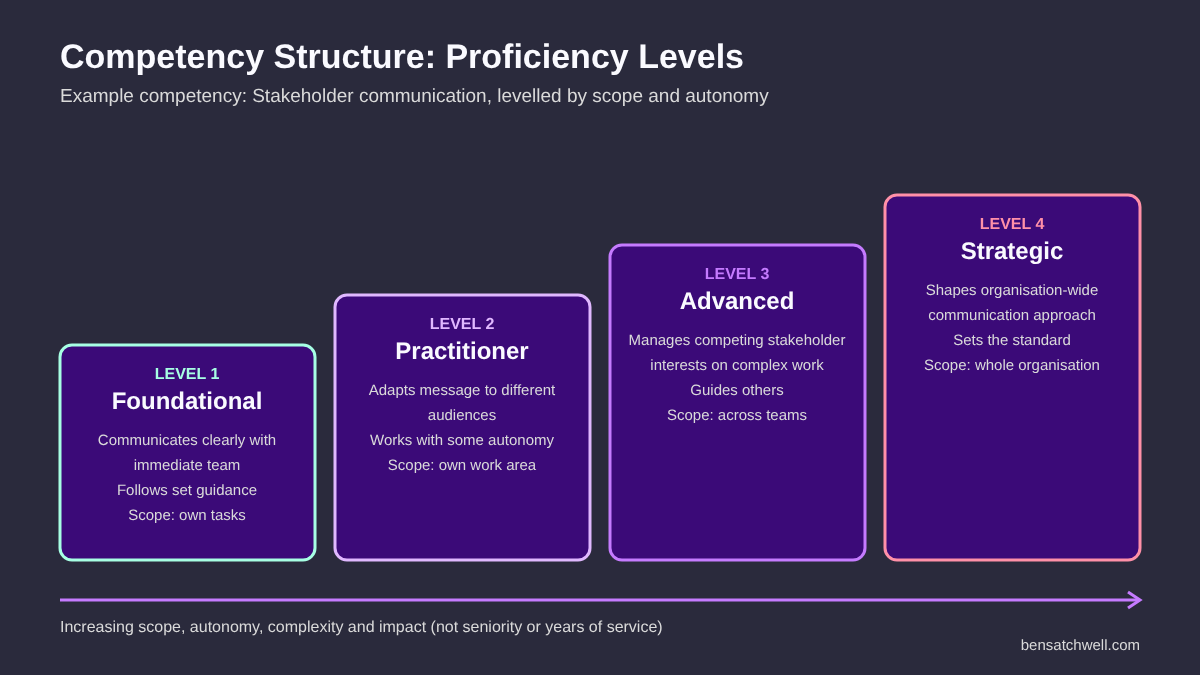
Levels describe how a competency grows. They are set by scope, autonomy, complexity and impact. They are not set by seniority, years of service or personality. A person early in their career can show advanced proficiency in one competency and foundational proficiency in another, and a good structure allows for that.
Writing Behavioural Indicators
Each indicator should be observable, contextual and descriptive rather than evaluative. "Adapts the message to different audiences" can be witnessed. "Is a strong communicator" cannot. The first is an indicator. The second is a judgement.
From Structure to Models and Matrices
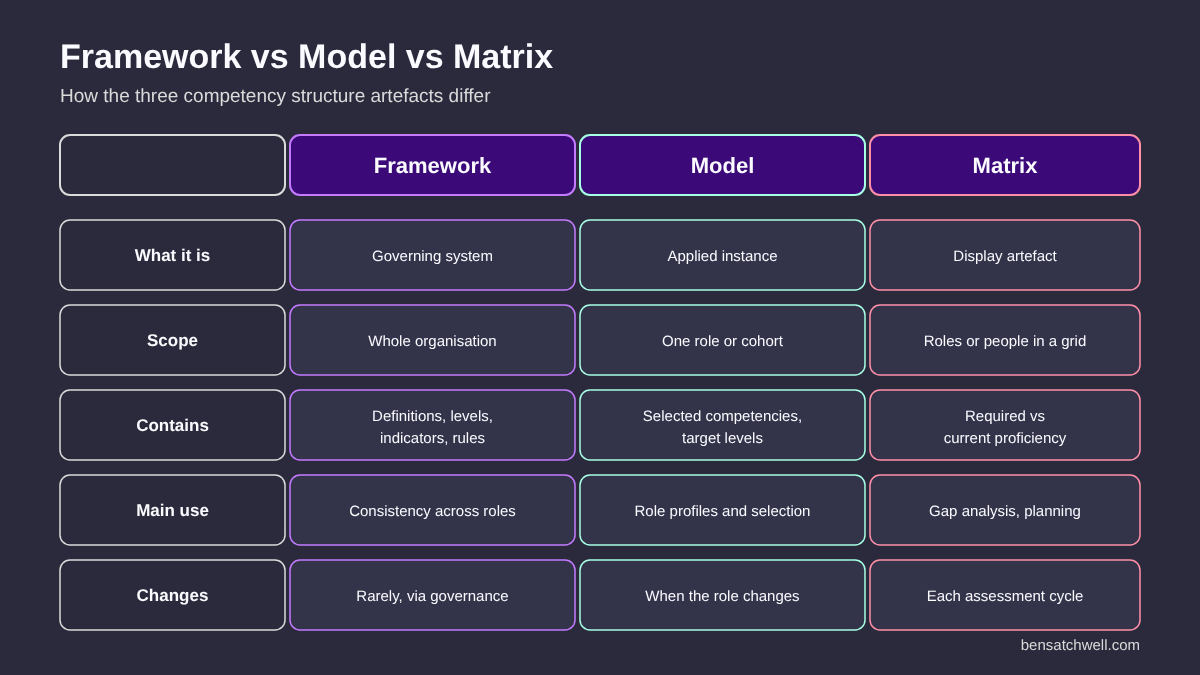
Once the structure exists, you draw from it. A competency model is an applied selection of competencies for a specific role, level or job family. A competency matrix is the grid that maps competencies against roles or people to show required versus current proficiency. Both depend on the structure being sound. If the framework is the system, the model is an instance of it and the matrix is a display of it. I cover how these pieces assemble in how the people capability system works.
What Is a Competency Structure Not?
This is where most of the conflation sits, so it is worth being direct.
- It is not a skills taxonomy. A skills taxonomy classifies discrete, learned abilities into a hierarchy. A competency structure organises integrated, role-contextual performance. Skills feed into competencies. They are not the same layer.
- It is not a capability framework. A capability is a broad, durable ability a person carries across roles. A competency is tied to performance in a role. Different constructs, different structures. The distinction is explored further in what makes the people capability system different.
- It is not a job description. A role defines what a person is accountable for. The competency structure defines what they need to do it well.
- It is not an org chart or a grading system. It can inform job architecture, but it does not replace it.
Which Named Frameworks Show Competency Structure?
Structure shows up differently across well-known standards, which is useful for seeing the range of reasonable choices.
Korn Ferry and Lominger group competencies into clusters and describe them across a spectrum of performance. Public sector frameworks tend to pair behavioural and functional competencies. India's Capacity Building Commission, for example, separates behavioural, functional and domain competencies as distinct types (Capacity Building Commission).
The lesson is not to copy any one of them. It is to notice that each makes explicit choices about domains, levels and indicators, and that those choices are documented.
What Are the Common Failure Modes of Competency Structure?
- Too many competencies. A structure with forty competencies cannot be assessed honestly. Managers default to ticking boxes.
- Levels tied to seniority. If level three simply means "senior", the structure measures tenure rather than proficiency.
- Vague indicators. Evaluative statements cannot be assessed against, so ratings become opinion.
- Domains that mix types. Placing a behavioural competency inside a technical domain muddles how it is built and measured.
- No governance. Without rules for who changes the structure and how, models drift away from the framework within a year.
- Assembly neglected. The parts may each be sound, but they are never connected. I wrote about this in the problem is assembly, not capability.
What Are the Trade-Offs in Designing a Competency Structure?
More levels give finer distinctions and harder assessment. Fewer levels are simpler to use and blur the differences that matter. Four to six is a sensible range for most organisations.
A single organisation-wide structure maximises consistency but can feel generic to specialist teams. Role-specific structures feel relevant but fragment comparability. My preference is one governing framework with models derived from it, so specialist detail lives in the model and the rules stay in one place.
Use a competency structure when you need consistent, assessable expectations of performance in a role. Use a capability or skills structure when the question is about transferable potential or discrete abilities. Choosing the wrong construct produces a structure that looks complete and answers the wrong question.
Competency Structure FAQ
What is the structure of a competency framework?
A competency framework is structured as domains containing competencies, each defined with proficiency levels and behavioural indicators, plus governance rules for how models and role profiles apply them.
How many proficiency levels should a competency structure have?
Four to six levels is workable for most organisations. Fewer than four blurs important differences, and more than six makes consistent assessment difficult.
What is the difference between a competency structure and a competency model?
The structure is the organising logic of the whole framework. A competency model is an applied selection of competencies from that structure for a specific role, level or job family.
What are competency domains?
Competency domains are groupings of related competencies, organised by the type of performance they describe. Common domains are functional or technical, behavioural, leadership, and professional or ethical.
Are behavioural indicators part of the competency structure?
Yes. Behavioural indicators are the levelled, observable statements at the base of the structure. They are what assessment is conducted against.
Is a competency structure the same as a skills taxonomy?
No. A skills taxonomy classifies discrete skills into a hierarchy. A competency structure organises integrated performance in a role, using skills as one of its inputs.
