
Competency Model SHRM
People searching for the competency model SHRM publishes usually assume they are looking at a template they can copy. They are not. The SHRM model is a professional standard for the HR function, built to describe what an HR professional must demonstrate. Treating it as a ready-made model for your organisation is the most common mistake I see, and it is the one this article is designed to correct.
What Is the Competency Model SHRM Publishes?
The SHRM competency model is the Society for Human Resource Management's published description of the behavioural and technical competencies an HR professional needs to perform effectively. SHRM now calls it the SHRM Body of Applied Skills and Knowledge (SHRM BASK), and it was formerly the Body of Competency and Knowledge (BoCK). SHRM states that the BASK is used to define the content areas of its certification exams, and that it was most recently updated in 2021.
The SHRM competency model describes one profession, HR, at two levels of practice. It is not a general-purpose competency model for any role in any organisation.
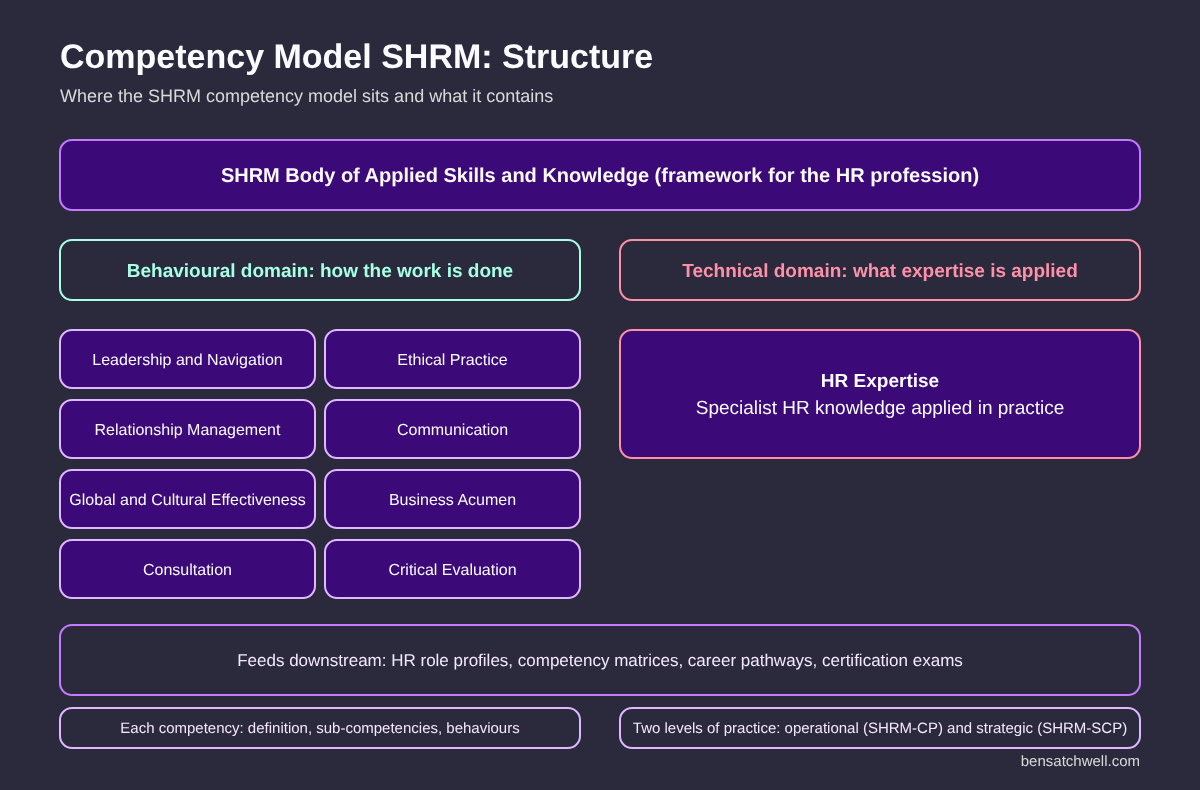
The original model grouped eight behavioural competencies with one technical competency. The behavioural competencies are Leadership and Navigation, Ethical Practice, Relationship Management, Communication, Global and Cultural Effectiveness, Business Acumen, Consultation and Critical Evaluation. The technical competency is HR Expertise. Because SHRM has revised the model since, check SHRM's current publication before you cite a specific list.
Why Does the SHRM Competency Model Exist?
A profession needs a shared answer to the question of what a competent practitioner looks like. Without one, a certification is only a test of recall. SHRM built its model so that its two certifications, the SHRM-CP and the SHRM-SCP, assess the same underlying construct: the ability to apply HR knowledge through behaviour.
The two credentials map to levels of practice. The SHRM-CP is for HR professionals in operational roles. The SHRM-SCP is for senior HR professionals in strategic roles. The competencies stay constant and the scope of application changes, which is how a well-built competency structure should work.
How Does the SHRM Competency Model Work in Practice?
The structure is a useful teaching example because it separates two things that most organisations blur. Behavioural competencies describe how work is done. The technical competency describes what specialist knowledge is applied. SHRM keeps them in separate domains, and each competency carries a definition, sub-competencies and expected behaviours.
That last element matters. By my definitions, a competency integrates skills, knowledge, judgement and behaviour applied in the context of a role, and it is assessed against observable behaviour at a level of proficiency. A competency without behavioural indicators is only a label. SHRM's approach of attaching behaviours to each competency is what makes the model assessable.
Framework or model?
Here is where terminology gets contested. In the way I use these terms, a framework is the organisation-wide governing system, and a model is an applied selection of competencies for a specific role, level or job family. SHRM calls its construct a model, but it behaves like a framework for a profession: it defines the competencies, the structure and the expectations that certifications and role descriptions then draw on. North American practice often uses "competency model" as the broadest term, so this is a convention rather than a universal rule. I flag it because the distinction changes what you do next. If you want the difference in depth, the four layers of the People Capability System show where frameworks, models and role profiles each sit.
What Is the SHRM Competency Model Not?
This is the section most search results skip, and it is where most of the value sits.
- Not a capability framework. A capability is a broad, durable area of ability a person owns and carries across roles. The SHRM model is bounded by the HR profession and by the roles that profession performs.
- Not a skills taxonomy. It does not classify discrete skills into a navigable hierarchy, and it does not define relationships between skills, tasks and roles.
- Not a competency framework for your whole organisation. It carries no governance rules for finance, operations or engineering roles.
- Not a job architecture. It does not organise roles, levels and job families into one coherent structure.
- Not an assessment of your people as they stand. It sets the standard. A competency matrix is what shows current proficiency against it.
I go further into why these layers get confused in what the People Capability System is not.
How Does SHRM Compare With Other Named Competency Models?
SHRM sits alongside several well-known constructs, and each answers a different design question.
- Korn Ferry and Lominger describe leadership and professional competencies for use across any organisation, so they are general-purpose in a way SHRM is not.
- CIPD maintains the Profession Map for the HR and L&D profession in the United Kingdom, which is the closest peer to SHRM.
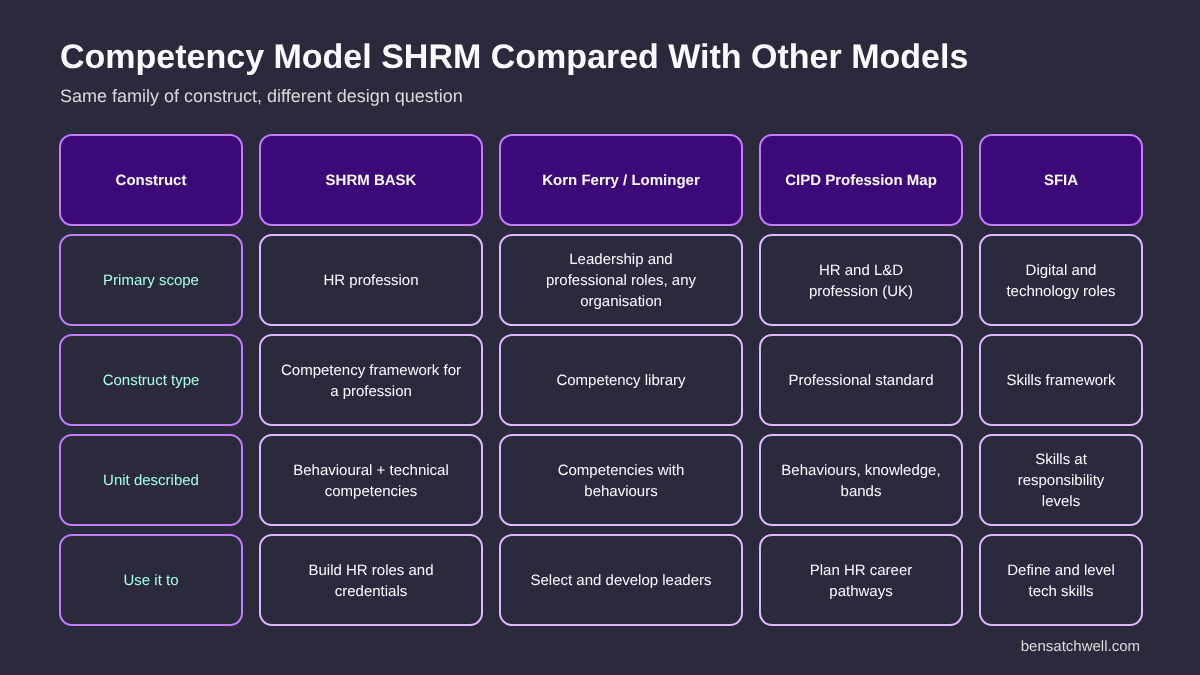
The practical point is that none of these should be adopted wholesale. They are reference material. The CIPD advises that anyone developing a framework should balance detail with flexibility and avoid an overly prescriptive and non-inclusive approach. That caution applies equally when you borrow from SHRM.
What Are the Common Failure Modes?
Copying the model into your own organisation
I regularly see HR teams rename the SHRM competencies and publish them as their company framework. The result describes the HR profession, not your workforce. Business Acumen means something specific for an HR business partner, and it means something different for a plant manager.
Treating competencies as capabilities
Competencies are tied to a role and its context. When the role changes, the competency set changes with it. If your aim is to build durable, transferable ability that carries across a changing workforce, a competency model alone will not do that job. I cover that failure in why most capability frameworks fail.
Skipping proficiency levels
A list of competencies without levels cannot support promotion decisions, development planning or workforce comparison. Levels are set by scope, autonomy, complexity and impact, not by seniority or years of service. A workable structure uses four to six of them.
Confusing a certification with workforce competence
Holding a credential shows that someone met a standard at a point in time. It does not describe how that person performs in your context. The distinction is the same one ISO draws in its guidance on competence management, where competence has to be determined, developed and evidenced inside the organisation, not assumed from a qualification.
When Should You Use the SHRM Competency Model, and When Not?
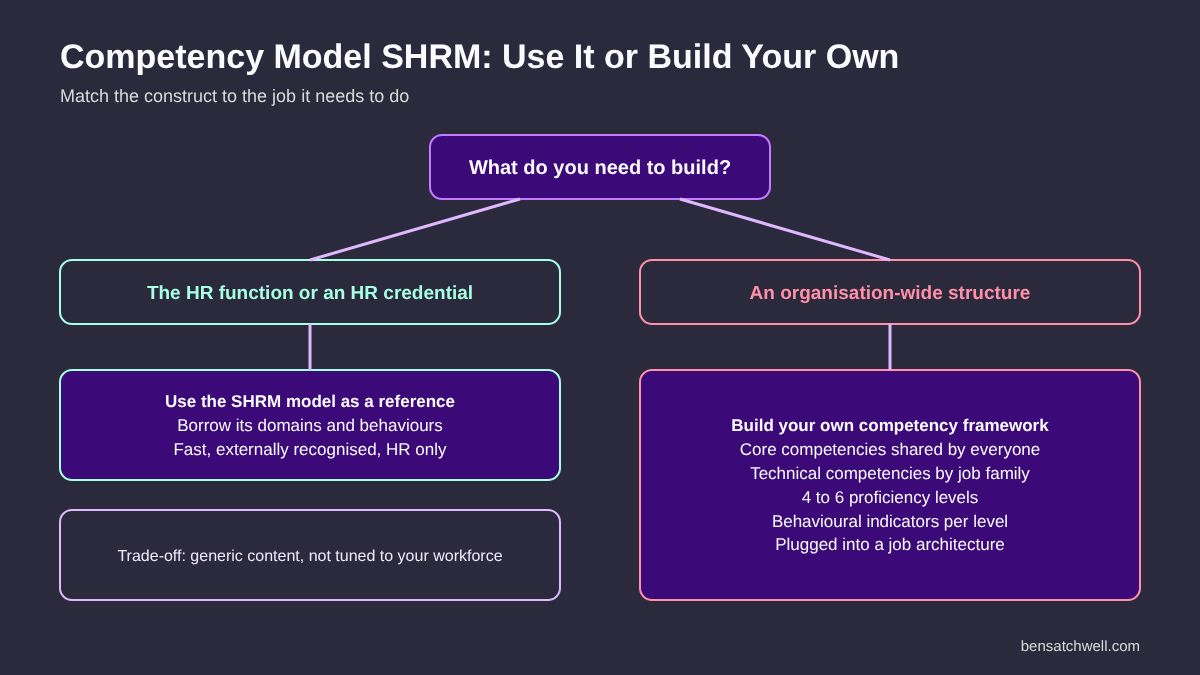
Use it when you are designing an HR function, writing HR role profiles, planning HR career pathways or preparing for a SHRM credential. It gives you a credible, externally recognised reference point for one profession.
Do not use it as the basis for an organisation-wide structure. For that you need a governing framework, a small set of core competencies shared by everyone, role-specific technical competencies, defined proficiency levels and behavioural indicators, all plugged into a job architecture. The trade-off is simple. A borrowed model is fast and defensible but generic. A purpose-built one takes longer and fits. I describe the whole system in what the People Capability System is.
Competency Model SHRM: Frequently Asked Questions
What is the SHRM competency model?
It is SHRM's published description of the behavioural and technical competencies HR professionals need. It is now called the SHRM Body of Applied Skills and Knowledge and is the basis of the SHRM-CP and SHRM-SCP exams.
How many competencies are in the SHRM competency model?
The original model had eight behavioural competencies and one technical competency, HR Expertise. SHRM updated it in 2021, so check the current publication for the exact list.
Is the SHRM competency model a framework or a model?
SHRM calls it a model. Under the convention I use, it functions as a framework for the HR profession, because it defines the competencies and structure that other role-level models would draw on.
Can I use the SHRM competency model for non-HR roles?
Not directly. It describes HR practice. You can borrow its structure, such as separating behavioural and technical domains, but the content needs to be rebuilt for each job family.
What is the difference between the SHRM-CP and SHRM-SCP?
The SHRM-CP is for HR professionals in operational roles and the SHRM-SCP is for senior HR professionals in strategic roles. Both are assessed against the same competency structure.
What is the difference between a competency model and a capability framework?
A competency model is tied to a role and describes observable behaviour at a level of proficiency. A capability framework describes broad, durable human abilities that carry across roles as work changes.
