

A Competency Model for Industrie 4.0 Employees
"Industrie 4.0" and "Industry 4.0" are the same thing, and the German spelling is not a typo. Industrie 4.0 is the original term, coined in Germany in 2011 to describe the fourth industrial revolution: the fusion of automation, data exchange and cyber-physical systems inside manufacturing. If you are searching for a competency model for Industrie 4.0 employees, you are asking a narrower and better question than most of what gets written about "future skills". You are asking what a specific cohort, employees working inside digitised manufacturing and engineering environments, actually needs to be good at, structured as a usable model rather than a list of buzzwords.
What Is a Competency Model for Industrie 4.0 Employees?
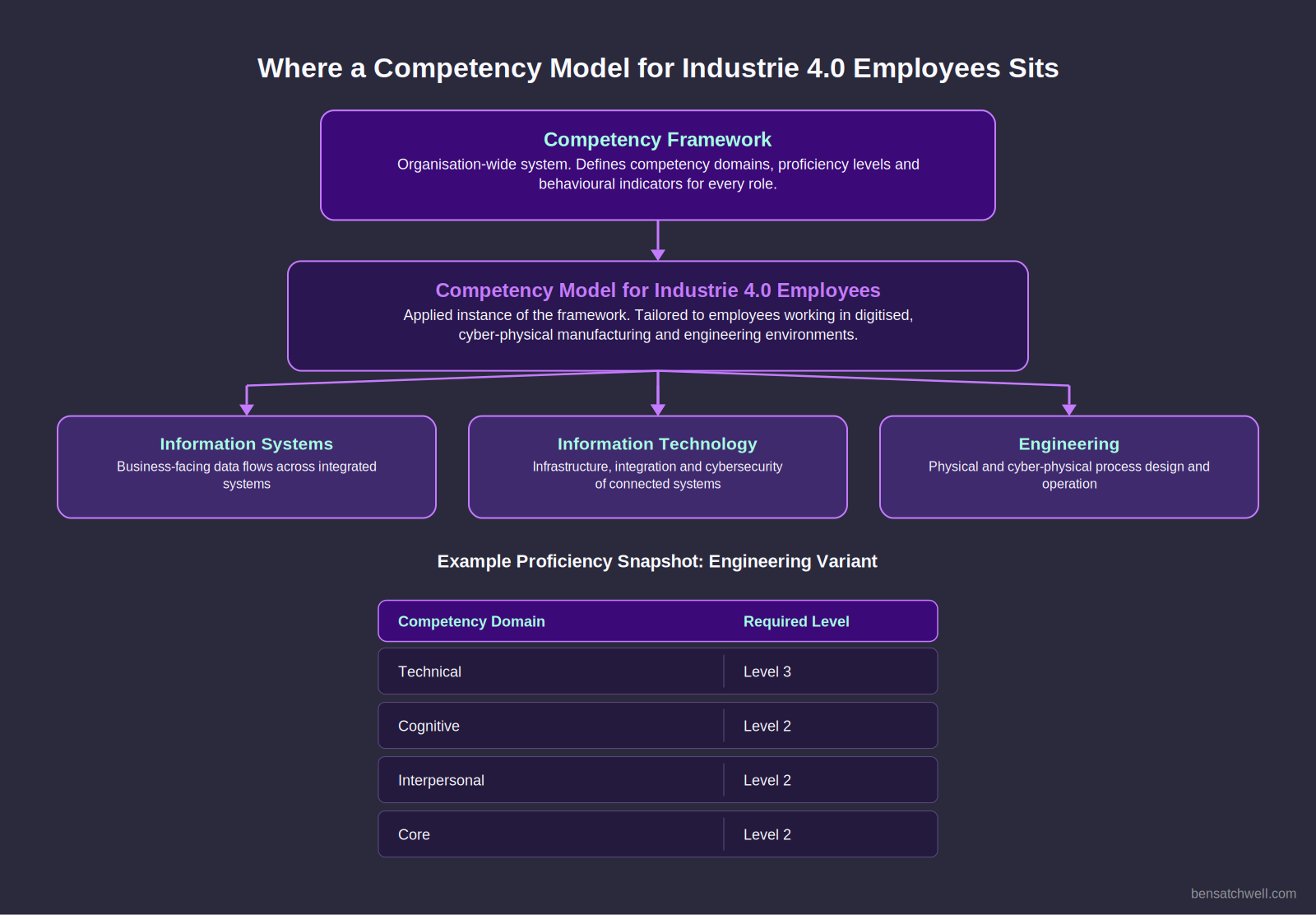
A competency model for Industrie 4.0 employees is an applied selection of competencies, drawn from a broader competency framework, that defines what good performance looks like for people working in digitised, cyber-physical manufacturing and engineering environments. It is not the framework itself. A competency is the integration of skills, knowledge, judgement and behaviour applied effectively in the context of a role, and a competency model is that integration made specific: this role, this level, this function.
Applied to Industrie 4.0, the model typically spans three role variants: information systems, information technology and engineering. This is not my framing. It comes from the academic literature that first formalised the concept, most directly Prifti, Knigge, Kienegger and Krcmar's 2017 paper for the Wirtschaftsinformatik conference, which built a behaviourally oriented competency model for Industrie 4.0 employees by extending an existing universal competency framework through literature review and structured input from academic and industry practitioners.
Why Does a Competency Model for Industrie 4.0 Employees Exist?
Manufacturing and engineering roles changed faster than the job descriptions written for them. A machine operator now monitors sensor dashboards. A maintenance technician troubleshoots software as often as hardware. A production engineer works alongside autonomous systems, not just alongside other people. Generic engineering competency frameworks, written before cyber-physical systems were common on the shop floor, do not capture this shift.
The problem is not that these roles need entirely new competencies invented from scratch. It is that the mix has changed, and the weighting between technical and behavioural competencies has changed with it. This is the same structural problem I've written about in the context of why most capability frameworks fail: frameworks age faster than the people who use them, because the work underneath keeps moving. Industrie 4.0 competency models exist to close that gap for a specific, fast-moving cohort, rather than waiting for a full organisation-wide framework refresh to catch up.
Germany's acatech, the National Academy of Science and Engineering, coordinated the original Industrie 4.0 research programme precisely because the shift was recognised as structural, not incremental. That is the origin point this competency model literature sits inside.
How Does a Competency Model for Industrie 4.0 Employees Work in Practice?
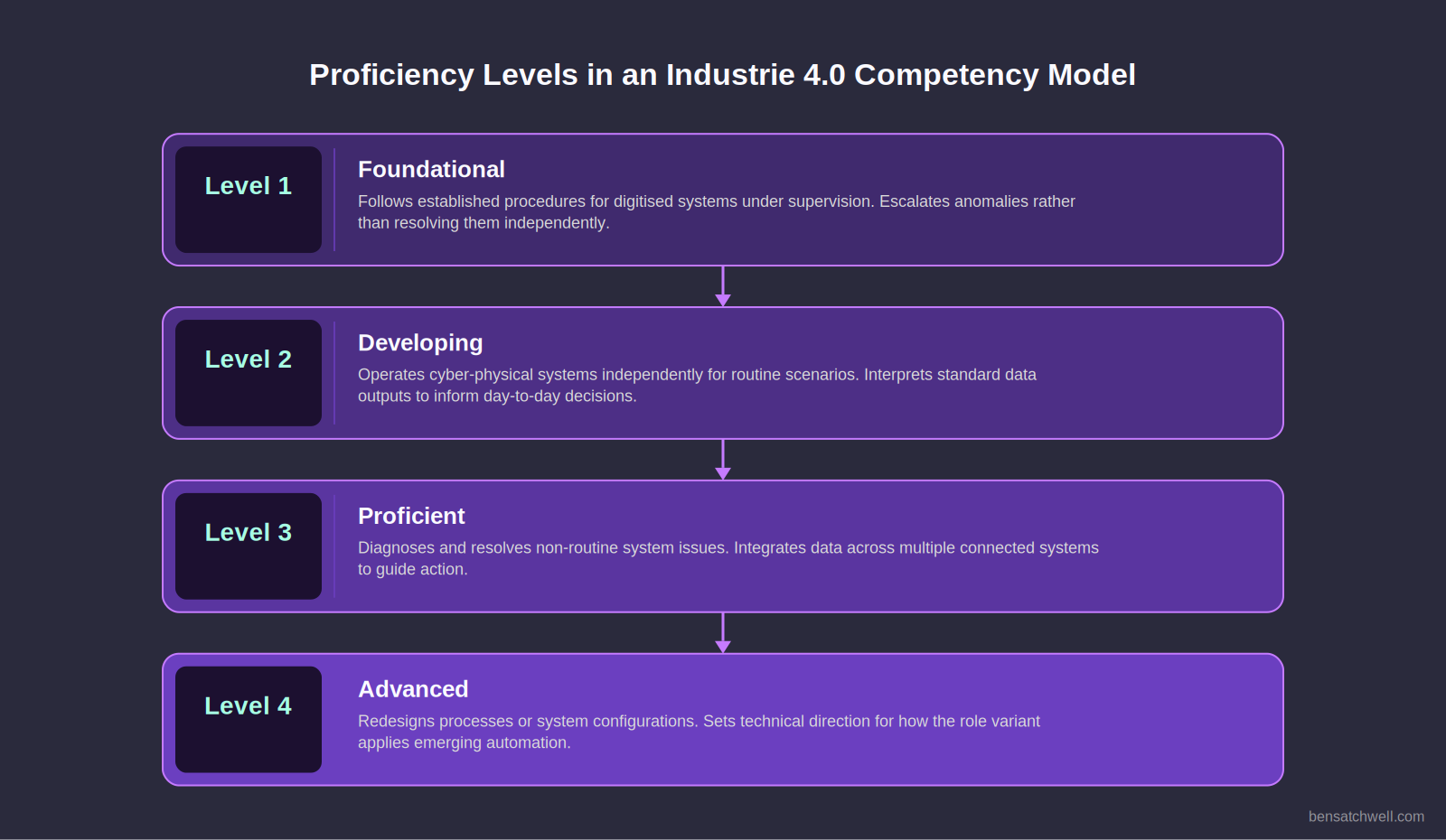
In practice, the model is built the same way any well-constructed competency model is built: by defining competency domains, setting proficiency levels, and writing behavioural indicators that describe what each level actually looks like in observable terms
This structure mirrors the layered approach I use in the People Capability System: domains organise the content, proficiency levels define how far someone needs to go, and behavioural indicators make the difference between levels concrete enough to assess against. Without that third layer, a competency model is just a list of nice-sounding words with no way to tell whether someone actually holds the competency.
What a Competency Model for Industrie 4.0 Employees Is Not
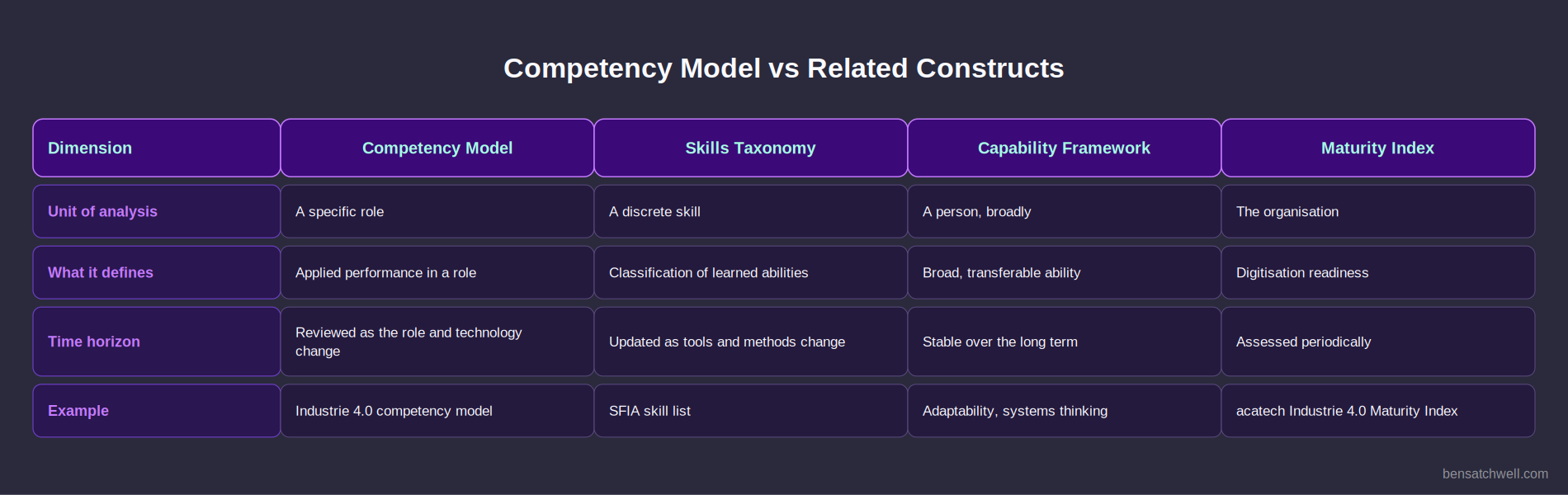
It is not a skills taxonomy. A skills taxonomy classifies discrete, learned abilities, coding in a specific language, operating a specific machine, without describing how those abilities combine into effective on-the-job performance. A competency model does the combining.
It is not a learning curriculum. A competency model defines what proficiency looks like. What gets built to close a proficiency gap, whether that is coaching, rotation, or structured development activity, is a separate decision made after the model exists, not part of the model itself.
It is not a capability framework. A capability is broad, durable and portable across roles: adaptability, systems thinking, digital fluency. A competency is role-specific and applied. Most Industrie 4.0 "future skills" lists on the market blur this distinction, listing capabilities and competencies together as if they were the same construct. They are not, and the model loses precision the moment they get conflated.
It is not a maturity index. Tools like acatech's Industrie 4.0 Maturity Index assess how digitised an organisation's operations are. A competency model assesses what an individual employee needs to be good at. The two are related but answer different questions, at different units of analysis.
Where Does the Evidence for This Model Come From?
The clearest empirical basis remains the original 2017 competency model built by Prifti and colleagues at the Technical University of Munich, which structured Industrie 4.0 competencies around three role variants and grounded each in behavioural indicators rather than abstract skill labels. It is a useful reference point precisely because it was built the way a competency model should be built: from observed role requirements, not from a marketing list of "21st century skills".
Broader labour market research reinforces the same pattern. The OECD's work on the future of work and skills treats reskilling as a structural response to technological change rather than a one-off event, which matches what a well-maintained competency model needs to do: stay current as the underlying work keeps shifting, not get published once and left alone. Named frameworks elsewhere in the competency space, SFIA for technical and digital roles, CIPD and SHRM for the HR function that governs these models, all follow the same underlying logic of domains, levels and indicators. Industrie 4.0 competency models are a specific application of that same logic to one workforce.
Where Do Industrie 4.0 Competency Models Go Wrong?
The most common failure is treating the model as a static artefact. A model built in 2017, or even one built two years ago, describes a moment in a technology environment that does not stand still. Cyber-physical systems, sensor architectures and automation tooling change faster than most organisations refresh their competency documentation. A model that is not revisited becomes decorative rather than useful.
The second failure is scope creep. Because Industrie 4.0 touches almost every function, engineering, IT, operations, quality, there is a temptation to build one sprawling model that tries to cover everyone. That produces a document nobody can apply to an actual role. The academic model that anchors this space deliberately scoped itself to three role variants for this reason. Narrower and applicable beats broad and unusable.
The third failure is skipping behavioural indicators altogether. It is easy to list competency names, "digital literacy", "systems thinking", and much harder to write what those look like at each proficiency level in a specific role. Skipping that step is the single biggest reason competency models fail to survive contact with a real performance conversation.
When Does This Model Make Sense, and When Doesn't It?
A competency model for Industrie 4.0 employees makes sense when an organisation has a defined cohort, engineers, technicians, systems specialists, working in genuinely digitised, cyber-physical environments, and needs a way to assess, hire against, or develop that cohort with precision.
It makes less sense as a standalone exercise for an organisation still running largely analogue operations. Building a detailed Industrie 4.0 competency model ahead of the underlying digitisation is building competency requirements for work that does not yet exist in that environment. Sequence matters: the technology environment and the competency model need to move together, not one far ahead of the other.
It also is not a substitute for a broader competency framework. A model without a framework behind it has no consistent proficiency scale, no governance, and nothing to keep it comparable to the rest of the organisation's role architecture over time.
FAQ
What is the difference between Industrie 4.0 and Industry 4.0?
None in substance. Industrie 4.0 is the original German term, coined by acatech and German government and industry bodies in 2011. Industry 4.0 is the English translation used interchangeably in most literature published outside Germany.
What competencies do Industrie 4.0 employees need most?
The academic literature groups them into technical (data literacy, systems integration, cybersecurity), cognitive (analytical reasoning, problem-solving under complexity) and interpersonal (cross-functional communication, adaptability) domains, plus a shared set of core competencies across the workforce.
Is a competency model the same as a skills framework for Industry 4.0?
No. A skills framework classifies and levels discrete skills. A competency model integrates skills with knowledge, judgement and behaviour to describe effective on-the-job performance in a specific role. They can sit alongside each other, but they answer different questions.
Who created the first Industrie 4.0 competency model?
Loina Prifti, Marlene Knigge, Harald Kienegger and Helmut Krcmar from the Technical University of Munich published the most widely cited model in 2017, structured around information systems, information technology and engineering role variants.
Does every manufacturing role need an Industrie 4.0 competency model?
No. It applies to roles genuinely working inside digitised, cyber-physical systems. Applying it to roles that have not yet been touched by that shift produces a model with no real performance evidence behind it.
How often should an Industrie 4.0 competency model be updated?
There is no universal interval, but it should track the pace of change in the underlying technology environment, not a fixed annual cycle. A model reviewed only occasionally against fast-moving automation and systems tooling will fall out of date faster than most organisations expect.